 Add to Chrome
 Add to Firefox
 Add to Edge
Exploring Transferability of Self-Supervised Learning by Task Conflict Calibration
Nov 16, 2025
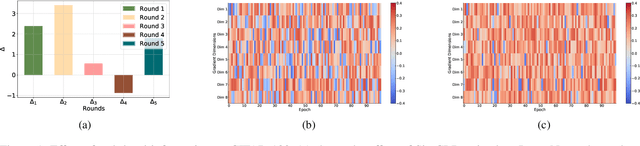
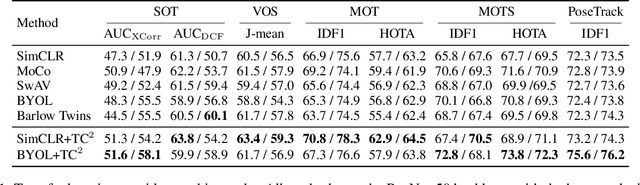
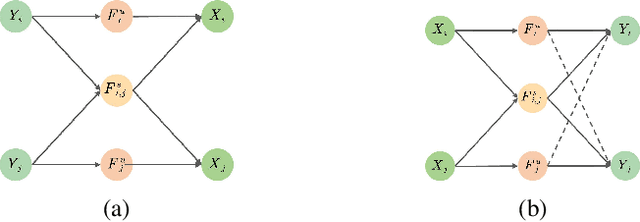
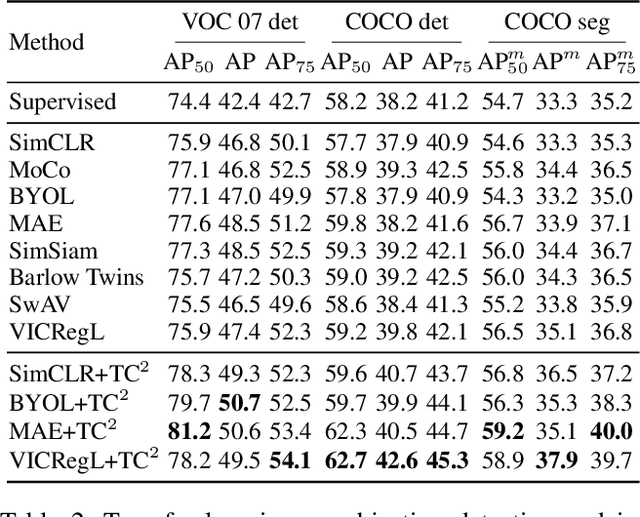
In this paper, we explore the transferability of SSL by addressing two central questions: (i) what is the representation transferability of SSL, and (ii) how can we effectively model this transferability? Transferability is defined as the ability of a representation learned from one task to support the objective of another. Inspired by the meta-learning paradigm, we construct multiple SSL tasks within each training batch to support explicitly modeling transferability. Based on empirical evidence and causal analysis, we find that although introducing task-level information improves transferability, it is still hindered by task conflict. To address this issue, we propose a Task Conflict Calibration (TC$^2$) method to alleviate the impact of task conflict. Specifically, it first splits batches to create multiple SSL tasks, infusing task-level information. Next, it uses a factor extraction network to produce causal generative factors for all tasks and a weight extraction network to assign dedicated weights to each sample, employing data reconstruction, orthogonality, and sparsity to ensure effectiveness. Finally, TC$^2$ calibrates sample representations during SSL training and integrates into the pipeline via a two-stage bi-level optimization framework to boost the transferability of learned representations. Experimental results on multiple downstream tasks demonstrate that our method consistently improves the transferability of SSL models.

Enhancing Time Series Forecasting via Logic-Inspired Regularization
Mar 10, 2025Time series forecasting (TSF) plays a crucial role in many applications. Transformer-based methods are one of the mainstream techniques for TSF. Existing methods treat all token dependencies equally. However, we find that the effectiveness of token dependencies varies across different forecasting scenarios, and existing methods ignore these differences, which affects their performance. This raises two issues: (1) What are effective token dependencies? (2) How can we learn effective dependencies? From a logical perspective, we align Transformer-based TSF methods with the logical framework and define effective token dependencies as those that ensure the tokens as atomic formulas (Issue 1). We then align the learning process of Transformer methods with the process of obtaining atomic formulas in logic, which inspires us to design a method for learning these effective dependencies (Issue 2). Specifically, we propose Attention Logic Regularization (Attn-L-Reg), a plug-and-play method that guides the model to use fewer but more effective dependencies by making the attention map sparse, thereby ensuring the tokens as atomic formulas and improving prediction performance. Extensive experiments and theoretical analysis confirm the effectiveness of Attn-L-Reg.