 Add to Chrome
 Add to Firefox
 Add to Edge
Active Label Cleaning for Reliable Detection of Electron Dense Deposits in Transmission Electron Microscopy Images
Feb 05, 2026
Automated detection of electron dense deposits (EDD) in glomerular disease is hindered by the scarcity of high-quality labeled data. While crowdsourcing reduces annotation cost, it introduces label noise. We propose an active label cleaning method to efficiently denoise crowdsourced datasets. Our approach uses active learning to select the most valuable noisy samples for expert re-annotation, building high-accuracy cleaning models. A Label Selection Module leverages discrepancies between crowdsourced labels and model predictions for both sample selection and instance-level noise grading. Experiments show our method achieves 67.18% AP\textsubscript{50} on a private dataset, an 18.83% improvement over training on noisy labels. This performance reaches 95.79% of that with full expert annotation while reducing annotation cost by 73.30%. The method provides a practical, cost-effective solution for developing reliable medical AI with limited expert resources.

Cross-modal ultra-scale learning with tri-modalities of renal biopsy images for glomerular multi-disease auxiliary diagnosis
Dec 17, 2025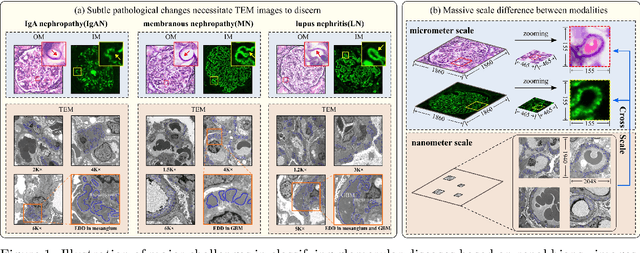
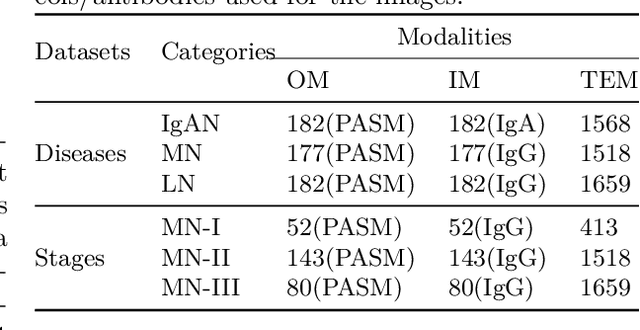
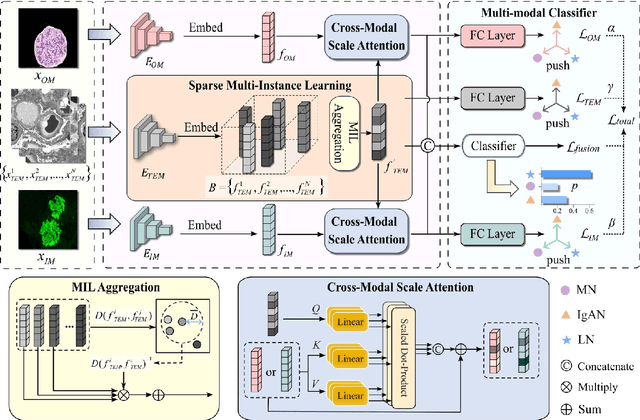
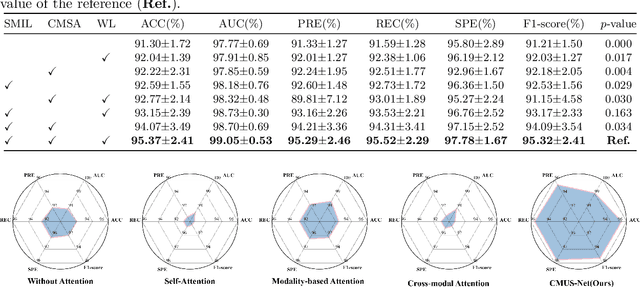
Constructing a multi-modal automatic classification model based on three types of renal biopsy images can assist pathologists in glomerular multi-disease identification. However, the substantial scale difference between transmission electron microscopy (TEM) image features at the nanoscale and optical microscopy (OM) or immunofluorescence microscopy (IM) images at the microscale poses a challenge for existing multi-modal and multi-scale models in achieving effective feature fusion and improving classification accuracy. To address this issue, we propose a cross-modal ultra-scale learning network (CMUS-Net) for the auxiliary diagnosis of multiple glomerular diseases. CMUS-Net utilizes multiple ultrastructural information to bridge the scale difference between nanometer and micrometer images. Specifically, we introduce a sparse multi-instance learning module to aggregate features from TEM images. Furthermore, we design a cross-modal scale attention module to facilitate feature interaction, enhancing pathological semantic information. Finally, multiple loss functions are combined, allowing the model to weigh the importance among different modalities and achieve precise classification of glomerular diseases. Our method follows the conventional process of renal biopsy pathology diagnosis and, for the first time, performs automatic classification of multiple glomerular diseases including IgA nephropathy (IgAN), membranous nephropathy (MN), and lupus nephritis (LN) based on images from three modalities and two scales. On an in-house dataset, CMUS-Net achieves an ACC of 95.37+/-2.41%, an AUC of 99.05+/-0.53%, and an F1-score of 95.32+/-2.41%. Extensive experiments demonstrate that CMUS-Net outperforms other well-known multi-modal or multi-scale methods and show its generalization capability in staging MN. Code is available at https://github.com/SMU-GL-Group/MultiModal_lkx/tree/main.
Glo-DMU: A Deep Morphometry Framework of Ultrastructural Characterization in Glomerular Electron Microscopic Images
Aug 14, 2025Complex and diverse ultrastructural features can indicate the type, progression, and prognosis of kidney diseases. Recently, computational pathology combined with deep learning methods has shown tremendous potential in advancing automatic morphological analysis of glomerular ultrastructure. However, current research predominantly focuses on the recognition of individual ultrastructure, which makes it challenging to meet practical diagnostic needs. In this study, we propose the glomerular morphometry framework of ultrastructural characterization (Glo-DMU), which is grounded on three deep models: the ultrastructure segmentation model, the glomerular filtration barrier region classification model, and the electron-dense deposits detection model. Following the conventional protocol of renal biopsy diagnosis, this framework simultaneously quantifies the three most widely used ultrastructural features: the thickness of glomerular basement membrane, the degree of foot process effacement, and the location of electron-dense deposits. We evaluated the 115 patients with 9 renal pathological types in real-world diagnostic scenarios, demonstrating good consistency between automatic quantification results and morphological descriptions in the pathological reports. Glo-DMU possesses the characteristics of full automation, high precision, and high throughput, quantifying multiple ultrastructural features simultaneously, and providing an efficient tool for assisting renal pathologists.