 Add to Chrome
 Add to Firefox
 Add to Edge
Cross-modal ultra-scale learning with tri-modalities of renal biopsy images for glomerular multi-disease auxiliary diagnosis
Dec 17, 2025
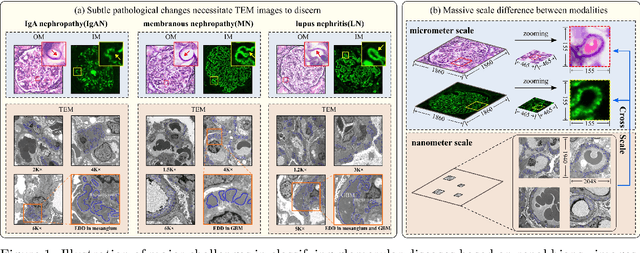
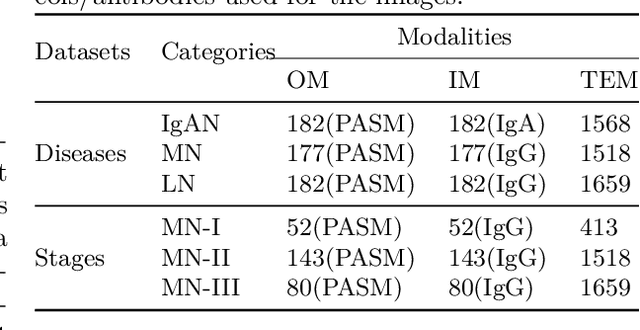
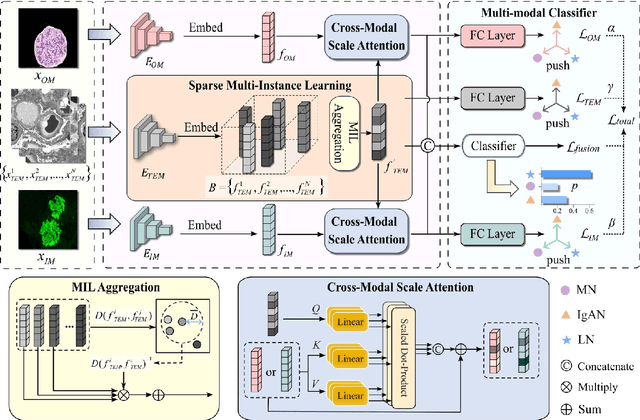
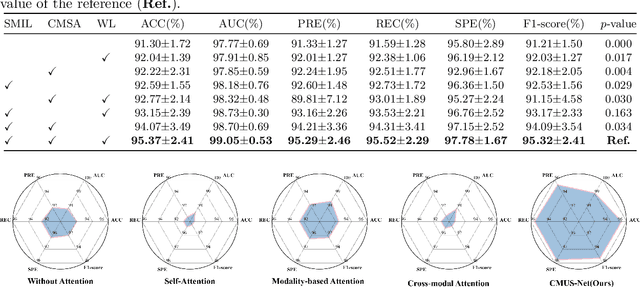
Constructing a multi-modal automatic classification model based on three types of renal biopsy images can assist pathologists in glomerular multi-disease identification. However, the substantial scale difference between transmission electron microscopy (TEM) image features at the nanoscale and optical microscopy (OM) or immunofluorescence microscopy (IM) images at the microscale poses a challenge for existing multi-modal and multi-scale models in achieving effective feature fusion and improving classification accuracy. To address this issue, we propose a cross-modal ultra-scale learning network (CMUS-Net) for the auxiliary diagnosis of multiple glomerular diseases. CMUS-Net utilizes multiple ultrastructural information to bridge the scale difference between nanometer and micrometer images. Specifically, we introduce a sparse multi-instance learning module to aggregate features from TEM images. Furthermore, we design a cross-modal scale attention module to facilitate feature interaction, enhancing pathological semantic information. Finally, multiple loss functions are combined, allowing the model to weigh the importance among different modalities and achieve precise classification of glomerular diseases. Our method follows the conventional process of renal biopsy pathology diagnosis and, for the first time, performs automatic classification of multiple glomerular diseases including IgA nephropathy (IgAN), membranous nephropathy (MN), and lupus nephritis (LN) based on images from three modalities and two scales. On an in-house dataset, CMUS-Net achieves an ACC of 95.37+/-2.41%, an AUC of 99.05+/-0.53%, and an F1-score of 95.32+/-2.41%. Extensive experiments demonstrate that CMUS-Net outperforms other well-known multi-modal or multi-scale methods and show its generalization capability in staging MN. Code is available at https://github.com/SMU-GL-Group/MultiModal_lkx/tree/main.

Task Graph offloading via Deep Reinforcement Learning in Mobile Edge Computing
Oct 02, 2023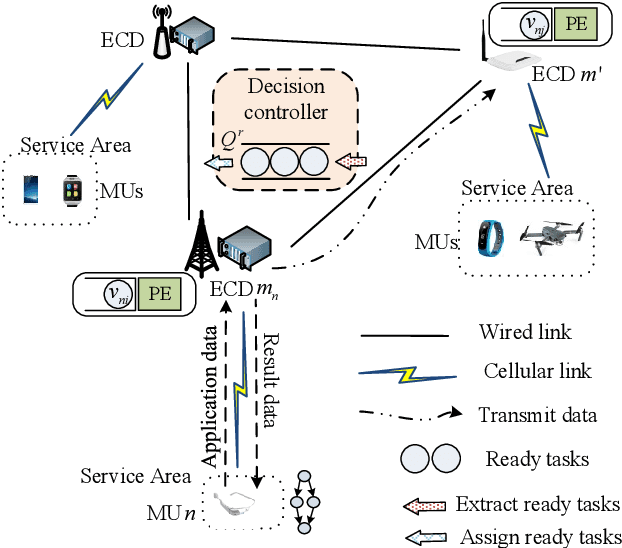
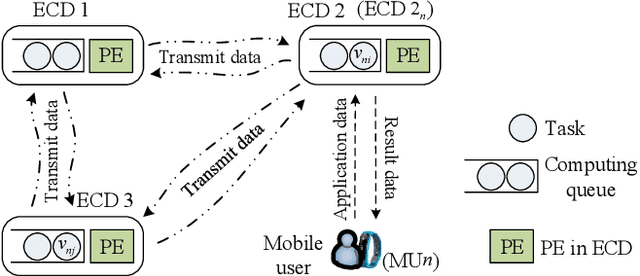
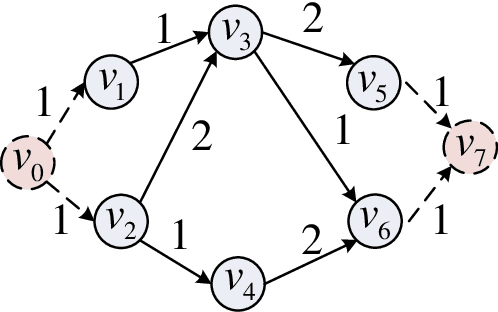
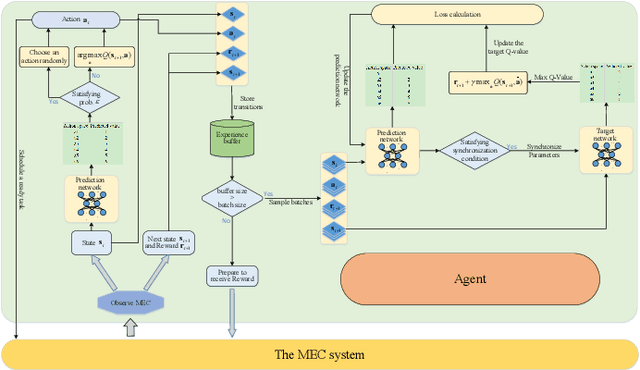
Various mobile applications that comprise dependent tasks are gaining widespread popularity and are increasingly complex. These applications often have low-latency requirements, resulting in a significant surge in demand for computing resources. With the emergence of mobile edge computing (MEC), it becomes the most significant issue to offload the application tasks onto small-scale devices deployed at the edge of the mobile network for obtaining a high-quality user experience. However, since the environment of MEC is dynamic, most existing works focusing on task graph offloading, which rely heavily on expert knowledge or accurate analytical models, fail to fully adapt to such environmental changes, resulting in the reduction of user experience. This paper investigates the task graph offloading in MEC, considering the time-varying computation capabilities of edge computing devices. To adapt to environmental changes, we model the task graph scheduling for computation offloading as a Markov Decision Process (MDP). Then, we design a deep reinforcement learning algorithm (SATA-DRL) to learn the task scheduling strategy from the interaction with the environment, to improve user experience. Extensive simulations validate that SATA-DRL is superior to existing strategies in terms of reducing average makespan and deadline violation.