 Add to Chrome
 Add to Firefox
 Add to Edge
Universal computational thermal imaging overcoming the ghosting effect
Apr 02, 2026
Thermal imaging is crucial for night vision but fundamentally hampered by the ghosting effect, a loss of detailed texture in cluttered photon streams. While conventional ghosting mitigation has relied on data post-processing, the recent breakthrough in heat-assisted detection and ranging (HADAR) opens a promising frontier for hyperspectral computational thermal imaging that produces night vision with day-like visibility. However, universal anti-ghosting imaging remains elusive, as state-of-the-art HADAR applies only to limited scenes with uniform materials, whereas material non-uniformity is ubiquitous in the real world. Here, we propose a universal computational thermal imaging framework, TAG (thermal anti-ghosting), to address material non-uniformity and overcome ghosting for high-fidelity night vision. TAG takes hyperspectral photon streams for nonparametric texture recovery, enabling our experimental demonstration of unprecedented expression recovery in thus-far-elusive ghostly human faces -- the archetypal, long-recognized ghosting phenomenon. Strikingly, TAG not only universally outperforms HADAR across various scenes, but also reveals the influence of material non-uniformity, shedding light on HADAR's effectiveness boundary. We extensively test facial texture and expression recovery across day and night, and demonstrate, for the first time, thermal 3D topological alignment and mood detection. This work establishes a universal foundation for high-fidelity computational night vision, with potential applications in autonomous navigation, reconnaissance, healthcare, and wildlife monitoring.

Adversarial Multiscale Feature Learning for Overlapping Chromosome Segmentation
Dec 22, 2020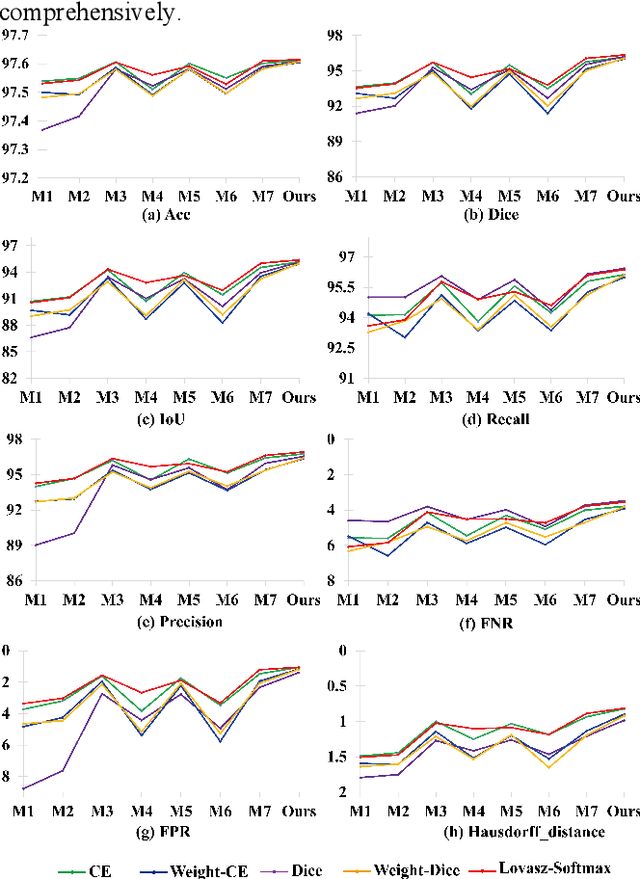
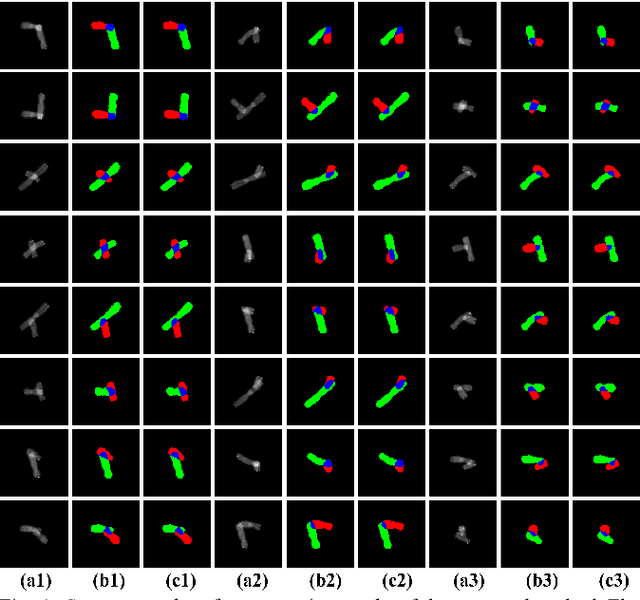
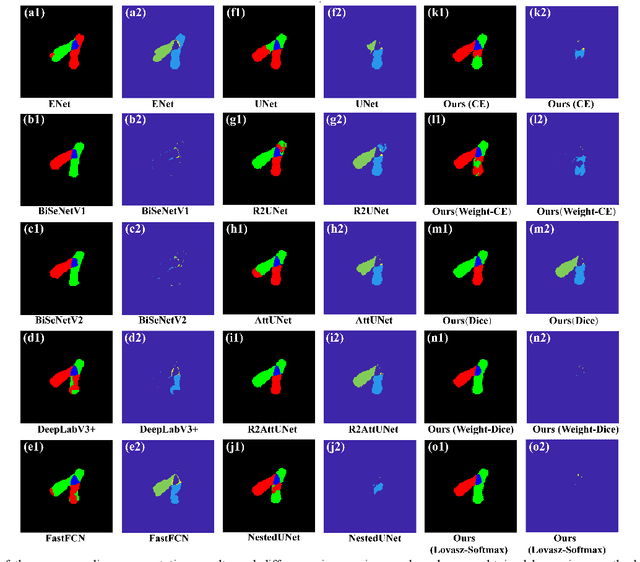
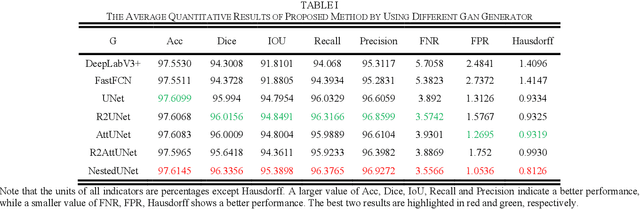
Chromosome karyotype analysis is of great clinical importance in the diagnosis and treatment of diseases, especially for genetic diseases. Since manual analysis is highly time and effort consuming, computer-assisted automatic chromosome karyotype analysis based on images is routinely used to improve the efficiency and accuracy of the analysis. Due to the strip shape of the chromosomes, they easily get overlapped with each other when imaged, significantly affecting the accuracy of the analysis afterward. Conventional overlapping chromosome segmentation methods are usually based on manually tagged features, hence, the performance of which is easily affected by the quality, such as resolution and brightness, of the images. To address the problem, in this paper, we present an adversarial multiscale feature learning framework to improve the accuracy and adaptability of overlapping chromosome segmentation. Specifically, we first adopt the nested U-shape network with dense skip connections as the generator to explore the optimal representation of the chromosome images by exploiting multiscale features. Then we use the conditional generative adversarial network (cGAN) to generate images similar to the original ones, the training stability of which is enhanced by applying the least-square GAN objective. Finally, we employ Lovasz-Softmax to help the model converge in a continuous optimization setting. Comparing with the established algorithms, the performance of our framework is proven superior by using public datasets in eight evaluation criteria, showing its great potential in overlapping chromosome segmentation