 Add to Chrome
 Add to Firefox
 Add to Edge
T$^2$exture: Sparsely Perturbed Thermal-to-Texture Imaging
Aug 03, 2026
Thermal imaging remains effective under adverse illumination, yet passive long-wave infrared (LWIR) measurements often lack fine texture. Existing thermal texture imaging approaches commonly rely on spectral sensing or registered auxiliary modalities, incurring substantial data throughput or vulnerability to cross-modal degradation. We introduce T$^2$exture, a sparsely perturbed thermal texture imaging framework that aims to reconstruct temporally dense thermal texture sequences from densely sampled passive frames and a few actively perturbed keyframes. We define thermal texture as the residual between a source-on observation and its corresponding source-off passive state. Under sparse LWIR illumination and rapid quasi-steady paired acquisition, this residual attenuates the passive-emission background and approximates a source-induced reflected response, exposing localized material- and geometry-dependent texture. T$^2$exture reconstructs a dense sequence of this source-conditioned response through two stages. Stage 1 estimates the unobserved source-off passive state at each active instant from neighboring passive frames to obtain reliable differential texture anchors. Stage 2 combines sparse anchors with passive structural context near each target time to reconstruct the dense sequence. On the simulated benchmark, T$^2$exture adds only 0.20M parameters to AMT-L while improving PSNR by 6.66 dB. Extensive evaluations on simulated and real acquisitions further show clearer texture recovery and stronger structural preservation than representative VFI baselines. These results establish T$^2$exture as a practical framework for thermal texture imaging under sparse active acquisition.

TeX-1500: A Paired Real-World LWIR Hyperspectral Dataset and Benchmark for Temperature-Emissivity-Texture Decomposition
Jun 02, 2026Temperature-emissivity-texture (TeX) decomposition seeks to recover object heat state, material spectral response, and visible-like geometric texture from long-wave infrared hyperspectral imaging (LWIR HSI). Existing TeX pipelines are mainly scene-specific inverse solvers, and the lack of paired LWIR HSI-TeX supervision has limited learning-based decomposition. To address this gap, we introduce TeX-1500, a large-scale paired LWIR HSI-TeX dataset and benchmark for supervised HSI-to-TeX decomposition. TeX-1500 contains 1,522 calibrated real-scene pairs from DARPA Invisible Headlights (DARPA IH) pushbroom imagery and our FTIR acquisitions, covering five locations, four seasons, diverse acquisition times, heterogeneous wavelength layouts, and two sensor families. Each sample stores a calibrated valid-band radiance cube, calibrated wavelength positions, and aligned temperature, emissivity, and texture supervision constructed through a consistent restoration and TeX-construction protocol. We further provide TeX-UNet, a simple wavelength-aware baseline that maps calibrated HSI bands and wavelength positions to TeX fields. Experiments on the held-out DARPA IH pushbroom scenes and zero-/few-shot transfer to FTIR scenes show that TeX-1500 provides usable paired supervision and a measurable benchmark for data-driven physical-property-centered thermal perception.
HADAR-Based Thermal Infrared Hyperspectral Image Restoration
May 13, 2026Thermal-infrared (TIR) hyperspectral imagery (HSI) provides critical scene information for various applications. However, its practical utility is severely limited by unique sensor degradations beyond the capabilities of existing restoration methods, which are ignorant of underlying thermal physics. Here, we propose HAIR (HADAR-based Image Restoration) as a physics-driven framework for ground-based TIR-HSI restoration. HAIR utilizes the HADAR rendering equation (HRE) and combines it with the atmospheric downwelling radiative transfer equation (RTE) to model TIR-HSI using temperature, emissivity, and texture (TeX) physical triplets. This physical model leads to a TeX decompose-synthesize strategy that guarantees physical consistency and spatio-spectral noise resilience, in stark contrast to existing approaches. Moreover, our framework uses a forward-modeled atmospheric downwelling reference, along with spectral smoothness of emissivity and blackbody radiation, to enable spectral calibration and generation that would otherwise be elusive. Our extensive experiments on the outdoor DARPA Invisible Headlights dataset and in-lab FTIR measurements show that HAIR consistently outperforms state-of-the-art methods across denoising, inpainting, spectral calibration, and spectral super-resolution, establishing a benchmark in objective accuracy and visual quality.
Universal computational thermal imaging overcoming the ghosting effect
Apr 02, 2026Thermal imaging is crucial for night vision but fundamentally hampered by the ghosting effect, a loss of detailed texture in cluttered photon streams. While conventional ghosting mitigation has relied on data post-processing, the recent breakthrough in heat-assisted detection and ranging (HADAR) opens a promising frontier for hyperspectral computational thermal imaging that produces night vision with day-like visibility. However, universal anti-ghosting imaging remains elusive, as state-of-the-art HADAR applies only to limited scenes with uniform materials, whereas material non-uniformity is ubiquitous in the real world. Here, we propose a universal computational thermal imaging framework, TAG (thermal anti-ghosting), to address material non-uniformity and overcome ghosting for high-fidelity night vision. TAG takes hyperspectral photon streams for nonparametric texture recovery, enabling our experimental demonstration of unprecedented expression recovery in thus-far-elusive ghostly human faces -- the archetypal, long-recognized ghosting phenomenon. Strikingly, TAG not only universally outperforms HADAR across various scenes, but also reveals the influence of material non-uniformity, shedding light on HADAR's effectiveness boundary. We extensively test facial texture and expression recovery across day and night, and demonstrate, for the first time, thermal 3D topological alignment and mood detection. This work establishes a universal foundation for high-fidelity computational night vision, with potential applications in autonomous navigation, reconnaissance, healthcare, and wildlife monitoring.
Why is thermal imaging textureless
Jul 28, 2023Thermal imaging can enable night vision but is usually textureless, well-known as the ghosting effect. The mechanism of this ghosting effect has recently been explained, and TeX vision has been proposed to overcome the ghosting effect. However, it is still unknown for realistic scenarios with non-uniform temperature whether TeX vision can correctly recover geometric textures and how its performance is compared with traditional thermal imaging. Here, we focus on the interplay of geometric textures and non-uniform temperature which is common in realistic thermal imaging, and demonstrate the failure of traditional approaches while TeX vision successfully recovers geometric textures. We also analyze important yet unexplored aspects of the TeX vision theory, and demonstrate a true night vision like broad daylight with the experimentally more feasible Bayer-filter setup. This deepens the understanding of the ghosting effect and bridges the gap between the TeX vision theory and the consumer thermal-imaging market.
Quantum Entropic Causal Inference
Feb 23, 2021
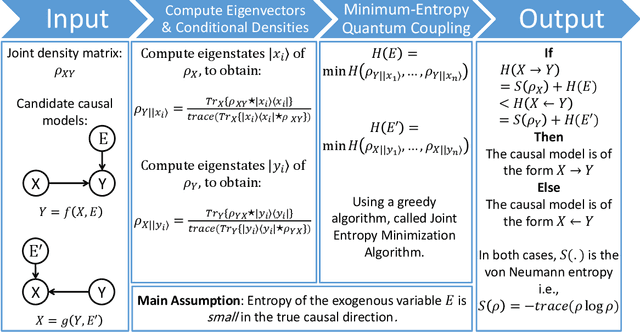
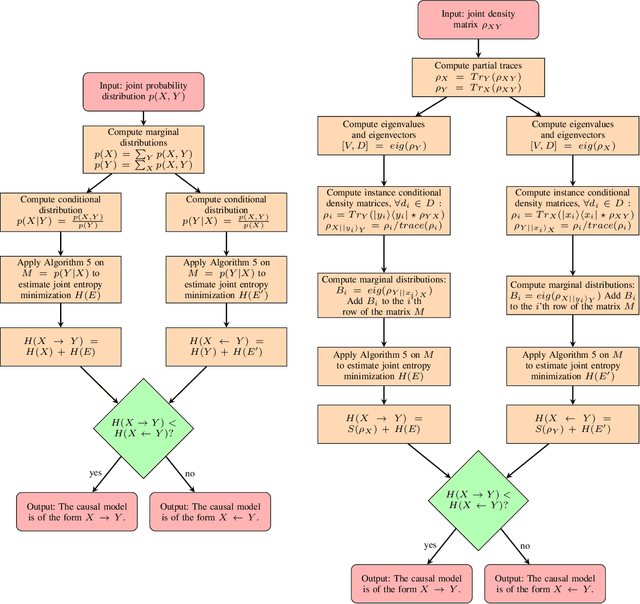
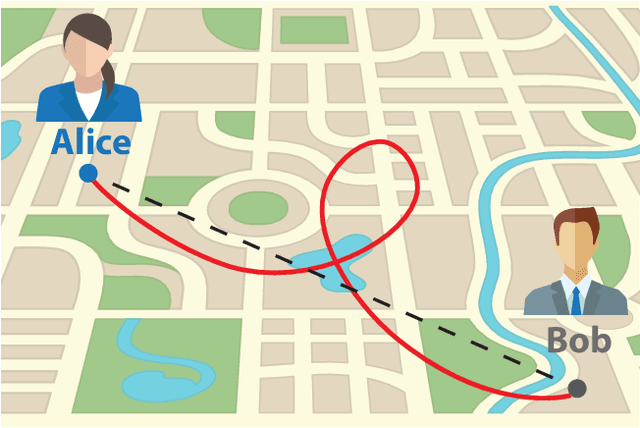
As quantum computing and networking nodes scale-up, important open questions arise on the causal influence of various sub-systems on the total system performance. These questions are related to the tomographic reconstruction of the macroscopic wavefunction and optimizing connectivity of large engineered qubit systems, the reliable broadcasting of information across quantum networks as well as speed-up of classical causal inference algorithms on quantum computers. A direct generalization of the existing causal inference techniques to the quantum domain is not possible due to superposition and entanglement. We put forth a new theoretical framework for merging quantum information science and causal inference by exploiting entropic principles. First, we build the fundamental connection between the celebrated quantum marginal problem and entropic causal inference. Second, inspired by the definition of geometric quantum discord, we fill the gap between classical conditional probabilities and quantum conditional density matrices. These fundamental theoretical advances are exploited to develop a scalable algorithmic approach for quantum entropic causal inference. We apply our proposed framework to an experimentally relevant scenario of identifying message senders on quantum noisy links. This successful inference on a synthetic quantum dataset can lay the foundations of identifying originators of malicious activity on future multi-node quantum networks. We unify classical and quantum causal inference in a principled way paving the way for future applications in quantum computing and networking.