 Add to Chrome
 Add to Firefox
 Add to Edge
PEFT-Arena: Understanding Parameter-Efficient Finetuning from a Stability-Plasticity Perspective
May 27, 2026
Parameter-efficient finetuning (PEFT) has become the standard approach for adapting large language models, yet evaluations largely emphasize downstream accuracy while overlooking the retention of pretrained capabilities. We argue that PEFT should be assessed through the stability-plasticity dilemma: the trade-off between target-task adaptation and resistance to forgetting. We introduce PEFT-Arena, a benchmark that jointly measures downstream performance and general capability retention. Across methods, we find distinct stability-plasticity profiles; under comparable parameter budgets, orthogonal finetuning achieves the most favorable Pareto frontier. To explain these differences, we analyze PEFT updates from two geometric perspectives. In weight space, spectral analysis reveals how parameterizations interact with the pretrained singular-value structure. In activation space, retention metrics show whether finetuning preserves or distorts general-capability representations, with forgetting linked to non-isometric representation distortion. Finally, an analysis shows that final SFT checkpoints often overshoot a better target-retention operating point. Inspired by this, we present case studies of a post-hoc improvement with path-wise rewinding.

Evaluating Parameter Efficient Methods for RLVR
Dec 30, 2025We systematically evaluate Parameter-Efficient Fine-Tuning (PEFT) methods under the paradigm of Reinforcement Learning with Verifiable Rewards (RLVR). RLVR incentivizes language models to enhance their reasoning capabilities through verifiable feedback; however, while methods like LoRA are commonly used, the optimal PEFT architecture for RLVR remains unidentified. In this work, we conduct the first comprehensive evaluation of over 12 PEFT methodologies across the DeepSeek-R1-Distill families on mathematical reasoning benchmarks. Our empirical results challenge the default adoption of standard LoRA with three main findings. First, we demonstrate that structural variants, such as DoRA, AdaLoRA, and MiSS, consistently outperform LoRA. Second, we uncover a spectral collapse phenomenon in SVD-informed initialization strategies (\textit{e.g.,} PiSSA, MiLoRA), attributing their failure to a fundamental misalignment between principal-component updates and RL optimization. Furthermore, our ablations reveal that extreme parameter reduction (\textit{e.g.,} VeRA, Rank-1) severely bottlenecks reasoning capacity. We further conduct ablation studies and scaling experiments to validate our findings. This work provides a definitive guide for advocating for more exploration for parameter-efficient RL methods.
ModRWKV: Transformer Multimodality in Linear Time
May 20, 2025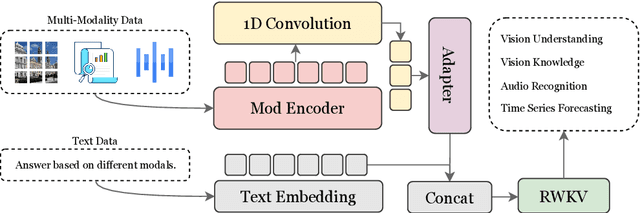
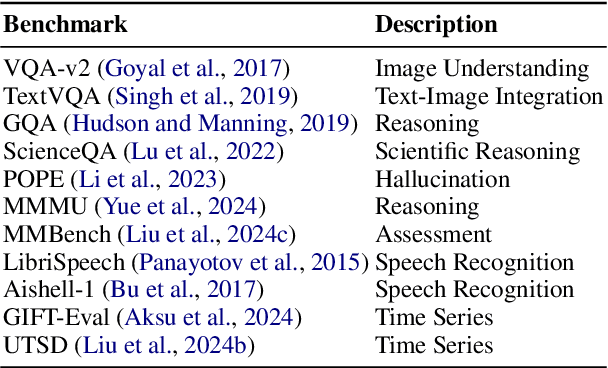
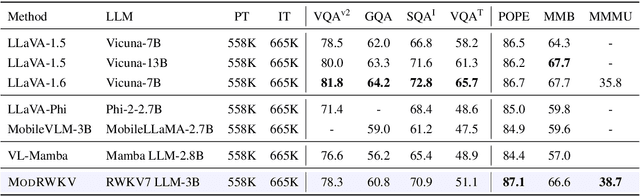
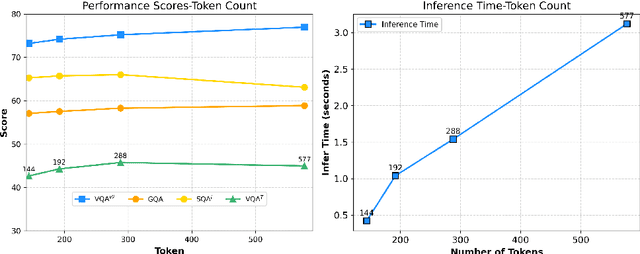
Currently, most multimodal studies are based on large language models (LLMs) with quadratic-complexity Transformer architectures. While linear models like RNNs enjoy low inference costs, their application has been largely limited to the text-only modality. This work explores the capabilities of modern RNN architectures in multimodal contexts. We propose ModRWKV-a decoupled multimodal framework built upon the RWKV7 architecture as its LLM backbone-which achieves multi-source information fusion through dynamically adaptable heterogeneous modality encoders. We designed the multimodal modules in ModRWKV with an extremely lightweight architecture and, through extensive experiments, identified a configuration that achieves an optimal balance between performance and computational efficiency. ModRWKV leverages the pretrained weights of the RWKV7 LLM for initialization, which significantly accelerates multimodal training. Comparative experiments with different pretrained checkpoints further demonstrate that such initialization plays a crucial role in enhancing the model's ability to understand multimodal signals. Supported by extensive experiments, we conclude that modern RNN architectures present a viable alternative to Transformers in the domain of multimodal large language models (MLLMs). Furthermore, we identify the optimal configuration of the ModRWKV architecture through systematic exploration.