 Add to Chrome
 Add to Firefox
 Add to Edge
Toward Secure and Reliable PDDL Formalization of Large Language Models with Planner-in-the-Loop Feedback
Jun 29, 2026
Planning often requires symbolic specifications that are both executable and verifiable. For large language models deployed in autonomous or decision-support systems, failures in such formalization may lead to unverifiable decisions, execution failures, or unsafe downstream behavior. We present NL-PDDL-Bench, a multi-domain benchmark for natural-language-to-PDDL specification construction with planner-verified executability and controlled difficulty scaling by object count. We further propose a planner-in-the-loop framework that uses validator and planner diagnostics to revise non-executable specifications through localized edits. Building on this infrastructure, we develop a planner-grounded optimization recipe that combines parameter-efficient Low-Rank Adaptation supervised fine-tuning, offline planner-derived preference pairs for Direct Preference Optimization, and inference-time planner-in-the-loop repair, without requiring online planner calls during training. We also provide a unified evaluation suite for parseability, solvability, specification similarity, and outcome-aware plan-level consistency against planner references. Experiments on representative model families show substantial gains in planner success and plan-level agreement, with improved robustness under difficulty scaling and cross-domain variation. These results highlight the value of externally verifiable formalization for reliable deployment of LLMs in safety- or security-sensitive planning systems. Code and data are available at: https://github.com/ibasicplan/NL-PDDL-Bench

Towards Reliable and Robust LLM Planning: Symbolic Feedback-Driven Iterative Self-Refinement Framework
Jun 26, 2026Large language models (LLMs) have attracted widespread attention from academia and industry, yet their deployment raises critical security concerns regarding robustness and reliability. Planning, a core component of intelligent behavior, remains challenging for LLMs, which often produce infeasible or incorrect solutions in long-horizon decision-making tasks due to inherent complexity. In this paper, we propose a symbolic feedback-driven iterative self-refinement framework to enhance the robustness and reliability of LLMs in long-horizon planning. Specifically, a natural language prompting mechanism is introduced to map logical symbols into natural language descriptions, enabling LLMs to better capture task constraints and semantics. We further design a symbolic verifier that identifies errors and converts them into corrective instructions interpretable by the LLM, thereby guiding self-refinement. In addition, we leverage a plan recognizer to infer goal reachability, facilitating more effective guidance toward desired goals. Empirical results demonstrate that the proposed framework consistently improves both feasibility and correctness in long-horizon planning tasks. This highlights its effectiveness in enhancing the reliability of LLM-based planning and potential to enable more trustworthy AI systems.
Pyramid Self-contrastive Learning Framework for Test-time Ultrasound Image Denoising
May 12, 2026The inherent electronic and speckle noise complicates clinical interpretation of ultrasound images. Conventional denoising methods rely on explicit noise assumptions whose validity diminishes under composite noise conditions. Learning-based methods require massive labeled data and model parameters. These pre-defined and pre-trained manners entail an inevitable domain shift in complex in vivo environments, so they are limited to a specific noise type and often blur structural details. In this study, we propose a pure test-time training framework for one-shot ultrasound image denoising and apply it to synthetic aperture ultrasound (SAU), which synthesizes transmit focus from sub-aperture transmissions. Our Aperture-to-Aperture (A2A) framework disentangles anatomical similarity and noise randomness from shuffled sub-apertures through self-contrastive learning in pyramid latent spaces. The clean image is then decoded from the anatomy space, while discarding the noise space. A2A is trained at test time on one noisy sample of SAU signals, so it fundamentally eliminates the domain shift and pretraining costs. Simulation experiments, including electronic noise levels of 0 to 30 dB and different inclusion geometries, demonstrated an improvement of 69.3% SNR and 34.4% CNR by A2A. The in vivo results showed 84.8% SNR and 25.7% CNR gains using only two aperture data of the heart in six echocardiographic views, liver, and kidney. A2A delivers clear images/signals across diverse imaging targets and configurations, paving the way for more reliable anatomical visualization and functional assessment by ultrasound.
D2ACE: Multi-Label Batch Selection Guided by Dual Dynamics and Adaptive Correlation Enhancement
May 10, 2026Batch selection is crucial for improving both training efficiency and predictive performance in deep multi-label classification (MLC). Existing batch selection methods typically rely on a single metric to assess instance importance and use static label weights to distinguish label significance, neglecting the dynamic evolution of metric utility and label significance during training. In addition, the method that explicitly exploits label correlations is largely affected by abundant irrelevant labels and insensitive to local label distributions. To address these issues, we propose D2ACE, a novel multi-label batch selection method guided by Dual Dynamics and Adaptive Correlation Enhancement. D2ACE explicitly captures metric and label-level training dynamics by combining stage-wise Bernoulli mixture sampling, which balances uncertainty and noise-resistant hardness, with dynamic label weighting to recalibrate label priorities at each epoch based on current metric statistics. Furthermore, D2ACE introduces a local context-aware correlation enhancement to focus on relevant labels with instance-adaptive dependencies. Extensive experiments on tabular and image benchmarks demonstrate that D2ACE outperforms existing batch selection approaches across various deep MLC models, achieving stronger predictive performance and more efficient correlation modeling.
R$^2$: A LLM Based Novel-to-Screenplay Generation Framework with Causal Plot Graphs
Mar 19, 2025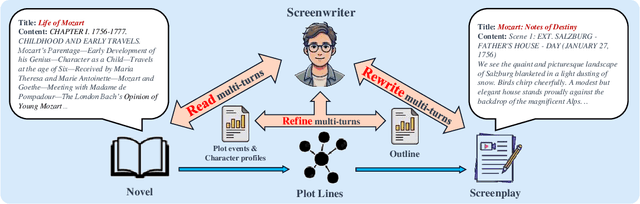

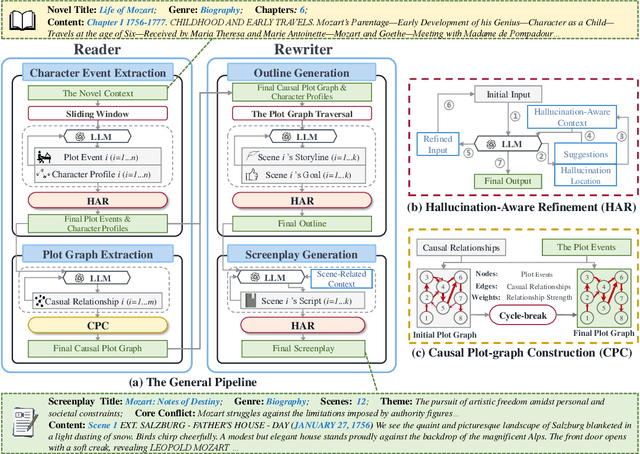
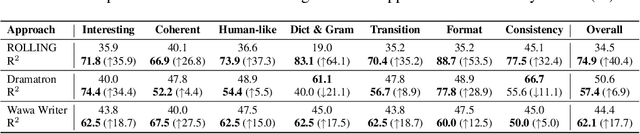
Automatically adapting novels into screenplays is important for the TV, film, or opera industries to promote products with low costs. The strong performances of large language models (LLMs) in long-text generation call us to propose a LLM based framework Reader-Rewriter (R$^2$) for this task. However, there are two fundamental challenges here. First, the LLM hallucinations may cause inconsistent plot extraction and screenplay generation. Second, the causality-embedded plot lines should be effectively extracted for coherent rewriting. Therefore, two corresponding tactics are proposed: 1) A hallucination-aware refinement method (HAR) to iteratively discover and eliminate the affections of hallucinations; and 2) a causal plot-graph construction method (CPC) based on a greedy cycle-breaking algorithm to efficiently construct plot lines with event causalities. Recruiting those efficient techniques, R$^2$ utilizes two modules to mimic the human screenplay rewriting process: The Reader module adopts a sliding window and CPC to build the causal plot graphs, while the Rewriter module generates first the scene outlines based on the graphs and then the screenplays. HAR is integrated into both modules for accurate inferences of LLMs. Experimental results demonstrate the superiority of R$^2$, which substantially outperforms three existing approaches (51.3%, 22.6%, and 57.1% absolute increases) in pairwise comparison at the overall win rate for GPT-4o.
A Neural Network Architecture Based on Attention Gate Mechanism for 3D Magnetotelluric Forward Modeling
Mar 14, 2025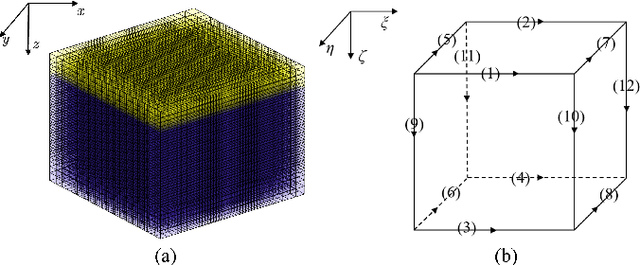
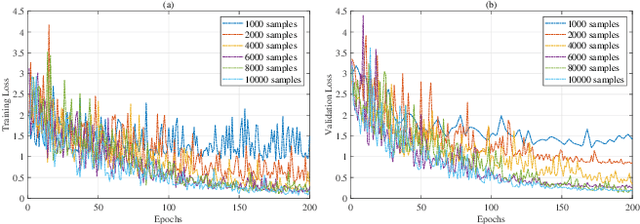
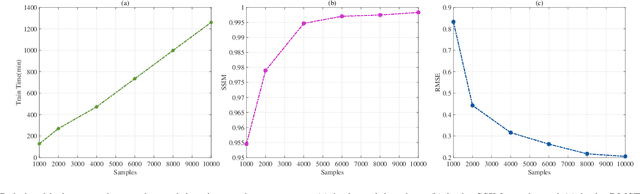
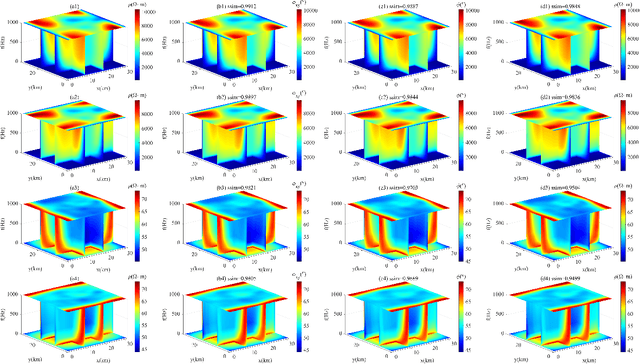
Traditional three-dimensional magnetotelluric (MT) numerical forward modeling methods, such as the finite element method (FEM) and finite volume method (FVM), suffer from high computational costs and low efficiency due to limitations in mesh refinement and computational resources. We propose a novel neural network architecture named MTAGU-Net, which integrates an attention gating mechanism for 3D MT forward modeling. Specifically, a dual-path attention gating module is designed based on forward response data images and embedded in the skip connections between the encoder and decoder. This module enables the fusion of critical anomaly information from shallow feature maps during the decoding of deep feature maps, significantly enhancing the network's capability to extract features from anomalous regions. Furthermore, we introduce a synthetic model generation method utilizing 3D Gaussian random field (GRF), which accurately replicates the electrical structures of real-world geological scenarios with high fidelity. Numerical experiments demonstrate that MTAGU-Net outperforms conventional 3D U-Net in terms of convergence stability and prediction accuracy, with the structural similarity index (SSIM) of the forward response data consistently exceeding 0.98. Moreover, the network can accurately predict forward response data on previously unseen datasets models, demonstrating its strong generalization ability and validating the feasibility and effectiveness of this method in practical applications.