 Add to Chrome
 Add to Firefox
 Add to Edge
Pyramid Self-contrastive Learning Framework for Test-time Ultrasound Image Denoising
May 12, 2026
The inherent electronic and speckle noise complicates clinical interpretation of ultrasound images. Conventional denoising methods rely on explicit noise assumptions whose validity diminishes under composite noise conditions. Learning-based methods require massive labeled data and model parameters. These pre-defined and pre-trained manners entail an inevitable domain shift in complex in vivo environments, so they are limited to a specific noise type and often blur structural details. In this study, we propose a pure test-time training framework for one-shot ultrasound image denoising and apply it to synthetic aperture ultrasound (SAU), which synthesizes transmit focus from sub-aperture transmissions. Our Aperture-to-Aperture (A2A) framework disentangles anatomical similarity and noise randomness from shuffled sub-apertures through self-contrastive learning in pyramid latent spaces. The clean image is then decoded from the anatomy space, while discarding the noise space. A2A is trained at test time on one noisy sample of SAU signals, so it fundamentally eliminates the domain shift and pretraining costs. Simulation experiments, including electronic noise levels of 0 to 30 dB and different inclusion geometries, demonstrated an improvement of 69.3% SNR and 34.4% CNR by A2A. The in vivo results showed 84.8% SNR and 25.7% CNR gains using only two aperture data of the heart in six echocardiographic views, liver, and kidney. A2A delivers clear images/signals across diverse imaging targets and configurations, paving the way for more reliable anatomical visualization and functional assessment by ultrasound.

Volumetric Ultrasound via 3D Null Subtraction Imaging with Circular and Spiral Apertures
Nov 15, 2025Volumetric ultrasound imaging faces a fundamental trade-off among image quality, frame rate, and hardware complexity. This study introduces three-dimensional Null Subtraction Imaging (3D NSI), a nonlinear beamforming framework that addresses this trade-off by combining computationally efficient null-subtraction process with multiplexing-aware sparse aperture designs on matrix arrays. We evaluate three apodization configurations: a fully addressed circular aperture and two Fermat's spiral sparse apertures. To overcome channel-sharing constraints common in matrix arrays multiplexed with low-channel-count ultrasound systems, we propose a spiral "no-reuse" apodization that enforces non-overlapping element sets across transmit-receive events. This design resolves multiplexing conflicts and enables up to a 16-fold increase in acquisition volume rate using only 240 active elements on a 1024-element probe. In computer simulations and tissue-mimicking phantom experiments, 3D NSI achieved an average improvement of 36% in azimuthal and elevational resolutions, along with an approximately 20% higher contrast ratio, compared to the conventional Delay-and-Sum (DAS) beamformer under matched transmit/receive configurations. When implemented with the spiral no-reuse aperture, the 3D NSI framework achieved over 1000 volumes per second with a computational load less than three times that of DAS, making it a practical solution for real-time 4D imaging.
Denoising ECG by Adaptive Filter with Empirical Mode Decomposition
Aug 18, 2021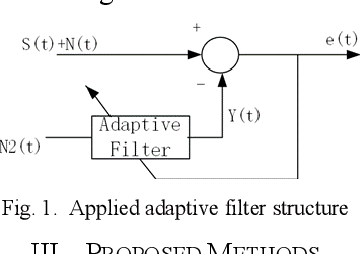
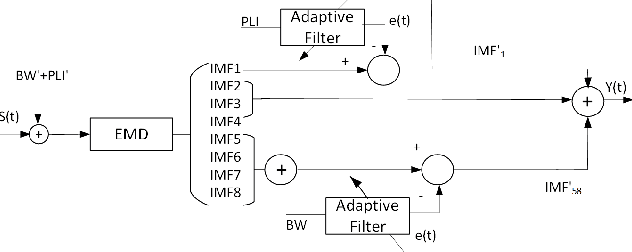
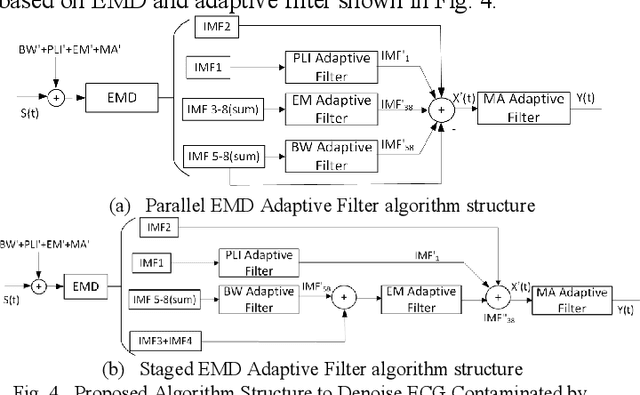
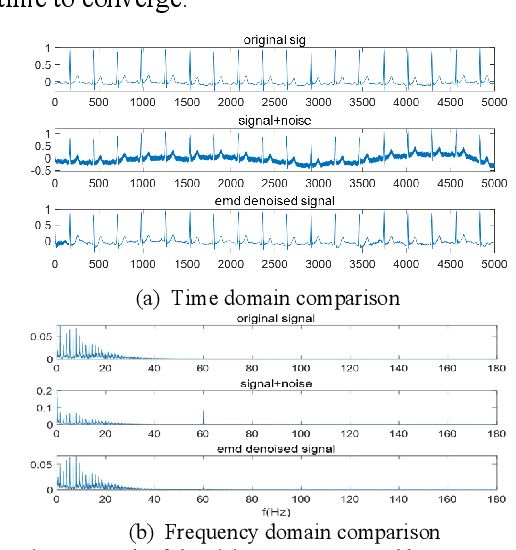
Electrocardiogram (ECG) signal is an important physiological signal which contains cardiac information and is the basis to diagnosis cardiac related diseases. In this paper, several innovative and efficient methods based on adaptive filter and empirical mode decomposition (EMD) to denoise ECG signal contaminated by various kinds of noise, including baseline wander (BW), power line interference (PLI), electrode motion artifact (EM) and muscle artifact (MA), are proposed. We first present a novel method based on EMD and adaptive filter for the removal of BW and PLI in ECG signal. We then extend the method to the complex scenario where four most common noises, PLI, BW, EM and MA are present. The proposed Parallel EMD adaptive filter structure yields the best SNR improvement on the MIT-BIH arrhythmia database, corrupted by the four types of noises.