 Add to Chrome
 Add to Firefox
 Add to Edge
Agentic Environment Engineering for Large Language Models: A Survey of Environment Modeling, Synthesis, Evaluation, and Application
Jun 10, 2026
Environments serve as interactive systems for large language model (LLM) based agents across diverse scenarios and play a crucial role in driving the continual evolution of model capabilities. Despite this importance, existing work lacks a systematic categorization and deep analysis. This paper systematically studies current researches on agentic environments from the perspective of the environment engineering lifecycle, covering their modeling, synthesis, evaluation and application. Specifically, the paper first introduces representative environments from the perspectives of eight attributes and eight domains, providing detailed analyses of their development paths and highlighting their core capabilities. Second, for automated environment synthesis, two paradigms are introduced, such as symbolic synthesis and neural synthesis. This paper also shows different environment evaluation methods in each paradigm. Thirdly, the corresponding environment applications from the perspective of agent-environment co-evolution are discussed. In specific, the paper characterizes the primary pathways for agent evolution in dynamic environments from four complementary perspectives: memory-centric experience evolution, orchestration-centric workflow evolution, trajectory-centric offline evolution, and exploration-centric online evolution. And three paradigms of environment evolution are identified, namely neural-driven, difficulty-driven, and scaling-driven approaches. At last, several promising future directions are discussed, including Environment-as-a-Service, Multi-agent Environments, and Neural-Symbolic Environments.

Low Rank for Rank: Uncertainty-Aware Task-Specific LLM Ranking under Sparse Pairwise Comparisons
May 28, 2026Pairwise human-preference platforms such as Chatbot Arena have become central to large language model (LLM) evaluation, yet reliable task-specific ranking remains challenging. Global leaderboards mask task heterogeneity, while ranking each fine-grained task independently is unstable under sparse, imbalanced comparisons. We propose a low-rank framework for task-specific LLM ranking from sparse pairwise comparisons, modeling the task-by-model ability matrix $Θ^\star \in \mathbb{R}^{d_t \times d_m}$ as low rank so that information is shared across related tasks while task-specific differences are preserved. We first develop a max-norm ($\ell_\infty$) accurate estimator for the latent scores, combining a convex initializer with alternating-minimization refinement, and prove task-wise top-$K$ recovery guarantees under sparse sampling. Our main contribution is an uncertainty quantification framework for task-specific ranking. We construct cross-fitted one-step debiased estimators for fixed score contrasts -- such as the task-specific ability gap between two models -- yielding asymptotically valid confidence intervals that attain the semiparametric efficiency bound. We then extend the inference to the high-dimensional ranking regime, where per-task ranks and top-$K$ membership are determined by many dependent score-gap hypotheses. Using Gaussian and multiplier-bootstrap calibration, we obtain simultaneous confidence sets for per-task ranks and valid top-$K$ membership tests across many tasks and models. Experiments on synthetic data and Chatbot Arena show that low-rank sharing improves sample efficiency over independent task-wise Bradley-Terry estimation and produces tighter, better-calibrated ranking certificates, with the largest gains in the sparse regime typical of real LLM benchmarks.
LLM Evaluation as Tensor Completion: Low Rank Structure and Semiparametric Efficiency
Apr 07, 2026Large language model (LLM) evaluation platforms increasingly rely on pairwise human judgments. These data are noisy, sparse, and non-uniform, yet leaderboards are reported with limited uncertainty quantification. We study this as semiparametric inference for a low-rank latent score tensor observed through pairwise comparisons under Bradley-Terry-Luce-type models. This places LLM evaluation in a new tensor completion setting with structured observations, non-uniform sampling, and pairwise contrasts. Our target is a smooth functional $ψ(T^\star)$, including linear estimands such as ability gaps and nonlinear ones such as win probabilities. We derive the information operator on the low-rank tangent space, the efficient influence function, and the semiparametric efficiency bound, then construct a one-step debiased estimator with asymptotic normality. A central challenge is that the information operator is anisotropic and does not commute with the tangent-space projection, creating a bottleneck absent from isotropic models. We introduce a score-whitening method that equalizes local Fisher information and restores stable inference at the optimal sample-complexity scale. Our results provide a principled framework for uncertainty quantification in LLM evaluation and more broadly for inference on low-rank structures from pairwise data.
MMR-Life: Piecing Together Real-life Scenes for Multimodal Multi-image Reasoning
Mar 02, 2026Recent progress in the reasoning capabilities of multimodal large language models (MLLMs) has empowered them to address more complex tasks such as scientific analysis and mathematical reasoning. Despite their promise, MLLMs' reasoning abilities across different scenarios in real life remain largely unexplored and lack standardized benchmarks for evaluation. To address this gap, we introduce MMR-Life, a comprehensive benchmark designed to evaluate the diverse multimodal multi-image reasoning capabilities of MLLMs across real-life scenarios. MMR-Life consists of 2,646 multiple-choice questions based on 19,108 images primarily sourced from real-world contexts, comprehensively covering seven reasoning types: abductive, analogical, causal, deductive, inductive, spatial, and temporal. Unlike existing reasoning benchmarks, MMR-Life does not rely on domain-specific expertise but instead requires models to integrate information across multiple images and apply diverse reasoning abilities. The evaluation of 37 advanced models highlights the substantial challenge posed by MMR-Life. Even top models like GPT-5 achieve only 58% accuracy and display considerable variance in performance across reasoning types. Moreover, we analyze the reasoning paradigms of existing MLLMs, exploring how factors such as thinking length, reasoning method, and reasoning type affect their performance. In summary, MMR-Life establishes a comprehensive foundation for evaluating, analyzing, and improving the next generation of multimodal reasoning systems.
MMR-V: What's Left Unsaid? A Benchmark for Multimodal Deep Reasoning in Videos
Jun 04, 2025The sequential structure of videos poses a challenge to the ability of multimodal large language models (MLLMs) to locate multi-frame evidence and conduct multimodal reasoning. However, existing video benchmarks mainly focus on understanding tasks, which only require models to match frames mentioned in the question (hereafter referred to as "question frame") and perceive a few adjacent frames. To address this gap, we propose MMR-V: A Benchmark for Multimodal Deep Reasoning in Videos. The benchmark is characterized by the following features. (1) Long-range, multi-frame reasoning: Models are required to infer and analyze evidence frames that may be far from the question frame. (2) Beyond perception: Questions cannot be answered through direct perception alone but require reasoning over hidden information. (3) Reliability: All tasks are manually annotated, referencing extensive real-world user understanding to align with common perceptions. (4) Confusability: Carefully designed distractor annotation strategies to reduce model shortcuts. MMR-V consists of 317 videos and 1,257 tasks. Our experiments reveal that current models still struggle with multi-modal reasoning; even the best-performing model, o4-mini, achieves only 52.5% accuracy. Additionally, current reasoning enhancement strategies (Chain-of-Thought and scaling test-time compute) bring limited gains. Further analysis indicates that the CoT demanded for multi-modal reasoning differs from it in textual reasoning, which partly explains the limited performance gains. We hope that MMR-V can inspire further research into enhancing multi-modal reasoning capabilities.
Rewarding Curse: Analyze and Mitigate Reward Modeling Issues for LLM Reasoning
Mar 07, 2025Chain-of-thought (CoT) prompting demonstrates varying performance under different reasoning tasks. Previous work attempts to evaluate it but falls short in providing an in-depth analysis of patterns that influence the CoT. In this paper, we study the CoT performance from the perspective of effectiveness and faithfulness. For the former, we identify key factors that influence CoT effectiveness on performance improvement, including problem difficulty, information gain, and information flow. For the latter, we interpret the unfaithful CoT issue by conducting a joint analysis of the information interaction among the question, CoT, and answer. The result demonstrates that, when the LLM predicts answers, it can recall correct information missing in the CoT from the question, leading to the problem. Finally, we propose a novel algorithm to mitigate this issue, in which we recall extra information from the question to enhance the CoT generation and evaluate CoTs based on their information gain. Extensive experiments demonstrate that our approach enhances both the faithfulness and effectiveness of CoT.
Near-Optimal Private Learning in Linear Contextual Bandits
Feb 18, 2025We analyze the problem of private learning in generalized linear contextual bandits. Our approach is based on a novel method of re-weighted regression, yielding an efficient algorithm with regret of order $\sqrt{T}+\frac{1}{\alpha}$ and $\sqrt{T}/\alpha$ in the joint and local model of $\alpha$-privacy, respectively. Further, we provide near-optimal private procedures that achieve dimension-independent rates in private linear models and linear contextual bandits. In particular, our results imply that joint privacy is almost "for free" in all the settings we consider, partially addressing the open problem posed by Azize and Basu (2024).
MIRAGE: Evaluating and Explaining Inductive Reasoning Process in Language Models
Oct 12, 2024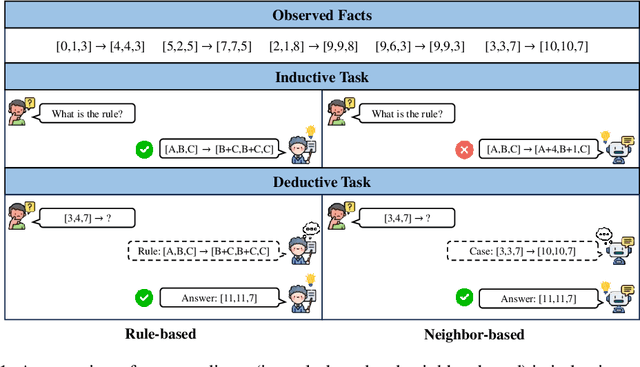
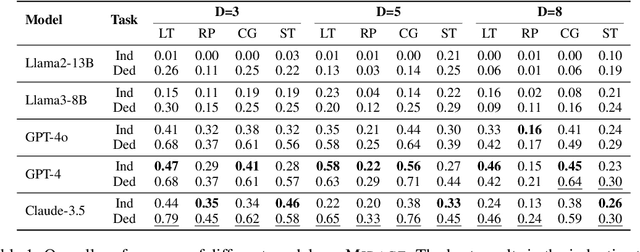
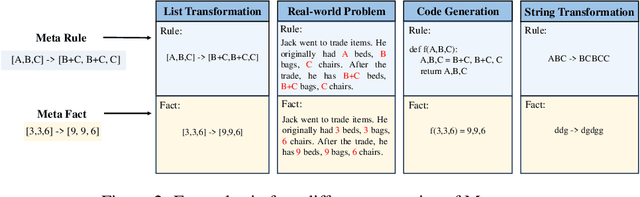
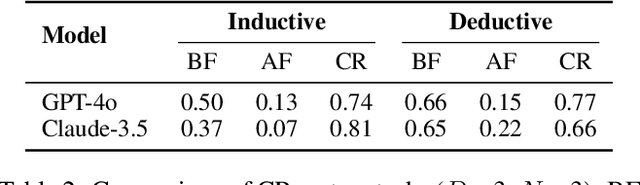
Inductive reasoning is an essential capability for large language models (LLMs) to achieve higher intelligence, which requires the model to generalize rules from observed facts and then apply them to unseen examples. We present {\scshape Mirage}, a synthetic dataset that addresses the limitations of previous work, specifically the lack of comprehensive evaluation and flexible test data. In it, we evaluate LLMs' capabilities in both the inductive and deductive stages, allowing for flexible variation in input distribution, task scenario, and task difficulty to analyze the factors influencing LLMs' inductive reasoning. Based on these multi-faceted evaluations, we demonstrate that the LLM is a poor rule-based reasoner. In many cases, when conducting inductive reasoning, they do not rely on a correct rule to answer the unseen case. From the perspectives of different prompting methods, observation numbers, and task forms, models tend to consistently conduct correct deduction without correct inductive rules. Besides, we find that LLMs are good neighbor-based reasoners. In the inductive reasoning process, the model tends to focus on observed facts that are close to the current test example in feature space. By leveraging these similar examples, the model maintains strong inductive capabilities within a localized region, significantly improving its deductive performance.
LINKED: Eliciting, Filtering and Integrating Knowledge in Large Language Model for Commonsense Reasoning
Oct 12, 2024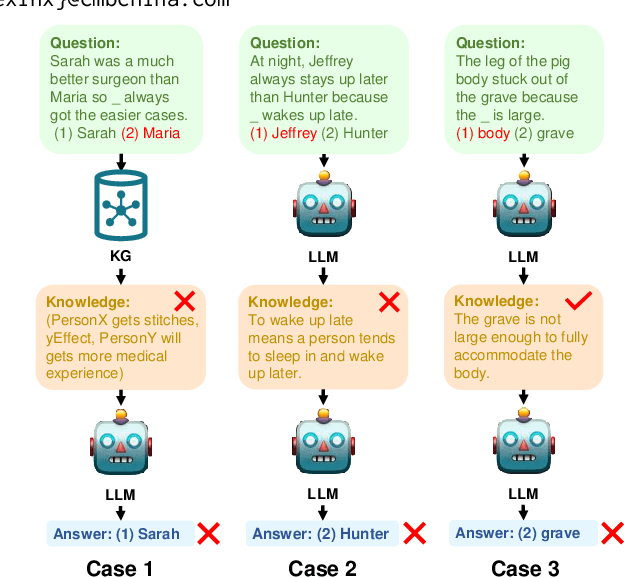
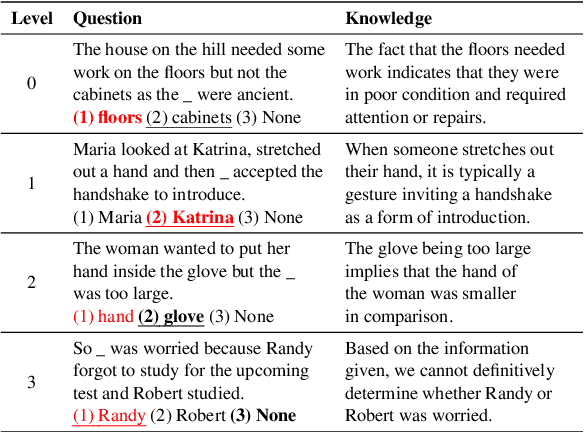
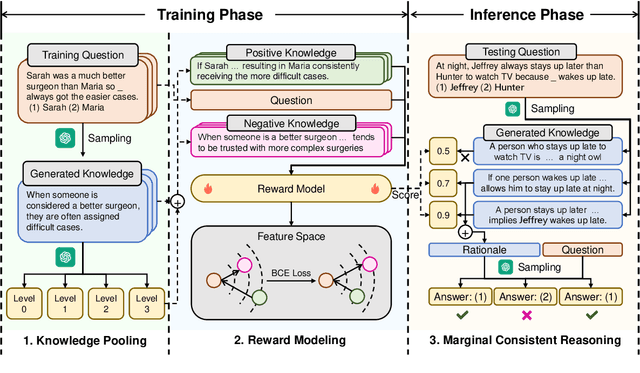
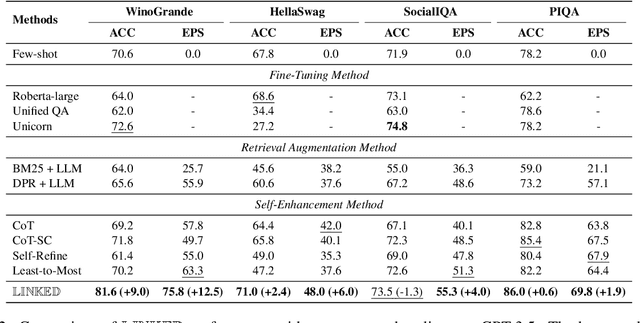
Large language models (LLMs) sometimes demonstrate poor performance on knowledge-intensive tasks, commonsense reasoning is one of them. Researchers typically address these issues by retrieving related knowledge from knowledge graphs or employing self-enhancement methods to elicit knowledge in LLMs. However, noisy knowledge and invalid reasoning issues hamper their ability to answer questions accurately. To this end, we propose a novel method named eliciting, filtering and integrating knowledge in large language model (LINKED). In it, we design a reward model to filter out the noisy knowledge and take the marginal consistent reasoning module to reduce invalid reasoning. With our comprehensive experiments on two complex commonsense reasoning benchmarks, our method outperforms SOTA baselines (up to 9.0% improvement of accuracy). Besides, to measure the positive and negative impact of the injected knowledge, we propose a new metric called effectiveness-preservation score for the knowledge enhancement works. Finally, through extensive experiments, we conduct an in-depth analysis and find many meaningful conclusions about LLMs in commonsense reasoning tasks.
The Power of Adaptivity in Experimental Design
Oct 10, 2024Given n experiment subjects with potentially heterogeneous covariates and two possible treatments, namely active treatment and control, this paper addresses the fundamental question of determining the optimal accuracy in estimating the treatment effect. Furthermore, we propose an experimental design that approaches this optimal accuracy, giving a (non-asymptotic) answer to this fundamental yet still open question. The methodological contribution is listed as following. First, we establish an idealized optimal estimator with minimal variance as benchmark, and then demonstrate that adaptive experiment is necessary to achieve near-optimal estimation accuracy. Secondly, by incorporating the concept of doubly robust method into sequential experimental design, we frame the optimal estimation problem as an online bandit learning problem, bridging the two fields of statistical estimation and bandit learning. Using tools and ideas from both bandit algorithm design and adaptive statistical estimation, we propose a general low switching adaptive experiment framework, which could be a generic research paradigm for a wide range of adaptive experimental design. Through information-theoretic lower bound combined with Bayes risk analysis, we demonstrate the optimality of our proposed experiment. Numerical result indicates that the estimation accuracy approaches optimal with as few as two or three policy updates.