 Add to Chrome
 Add to Firefox
 Add to Edge
Cross-Domain Hybrid OPD for Generalizable Search Agents
Aug 03, 2026
Recent advances in Reinforcement Learning (RL) have substantially improved the capabilities of autonomous search agents, enabling sophisticated planning, and iterative retrieval over dynamic information sources. However, optimizing language models for specialized search behaviors often incurs an alignment tax, where gains in search performance come at the expense of general-purpose capabilities, limiting their effectiveness as universal assistants. In this technical report, we present the training framework behind the Yuanbao search agent, designed to achieve search specialization without sacrificing general intelligence. Built upon the Hunyuan3 architecture, our framework combines agentic reinforcement learning for autonomous search with a cross-domain expert On-Policy Distillation (OPD) pipeline. Experts specializing in complementary general-purpose domains are distilled into the search-specialized student, restoring and further enhancing its broad capabilities. Rather than treating specialization and general capability as competing objectives, our hybrid training strategy jointly optimizes both, effectively mitigating the alignment tax. Extensive experiments demonstrate that the resulting model achieves competitive search performance while consistently improving its general-purpose capabilities, providing a favorable balance between specialized execution and broad generalization in real-world search scenarios.

Let the Barbarians In: How AI Can Accelerate Systems Performance Research
Dec 22, 2025Artificial Intelligence (AI) is beginning to transform the research process by automating the discovery of new solutions. This shift depends on the availability of reliable verifiers, which AI-driven approaches require to validate candidate solutions. Research focused on improving systems performance is especially well-suited to this paradigm because system performance problems naturally admit such verifiers: candidates can be implemented in real systems or simulators and evaluated against predefined workloads. We term this iterative cycle of generation, evaluation, and refinement AI-Driven Research for Systems (ADRS). Using several open-source ADRS instances (i.e., OpenEvolve, GEPA, and ShinkaEvolve), we demonstrate across ten case studies (e.g., multi-region cloud scheduling, mixture-of-experts load balancing, LLM-based SQL, transaction scheduling) that ADRS-generated solutions can match or even outperform human state-of-the-art designs. Based on these findings, we outline best practices (e.g., level of prompt specification, amount of feedback, robust evaluation) for effectively using ADRS, and we discuss future research directions and their implications. Although we do not yet have a universal recipe for applying ADRS across all of systems research, we hope our preliminary findings, together with the challenges we identify, offer meaningful guidance for future work as researcher effort shifts increasingly toward problem formulation and strategic oversight. Note: This paper is an extension of our prior work [14]. It adds extensive evaluation across multiple ADRS frameworks and provides deeper analysis and insights into best practices.
Tempus Core: Area-Power Efficient Temporal-Unary Convolution Core for Low-Precision Edge DLAs
Dec 25, 2024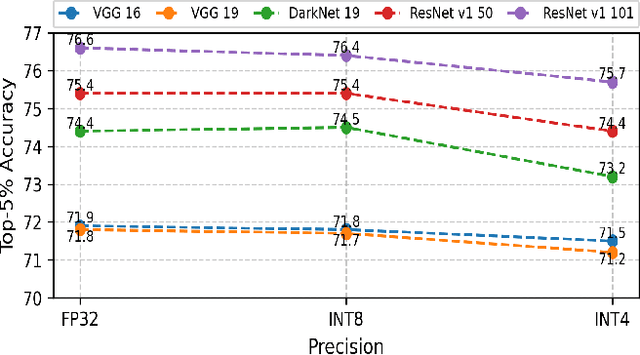
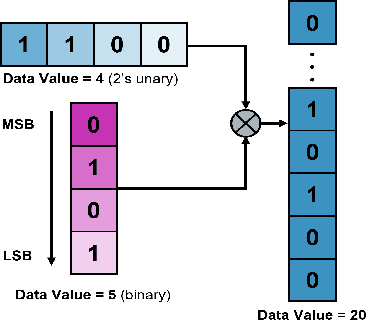
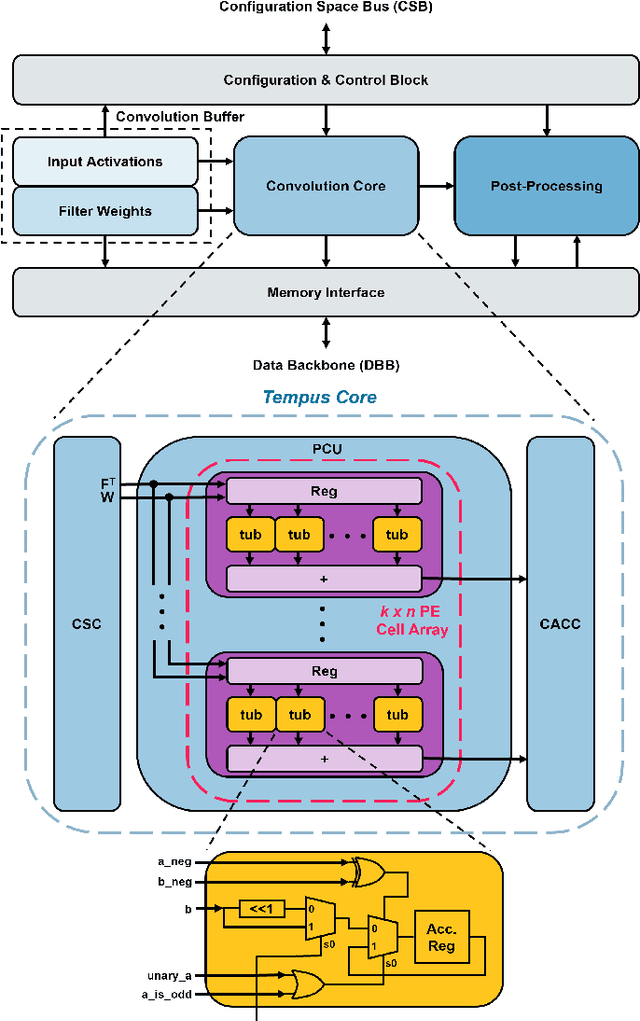
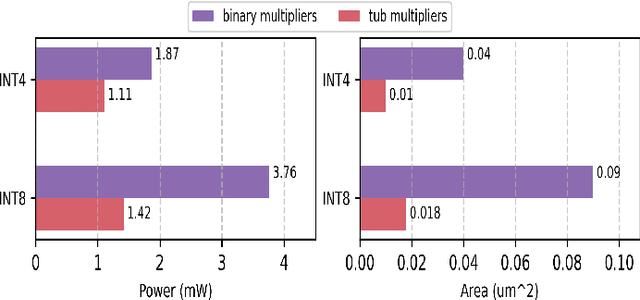
The increasing complexity of deep neural networks (DNNs) poses significant challenges for edge inference deployment due to resource and power constraints of edge devices. Recent works on unary-based matrix multiplication hardware aim to leverage data sparsity and low-precision values to enhance hardware efficiency. However, the adoption and integration of such unary hardware into commercial deep learning accelerators (DLA) remain limited due to processing element (PE) array dataflow differences. This work presents Tempus Core, a convolution core with highly scalable unary-based PE array comprising of tub (temporal-unary-binary) multipliers that seamlessly integrates with the NVDLA (NVIDIA's open-source DLA for accelerating CNNs) while maintaining dataflow compliance and boosting hardware efficiency. Analysis across various datapath granularities shows that for INT8 precision in 45nm CMOS, Tempus Core's PE cell unit (PCU) yields 59.3% and 15.3% reductions in area and power consumption, respectively, over NVDLA's CMAC unit. Considering a 16x16 PE array in Tempus Core, area and power improves by 75% and 62%, respectively, while delivering 5x and 4x iso-area throughput improvements for INT8 and INT4 precisions. Post-place and route analysis of Tempus Core's PCU shows that the 16x4 PE array for INT4 precision in 45nm CMOS requires only 0.017 mm^2 die area and consumes only 6.2mW of total power. We demonstrate that area-power efficient unary-based hardware can be seamlessly integrated into conventional DLAs, paving the path for efficient unary hardware for edge AI inference.