 Add to Chrome
 Add to Firefox
 Add to Edge
SETA: Scaling Environments for Terminal Agents
Jul 12, 2026
Large language models (LLMs) are rapidly shifting toward agents that solve tasks through diverse interfaces, including web and graphical user interfaces (GUIs). Among these, the terminal command line provides a text-based, general-purpose interface, covering tasks from system operations to data science and machine learning. However, scaling terminal-agent training remains challenging, as it requires diverse and coherent task instructions, executable environments, and reliable verification, while lacking naturally grounded supervision data. In this work, we propose SETA, a scalable framework for generating verifiable terminal environments for reinforcement learning (RL). The framework consists of two pipelines sharing a unified verification mechanism: SETA-Synth converts diverse sources into standardized RL environments, and SETA-Evol further expands from existing environments with adaptive control of difficulty and diversity. Together, we construct and release SETA-Env, the largest open-source verifiable terminal RL dataset to date, containing over 4,500 environments. We evaluate our dataset by training Qwen3-8B with GRPO on SETA-Env, achieving 12% pass rate on Terminal-Bench 2.0, the best reported result for an RL-trained model at the 8B scale. We further observe gains on DeepSeek-V4-Flash under the same terminal agent harness, with pass@1 on Terminal-Bench 2.0 improving from 40% to 43% and pass@5 improving from 54% to 58%. These results demonstrate that SETA- Env provides high-quality training environments for terminal agents and serves as a valuable resource for advancing research on terminal-based agent learning.

Agentic Context Engineering: Evolving Contexts for Self-Improving Language Models
Oct 06, 2025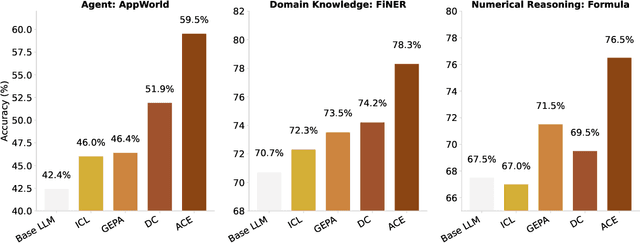
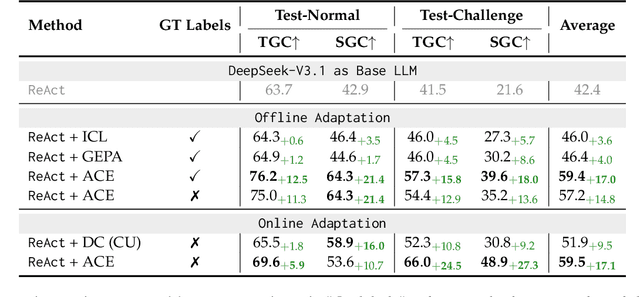
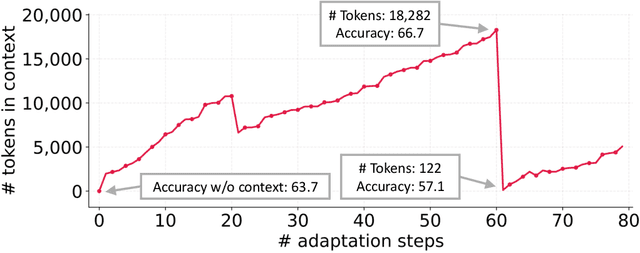
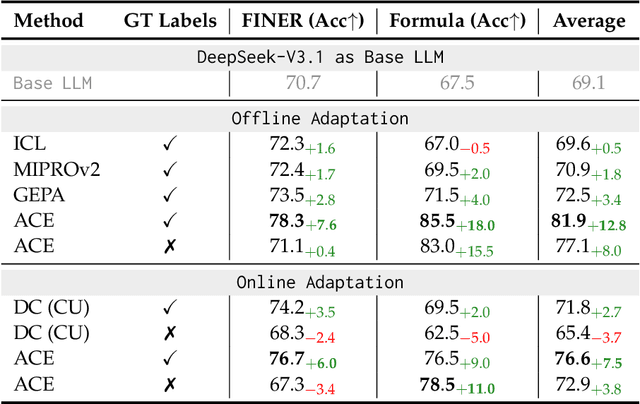
Large language model (LLM) applications such as agents and domain-specific reasoning increasingly rely on context adaptation -- modifying inputs with instructions, strategies, or evidence, rather than weight updates. Prior approaches improve usability but often suffer from brevity bias, which drops domain insights for concise summaries, and from context collapse, where iterative rewriting erodes details over time. Building on the adaptive memory introduced by Dynamic Cheatsheet, we introduce ACE (Agentic Context Engineering), a framework that treats contexts as evolving playbooks that accumulate, refine, and organize strategies through a modular process of generation, reflection, and curation. ACE prevents collapse with structured, incremental updates that preserve detailed knowledge and scale with long-context models. Across agent and domain-specific benchmarks, ACE optimizes contexts both offline (e.g., system prompts) and online (e.g., agent memory), consistently outperforming strong baselines: +10.6% on agents and +8.6% on finance, while significantly reducing adaptation latency and rollout cost. Notably, ACE could adapt effectively without labeled supervision and instead by leveraging natural execution feedback. On the AppWorld leaderboard, ACE matches the top-ranked production-level agent on the overall average and surpasses it on the harder test-challenge split, despite using a smaller open-source model. These results show that comprehensive, evolving contexts enable scalable, efficient, and self-improving LLM systems with low overhead.