 Add to Chrome
 Add to Firefox
 Add to Edge
Communication-Efficient Verifiable Attention for LLM Inference
Jun 15, 2026
Computation integrity of remote large language model (LLM) serving can be questionable. For conventional deep neural networks (DNNs), the existing TEE-shielded DNN partitioning (TSDP) approach uses Trusted Execution Environment (TEE) to compute non-linear components and verify the integrity of linear components offloaded to an untrusted GPU. However, directly applying TSDP to Transformer-based LLMs incurs significant TEE computation and TEE-GPU communication overhead. This paper presents Communication-efficient TEE-GPU Attention (\textsc{VeriAttn}) for accelerating verifiable LLM inference. \textsc{VeriAttn} offloads both linear and non-linear computations of attention to the GPU, while TEE performs verification. Moreover, for prefill, \textsc{VeriAttn} uses a two-level pipeline to overlap data movement, TEE pre-/post-processing, and GPU computation. For decoding, when the key-value cache exceeds available GPU memory, \textsc{VeriAttn} partitions attention across TEE and GPU to reduce repeated key-value transfers. Evaluation on an Intel TDX platform shows that \textsc{VeriAttn} achieves 2.60-3.38$\times$ and 3.86-5.42$\times$ acceleration over TSDP for 6k-token prompts and 10k-token outputs during prefill and decoding, respectively.

Agora: Toward Autonomous Bug Detection in Production-Level Consensus Protocols with LLM Agents
May 28, 2026Consensus protocols form the backbone of distributed systems and blockchains, where implementation bugs can cause data corruption and financial losses. While LLM-based approaches show promise in code analysis, they struggle with deep protocol-level logic bugs involving complex state-dependent behaviors across multiple execution stages. We present Agora, a domain-aware multi-agent framework that integrates hypothesis-driven testing with LLM capabilities for systematic protocol verification. Agora employs specialized agents that collaboratively explore protocol state spaces, synthesize attack scenarios using domain-specific constraints, and validate findings through iterative refinement. This explicit role separation enables reasoning about global protocol invariants beyond single-function code analysis. We evaluate Agora on four consensus implementations (Raft, EPaxos, HotStuff, BullShark) using four state-of-the-art LLMs. Agora discovers 15 previously unknown protocol-level logic bugs that violate safety properties, while existing LLM-based agents fail to detect any such protocol-level logic bugs. Our results demonstrate that domain-aware multi-agent collaboration is essential for detecting deep logic bugs in complex protocols.
BadSFL: Backdoor Attack against Scaffold Federated Learning
Nov 26, 2024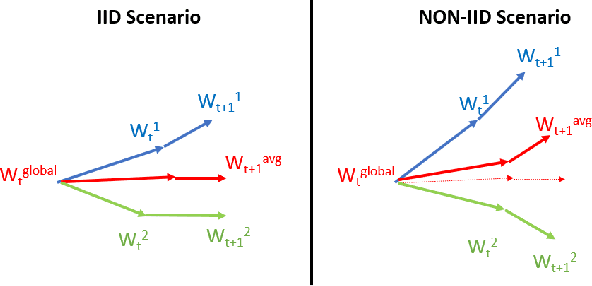

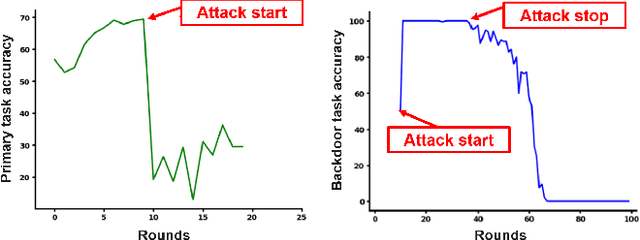
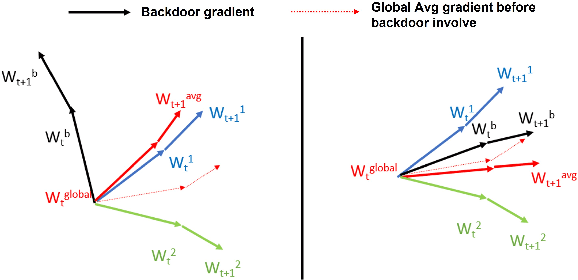
Federated learning (FL) enables the training of deep learning models on distributed clients to preserve data privacy. However, this learning paradigm is vulnerable to backdoor attacks, where malicious clients can upload poisoned local models to embed backdoors into the global model, leading to attacker-desired predictions. Existing backdoor attacks mainly focus on FL with independently and identically distributed (IID) scenarios, while real-world FL training data are typically non-IID. Current strategies for non-IID backdoor attacks suffer from limitations in maintaining effectiveness and durability. To address these challenges, we propose a novel backdoor attack method, BadSFL, specifically designed for the FL framework using the scaffold aggregation algorithm in non-IID settings. BadSFL leverages a Generative Adversarial Network (GAN) based on the global model to complement the training set, achieving high accuracy on both backdoor and benign samples. It utilizes a specific feature as the backdoor trigger to ensure stealthiness, and exploits the Scaffold's control variate to predict the global model's convergence direction, ensuring the backdoor's persistence. Extensive experiments on three benchmark datasets demonstrate the high effectiveness, stealthiness, and durability of BadSFL. Notably, our attack remains effective over 60 rounds in the global model and up to 3 times longer than existing baseline attacks after stopping the injection of malicious updates.