 Add to Chrome
 Add to Firefox
 Add to Edge
Multimodality as Supervision: Self-Supervised Specialization to the Test Environment via Multimodality
Jul 16, 2026
Cross-modal learning, i.e., learning to predict one modality from another, is a fundamental mechanism for self-supervision via leveraging multimodality. Many practical applications, e.g., deploying a household robot, involve devices that are equipped with a rich set of sensors that enable multimodal sensing in their test environment. This presents an opportunity to apply cross-modal learning to the multimodal data sensed by these devices to learn representations. Findings in developmental psychology also suggest that biological agents leverage it to build an effective representation of their surroundings. To study this, we propose a controlled setup, where we restrict a user device to just a given test environment. It results in a specialization setup where we attempt to develop a performant model for this specific test environment. Under this setup, we develop Test-Space Training (TST), which performs multimodal data collection in the test environment and performs self-supervised pre-training on it. We evaluate these models on various downstream tasks in the same environment. Under this setup, we find various interesting insights, such as collecting rich multimodal data only from the test environment and leveraging cross-modal learning, we can achieve competitive results with generalist models (e.g., DINOv2 and CLIP) pre-trained on large-scale internet datasets. This enables an alternative scenario where the need for external Internet-scale datasets for pre-training models is reduced. We also present a set of analyses and ablations that raise intriguing points on substituting data with (multi)modality, and how varying pre-training data enables a tradeoff between a model's abilities to specialise to a test environment, and generalize to held-out spaces.

Supermarket-6DoF: A Real-World Grasping Dataset and Grasp Pose Representation Analysis
Feb 22, 2025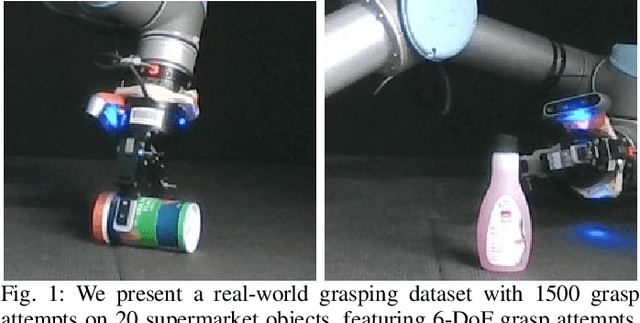
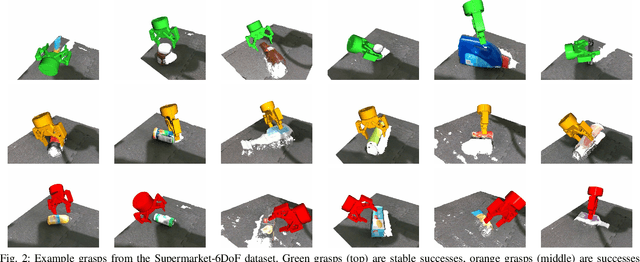
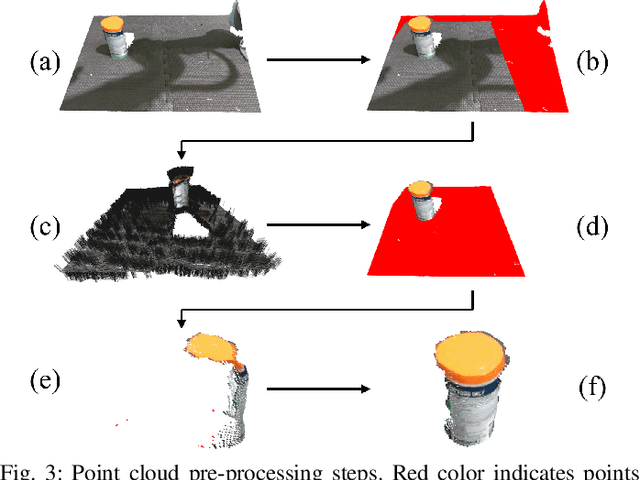
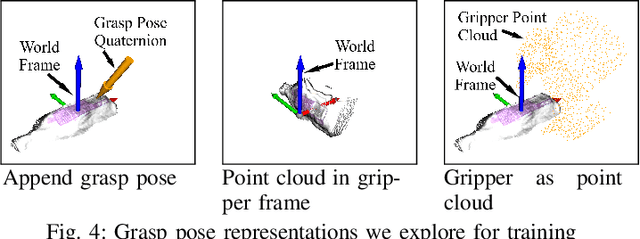
We present Supermarket-6DoF, a real-world dataset of 1500 grasp attempts across 20 supermarket objects with publicly available 3D models. Unlike most existing grasping datasets that rely on analytical metrics or simulation for grasp labeling, our dataset provides ground-truth outcomes from physical robot executions. Among the few real-world grasping datasets, wile more modest in size, Supermarket-6DoF uniquely features full 6-DoF grasp poses annotated with both initial grasp success and post-grasp stability under external perturbation. We demonstrate the dataset's utility by analyzing three grasp pose representations for grasp success prediction from point clouds. Our results show that representing the gripper geometry explicitly as a point cloud achieves higher prediction accuracy compared to conventional quaternion-based grasp pose encoding.
In-Hand Gravitational Pivoting Using Tactile Sensing
Oct 11, 2022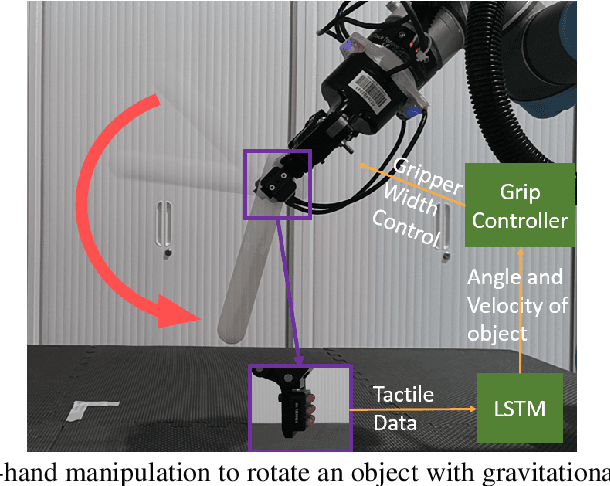
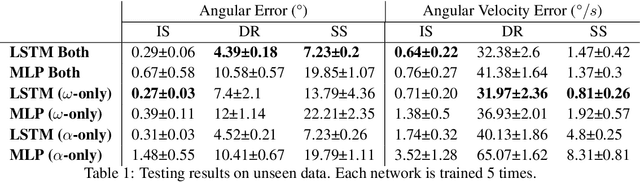
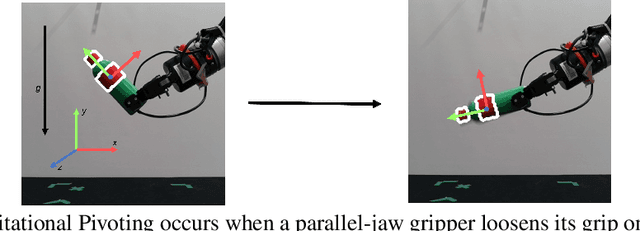
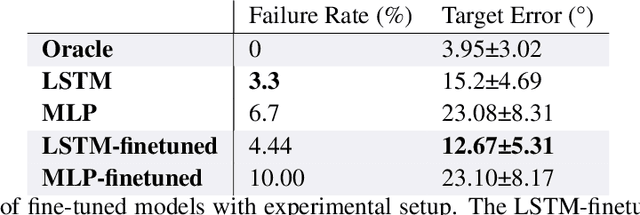
We study gravitational pivoting, a constrained version of in-hand manipulation, where we aim to control the rotation of an object around the grip point of a parallel gripper. To achieve this, instead of controlling the gripper to avoid slip, we embrace slip to allow the object to rotate in-hand. We collect two real-world datasets, a static tracking dataset and a controller-in-the loop dataset, both annotated with object angle and angular velocity labels. Both datasets contain force-based tactile information on ten different household objects. We train an LSTM model to predict the angular position and velocity of the held object from purely tactile data. We integrate this model with a controller that opens and closes the gripper allowing the object to rotate to desired relative angles. We conduct real-world experiments where the robot is tasked to achieve a relative target angle. We show that our approach outperforms a sliding-window based MLP in a zero-shot generalization setting with unseen objects. Furthermore, we show a 16.6% improvement in performance when the LSTM model is fine-tuned on a small set of data collected with both the LSTM model and the controller in-the-loop. Code and videos are available at https://rhys-newbury.github.io/projects/pivoting/