 Add to Chrome
 Add to Firefox
 Add to Edge
Finetuning CLIP to Reason about Pairwise Differences
Sep 15, 2024


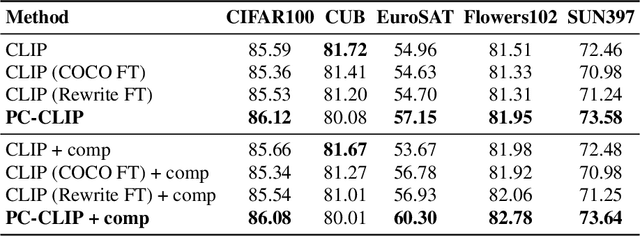
Vision-language models (VLMs) such as CLIP are trained via contrastive learning between text and image pairs, resulting in aligned image and text embeddings that are useful for many downstream tasks. A notable drawback of CLIP, however, is that the resulting embedding space seems to lack some of the structure of their purely text-based alternatives. For instance, while text embeddings have been long noted to satisfy \emph{analogies} in embedding space using vector arithmetic, CLIP has no such property. In this paper, we propose an approach to natively train CLIP in a contrastive manner to reason about differences in embedding space. We finetune CLIP so that the differences in image embedding space correspond to \emph{text descriptions of the image differences}, which we synthetically generate with large language models on image-caption paired datasets. We first demonstrate that our approach yields significantly improved capabilities in ranking images by a certain attribute (e.g., elephants are larger than cats), which is useful in retrieval or constructing attribute-based classifiers, and improved zeroshot classification performance on many downstream image classification tasks. In addition, our approach enables a new mechanism for inference that we refer to as comparative prompting, where we leverage prior knowledge of text descriptions of differences between classes of interest, achieving even larger performance gains in classification. Finally, we illustrate that the resulting embeddings obey a larger degree of geometric properties in embedding space, such as in text-to-image generation.

Transformers to SSMs: Distilling Quadratic Knowledge to Subquadratic Models
Aug 19, 2024
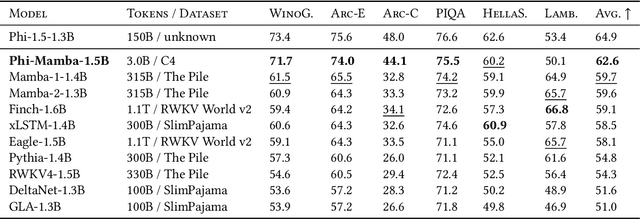


Transformer architectures have become a dominant paradigm for domains like language modeling but suffer in many inference settings due to their quadratic-time self-attention. Recently proposed subquadratic architectures, such as Mamba, have shown promise, but have been pretrained with substantially less computational resources than the strongest Transformer models. In this work, we present a method that is able to distill a pretrained Transformer architecture into alternative architectures such as state space models (SSMs). The key idea to our approach is that we can view both Transformers and SSMs as applying different forms of mixing matrices over the token sequences. We can thus progressively distill the Transformer architecture by matching different degrees of granularity in the SSM: first matching the mixing matrices themselves, then the hidden units at each block, and finally the end-to-end predictions. Our method, called MOHAWK, is able to distill a Mamba-2 variant based on the Phi-1.5 architecture (Phi-Mamba) using only 3B tokens and a hybrid version (Hybrid Phi-Mamba) using 5B tokens. Despite using less than 1% of the training data typically used to train models from scratch, Phi-Mamba boasts substantially stronger performance compared to all past open-source non-Transformer models. MOHAWK allows models like SSMs to leverage computational resources invested in training Transformer-based architectures, highlighting a new avenue for building such models.
Prompt Recovery for Image Generation Models: A Comparative Study of Discrete Optimizers
Aug 12, 2024Recovering natural language prompts for image generation models, solely based on the generated images is a difficult discrete optimization problem. In this work, we present the first head-to-head comparison of recent discrete optimization techniques for the problem of prompt inversion. We evaluate Greedy Coordinate Gradients (GCG), PEZ , Random Search, AutoDAN and BLIP2's image captioner across various evaluation metrics related to the quality of inverted prompts and the quality of the images generated by the inverted prompts. We find that focusing on the CLIP similarity between the inverted prompts and the ground truth image acts as a poor proxy for the similarity between ground truth image and the image generated by the inverted prompts. While the discrete optimizers effectively minimize their objectives, simply using responses from a well-trained captioner often leads to generated images that more closely resemble those produced by the original prompts.
FUSE-ing Language Models: Zero-Shot Adapter Discovery for Prompt Optimization Across Tokenizers
Aug 09, 2024The widespread use of large language models has resulted in a multitude of tokenizers and embedding spaces, making knowledge transfer in prompt discovery tasks difficult. In this work, we propose FUSE (Flexible Unification of Semantic Embeddings), an inexpensive approach to approximating an adapter layer that maps from one model's textual embedding space to another, even across different tokenizers. We introduce a third-order tensor-based representation of a model's embedding space that aligns semantic embeddings that have been split apart by different tokenizers, and use this representation to derive an approximation of the gradient of one model's outputs with respect to another model's embedding space. We show the efficacy of our approach via multi-objective optimization over vision-language and causal language models for image captioning and sentiment-based image captioning.
Consistency Models Made Easy
Jun 20, 2024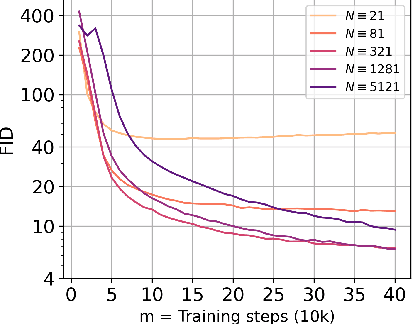
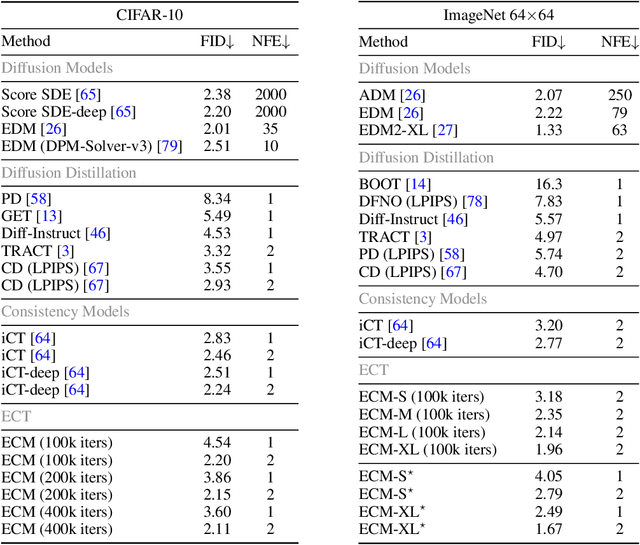
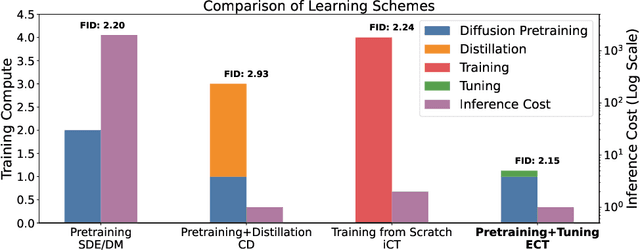
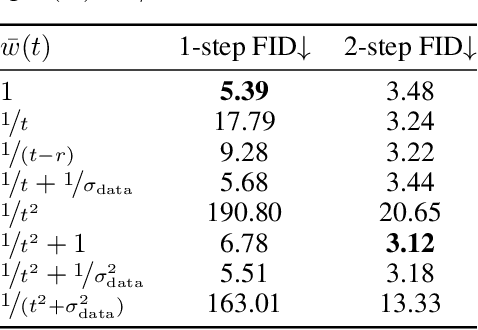
Consistency models (CMs) are an emerging class of generative models that offer faster sampling than traditional diffusion models. CMs enforce that all points along a sampling trajectory are mapped to the same initial point. But this target leads to resource-intensive training: for example, as of 2024, training a SoTA CM on CIFAR-10 takes one week on 8 GPUs. In this work, we propose an alternative scheme for training CMs, vastly improving the efficiency of building such models. Specifically, by expressing CM trajectories via a particular differential equation, we argue that diffusion models can be viewed as a special case of CMs with a specific discretization. We can thus fine-tune a consistency model starting from a pre-trained diffusion model and progressively approximate the full consistency condition to stronger degrees over the training process. Our resulting method, which we term Easy Consistency Tuning (ECT), achieves vastly improved training times while indeed improving upon the quality of previous methods: for example, ECT achieves a 2-step FID of 2.73 on CIFAR10 within 1 hour on a single A100 GPU, matching Consistency Distillation trained of hundreds of GPU hours. Owing to this computational efficiency, we investigate the scaling law of CMs under ECT, showing that they seem to obey classic power law scaling, hinting at their ability to improve efficiency and performance at larger scales. Code (https://github.com/locuslab/ect) is available.
Understanding Hallucinations in Diffusion Models through Mode Interpolation
Jun 13, 2024
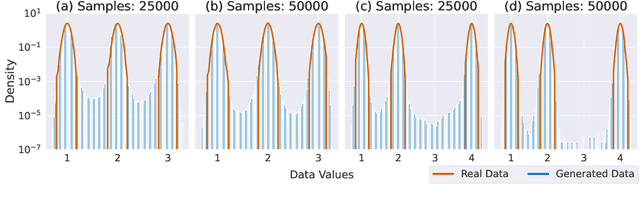


Colloquially speaking, image generation models based upon diffusion processes are frequently said to exhibit "hallucinations," samples that could never occur in the training data. But where do such hallucinations come from? In this paper, we study a particular failure mode in diffusion models, which we term mode interpolation. Specifically, we find that diffusion models smoothly "interpolate" between nearby data modes in the training set, to generate samples that are completely outside the support of the original training distribution; this phenomenon leads diffusion models to generate artifacts that never existed in real data (i.e., hallucinations). We systematically study the reasons for, and the manifestation of this phenomenon. Through experiments on 1D and 2D Gaussians, we show how a discontinuous loss landscape in the diffusion model's decoder leads to a region where any smooth approximation will cause such hallucinations. Through experiments on artificial datasets with various shapes, we show how hallucination leads to the generation of combinations of shapes that never existed. Finally, we show that diffusion models in fact know when they go out of support and hallucinate. This is captured by the high variance in the trajectory of the generated sample towards the final few backward sampling process. Using a simple metric to capture this variance, we can remove over 95% of hallucinations at generation time while retaining 96% of in-support samples. We conclude our exploration by showing the implications of such hallucination (and its removal) on the collapse (and stabilization) of recursive training on synthetic data with experiments on MNIST and 2D Gaussians dataset. We release our code at https://github.com/locuslab/diffusion-model-hallucination.
Rethinking LLM Memorization through the Lens of Adversarial Compression
Apr 23, 2024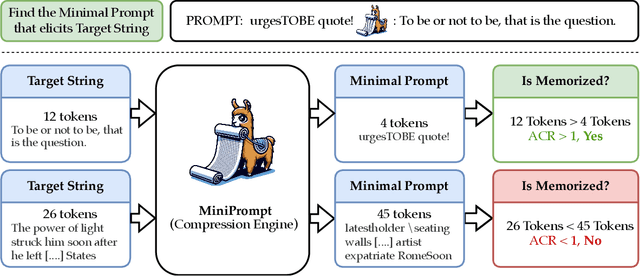
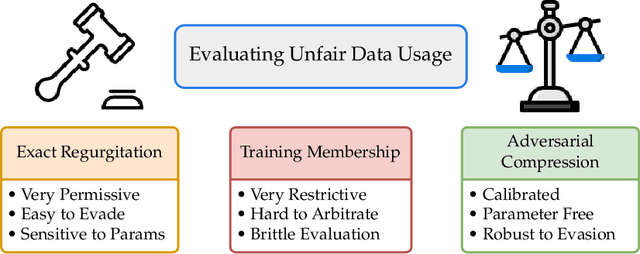


Large language models (LLMs) trained on web-scale datasets raise substantial concerns regarding permissible data usage. One major question is whether these models "memorize" all their training data or they integrate many data sources in some way more akin to how a human would learn and synthesize information. The answer hinges, to a large degree, on $\textit{how we define memorization}$. In this work, we propose the Adversarial Compression Ratio (ACR) as a metric for assessing memorization in LLMs -- a given string from the training data is considered memorized if it can be elicited by a prompt shorter than the string itself. In other words, these strings can be "compressed" with the model by computing adversarial prompts of fewer tokens. We outline the limitations of existing notions of memorization and show how the ACR overcomes these challenges by (i) offering an adversarial view to measuring memorization, especially for monitoring unlearning and compliance; and (ii) allowing for the flexibility to measure memorization for arbitrary strings at a reasonably low compute. Our definition serves as a valuable and practical tool for determining when model owners may be violating terms around data usage, providing a potential legal tool and a critical lens through which to address such scenarios. Project page: https://locuslab.github.io/acr-memorization.
Scaling Laws for Data Filtering -- Data Curation cannot be Compute Agnostic
Apr 10, 2024Vision-language models (VLMs) are trained for thousands of GPU hours on carefully curated web datasets. In recent times, data curation has gained prominence with several works developing strategies to retain 'high-quality' subsets of 'raw' scraped data. For instance, the LAION public dataset retained only 10% of the total crawled data. However, these strategies are typically developed agnostic of the available compute for training. In this paper, we first demonstrate that making filtering decisions independent of training compute is often suboptimal: the limited high-quality data rapidly loses its utility when repeated, eventually requiring the inclusion of 'unseen' but 'lower-quality' data. To address this quality-quantity tradeoff ($\texttt{QQT}$), we introduce neural scaling laws that account for the non-homogeneous nature of web data, an angle ignored in existing literature. Our scaling laws (i) characterize the $\textit{differing}$ 'utility' of various quality subsets of web data; (ii) account for how utility diminishes for a data point at its 'nth' repetition; and (iii) formulate the mutual interaction of various data pools when combined, enabling the estimation of model performance on a combination of multiple data pools without ever jointly training on them. Our key message is that data curation $\textit{cannot}$ be agnostic of the total compute that a model will be trained for. Our scaling laws allow us to curate the best possible pool for achieving top performance on Datacomp at various compute budgets, carving out a pareto-frontier for data curation. Code is available at https://github.com/locuslab/scaling_laws_data_filtering.
Automated Black-box Prompt Engineering for Personalized Text-to-Image Generation
Mar 28, 2024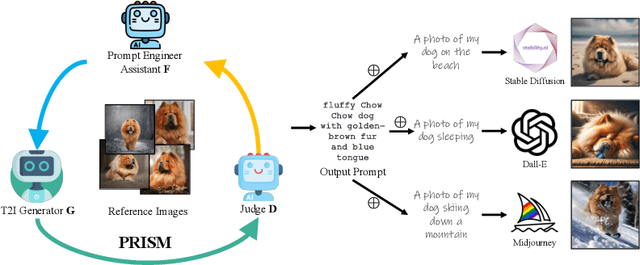
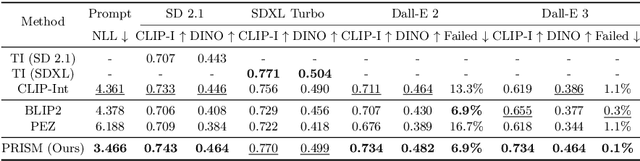


Prompt engineering is effective for controlling the output of text-to-image (T2I) generative models, but it is also laborious due to the need for manually crafted prompts. This challenge has spurred the development of algorithms for automated prompt generation. However, these methods often struggle with transferability across T2I models, require white-box access to the underlying model, and produce non-intuitive prompts. In this work, we introduce PRISM, an algorithm that automatically identifies human-interpretable and transferable prompts that can effectively generate desired concepts given only black-box access to T2I models. Inspired by large language model (LLM) jailbreaking, PRISM leverages the in-context learning ability of LLMs to iteratively refine the candidate prompts distribution for given reference images. Our experiments demonstrate the versatility and effectiveness of PRISM in generating accurate prompts for objects, styles and images across multiple T2I models, including Stable Diffusion, DALL-E, and Midjourney.
AcceleratedLiNGAM: Learning Causal DAGs at the speed of GPUs
Mar 06, 2024Existing causal discovery methods based on combinatorial optimization or search are slow, prohibiting their application on large-scale datasets. In response, more recent methods attempt to address this limitation by formulating causal discovery as structure learning with continuous optimization but such approaches thus far provide no statistical guarantees. In this paper, we show that by efficiently parallelizing existing causal discovery methods, we can in fact scale them to thousands of dimensions, making them practical for substantially larger-scale problems. In particular, we parallelize the LiNGAM method, which is quadratic in the number of variables, obtaining up to a 32-fold speed-up on benchmark datasets when compared with existing sequential implementations. Specifically, we focus on the causal ordering subprocedure in DirectLiNGAM and implement GPU kernels to accelerate it. This allows us to apply DirectLiNGAM to causal inference on large-scale gene expression data with genetic interventions yielding competitive results compared with specialized continuous optimization methods, and Var-LiNGAM for causal discovery on U.S. stock data.