 Add to Chrome
 Add to Firefox
 Add to Edge
Overview of FinMMEval 2026 Task 2: Multilingual Financial Short-Answer Question Answering
Jul 22, 2026
FinMMEval 2026 Task 2 evaluates short-answer financial question answering over multilingual evidence. Each final-test item pairs an English question with financial statements and news in English, Chinese, Japanese, Spanish, and Greek. Participating systems submit one concise answer per item in JSONL format. The final-test set contains 256 items, split evenly between easy and expert tiers; each tier contains four question templates instantiated over 32 company-report groups. Gold answers were withheld during submission, and systems were ranked by macro-averaged item-level ROUGE-1 F1 against organizer-held reference answers. The final leaderboard includes 12 ranked submissions. The strongest systems are closely clustered, with the top four separated by less than one percentage point in ROUGE-1 F1. The submitted system papers document retrieval-augmented generation, cross-lingual evidence handling, structured prompting, answer compression, and validation strategies.

Overview of FinMMEval 2026 Task 1: Multilingual Financial Multiple-Choice Question Answering
Jul 22, 2026FinMMEval 2026 Task 1 evaluates multilingual financial multiple-choice question answering in English, Chinese, Arabic, and Hindi. The task tests whether systems can select the correct answer to finance questions involving domain terminology, numerical interpretation, and conceptual financial reasoning across languages and scripts. The final-test set contains 800 questions, with 200 questions per language; gold answers were withheld during submission, and each language was ranked independently by accuracy. The final leaderboards contain 13 English, 11 Chinese, 11 Arabic, and 10 Hindi ranked submissions. Top accuracies range from 92.0% in Hindi to 97.5% in English and Arabic, with the same leading teams appearing near the top across all four languages. The documented systems used retrieval augmentation, direct answer-option scoring, language-specific prompting, selective self-consistency, confidence checks, and LLM-based review stages.
Schützen: Evaluating LLM Safety in Bulgarian and German Contexts
Jun 09, 2026Large language models are increasingly deployed across professional domains, bringing hard-to-predict risks, including the generation of harmful or disrespectful content. Although substantial progress has been made in developing safety evaluation datasets, existing resources remain overwhelmingly English- and Chinese-centric. This limitation is particularly pronounced when evaluating languages that operate within shared sociocultural, legal, and ethical contexts. To address this gap, we introduce Schützen: a German--Bulgarian safety dataset designed to assess model answerability under risk, covering both a low-resource language (Bulgarian) and a high-resource language (German). Experiments with multilingual and language-specific LLMs reveal pronounced cross-language differences in safety behavior, highlighting the necessity of tailored, region-specific evaluation resources to support the responsible deployment of LLMs in Germany and Bulgaria. Datasets and code are available at https://github.com/xnlp-lab/Schutzen. Warning: this paper contains examples that may be offensive, harmful, or biased.
FMI_SU_Yotkova_Kastreva at SemEval-2026 Task 13: Lightweight Detection of LLM-Generated Code via Stylometric Signals
May 05, 2026SemEval-2026 Task 13 investigates machine-generated code detection across multiple programming languages and application scenarios, asking participating systems to generalize to unseen languages and domains. This paper describes our participation in Subtask A (binary classification) and explores both pretrained code encoders and lightweight feature-based methods. We design ratio-based features that are less sensitive to snippet length. To support the extraction of descriptiveness-related signals, we use parsing engines and a programming-language classifier. Additionally, we train a separate code-vs-text line classifier to identify raw natural language segments embedded within samples. We combine a shallow decision tree with heuristic rules derived from data analysis to produce the final predictions. Our approach is computationally efficient, requires only CPU resources for training, and achieves near-instant inference time, offering a lightweight alternative to large pretrained models.
FMI@SU ToxHabits: Evaluating LLMs Performance on Toxic Habit Extraction in Spanish Clinical Texts
Apr 07, 2026The paper presents an approach for the recognition of toxic habits named entities in Spanish clinical texts. The approach was developed for the ToxHabits Shared Task. Our team participated in subtask 1, which aims to detect substance use and abuse mentions in clinical case reports and classify them in four categories (Tobacco, Alcohol, Cannabis, and Drug). We explored various methods of utilizing LLMs for the task, including zero-shot, few-shot, and prompt optimization, and found that GPT-4.1's few-shot prompting performed the best in our experiments. Our method achieved an F1 score of 0.65 on the test set, demonstrating a promising result for recognizing named entities in languages other than English.
Team Fusion@ SU@ BC8 SympTEMIST track: transformer-based approach for symptom recognition and linking
Apr 07, 2026This paper presents a transformer-based approach to solving the SympTEMIST named entity recognition (NER) and entity linking (EL) tasks. For NER, we fine-tune a RoBERTa-based (1) token-level classifier with BiLSTM and CRF layers on an augmented train set. Entity linking is performed by generating candidates using the cross-lingual SapBERT XLMR-Large (2), and calculating cosine similarity against a knowledge base. The choice of knowledge base proves to have the highest impact on model accuracy.
The CLEF-2026 FinMMEval Lab: Multilingual and Multimodal Evaluation of Financial AI Systems
Feb 11, 2026We present the setup and the tasks of the FinMMEval Lab at CLEF 2026, which introduces the first multilingual and multimodal evaluation framework for financial Large Language Models (LLMs). While recent advances in financial natural language processing have enabled automated analysis of market reports, regulatory documents, and investor communications, existing benchmarks remain largely monolingual, text-only, and limited to narrow subtasks. FinMMEval 2026 addresses this gap by offering three interconnected tasks that span financial understanding, reasoning, and decision-making: Financial Exam Question Answering, Multilingual Financial Question Answering (PolyFiQA), and Financial Decision Making. Together, these tasks provide a comprehensive evaluation suite that measures models' ability to reason, generalize, and act across diverse languages and modalities. The lab aims to promote the development of robust, transparent, and globally inclusive financial AI systems, with datasets and evaluation resources publicly released to support reproducible research.
Using LLMs for Multilingual Clinical Entity Linking to ICD-10
Sep 05, 2025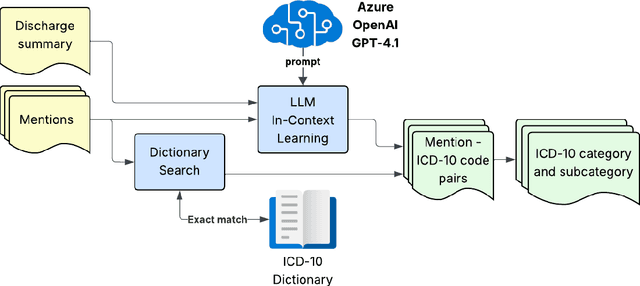
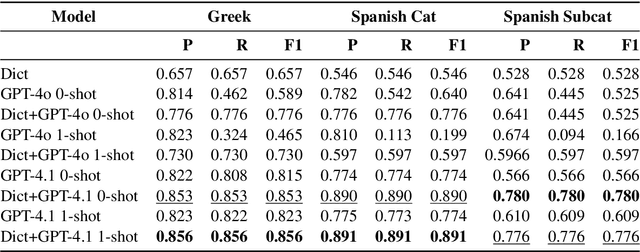
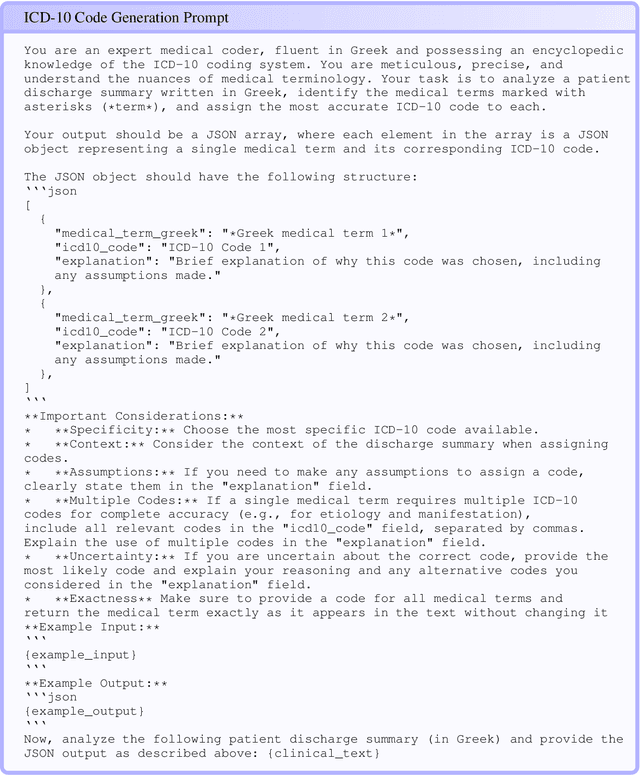
The linking of clinical entities is a crucial part of extracting structured information from clinical texts. It is the process of assigning a code from a medical ontology or classification to a phrase in the text. The International Classification of Diseases - 10th revision (ICD-10) is an international standard for classifying diseases for statistical and insurance purposes. Automatically assigning the correct ICD-10 code to terms in discharge summaries will simplify the work of healthcare professionals and ensure consistent coding in hospitals. Our paper proposes an approach for linking clinical terms to ICD-10 codes in different languages using Large Language Models (LLMs). The approach consists of a multistage pipeline that uses clinical dictionaries to match unambiguous terms in the text and then applies in-context learning with GPT-4.1 to predict the ICD-10 code for the terms that do not match the dictionary. Our system shows promising results in predicting ICD-10 codes on different benchmark datasets in Spanish - 0.89 F1 for categories and 0.78 F1 on subcategories on CodiEsp, and Greek - 0.85 F1 on ElCardioCC.
Post-OCR Text Correction for Bulgarian Historical Documents
Aug 31, 2024

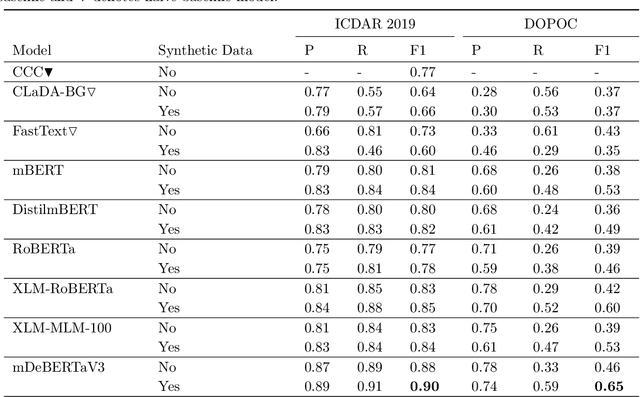
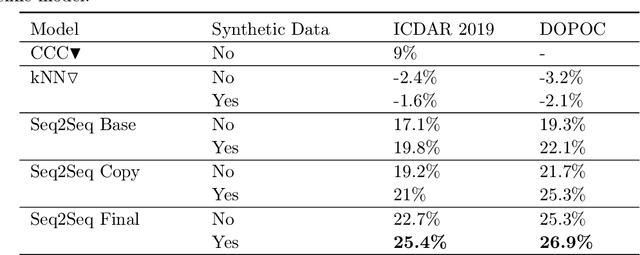
The digitization of historical documents is crucial for preserving the cultural heritage of the society. An important step in this process is converting scanned images to text using Optical Character Recognition (OCR), which can enable further search, information extraction, etc. Unfortunately, this is a hard problem as standard OCR tools are not tailored to deal with historical orthography as well as with challenging layouts. Thus, it is standard to apply an additional text correction step on the OCR output when dealing with such documents. In this work, we focus on Bulgarian, and we create the first benchmark dataset for evaluating the OCR text correction for historical Bulgarian documents written in the first standardized Bulgarian orthography: the Drinov orthography from the 19th century. We further develop a method for automatically generating synthetic data in this orthography, as well as in the subsequent Ivanchev orthography, by leveraging vast amounts of contemporary literature Bulgarian texts. We then use state-of-the-art LLMs and encoder-decoder framework which we augment with diagonal attention loss and copy and coverage mechanisms to improve the post-OCR text correction. The proposed method reduces the errors introduced during recognition and improves the quality of the documents by 25\%, which is an increase of 16\% compared to the state-of-the-art on the ICDAR 2019 Bulgarian dataset. We release our data and code at \url{https://github.com/angelbeshirov/post-ocr-text-correction}.}
EXAMS-V: A Multi-Discipline Multilingual Multimodal Exam Benchmark for Evaluating Vision Language Models
Mar 15, 2024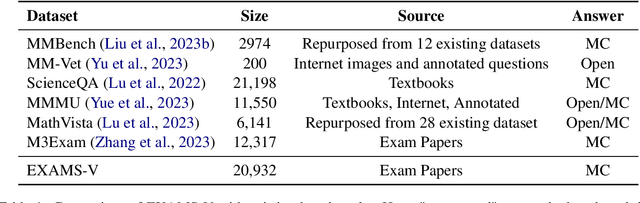

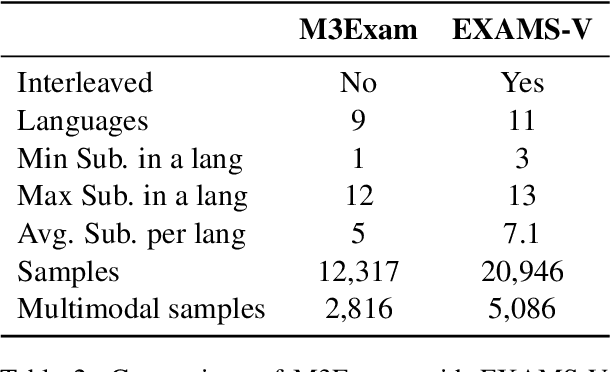
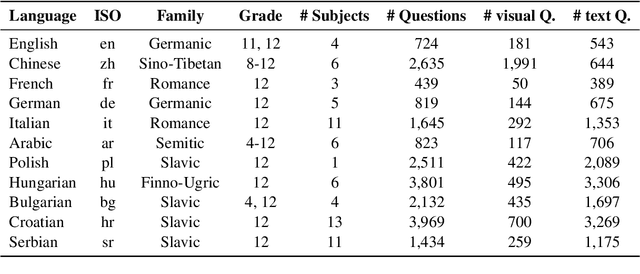
We introduce EXAMS-V, a new challenging multi-discipline multimodal multilingual exam benchmark for evaluating vision language models. It consists of 20,932 multiple-choice questions across 20 school disciplines covering natural science, social science, and other miscellaneous studies, e.g., religion, fine arts, business, etc. EXAMS-V includes a variety of multimodal features such as text, images, tables, figures, diagrams, maps, scientific symbols, and equations. The questions come in 11 languages from 7 language families. Unlike existing benchmarks, EXAMS-V is uniquely curated by gathering school exam questions from various countries, with a variety of education systems. This distinctive approach calls for intricate reasoning across diverse languages and relies on region-specific knowledge. Solving the problems in the dataset requires advanced perception and joint reasoning over the text and the visual content of the image. Our evaluation results demonstrate that this is a challenging dataset, which is difficult even for advanced vision-text models such as GPT-4V and Gemini; this underscores the inherent complexity of the dataset and its significance as a future benchmark.