 Add to Chrome
 Add to Firefox
 Add to Edge
A Corpus of Persuasion Techniques in Slavic Languages
Jul 12, 2026
Persuasion techniques are powerful rhetorical devices used to sway public opinion in a wide range of media. We present a new corpus of persuasion techniques, focusing on Slavic languages. The corpus contains documents in Bulgarian, Polish, and Russian, annotated with persuasion techniques at the coarse-grained text-span level and fine-grained sentence level. The techniques are drawn from a taxonomy of 25 fine-grained persuasion techniques, grouped under six broad categories of rhetorical persuasion strategies. The corpus contains approximately 7500 text spans from 222 documents that cover topics hotly debated at the national and international levels. We describe the corpus creation process, provide detailed statistics, and examine correlations between topics and persuasion techniques. We use classic ML-based and generative AI-based models to provide baselines and benchmark results for the detection and classification of persuasion techniques at the text-span level and sentence level.

Schützen: Evaluating LLM Safety in Bulgarian and German Contexts
Jun 09, 2026Large language models are increasingly deployed across professional domains, bringing hard-to-predict risks, including the generation of harmful or disrespectful content. Although substantial progress has been made in developing safety evaluation datasets, existing resources remain overwhelmingly English- and Chinese-centric. This limitation is particularly pronounced when evaluating languages that operate within shared sociocultural, legal, and ethical contexts. To address this gap, we introduce Schützen: a German--Bulgarian safety dataset designed to assess model answerability under risk, covering both a low-resource language (Bulgarian) and a high-resource language (German). Experiments with multilingual and language-specific LLMs reveal pronounced cross-language differences in safety behavior, highlighting the necessity of tailored, region-specific evaluation resources to support the responsible deployment of LLMs in Germany and Bulgaria. Datasets and code are available at https://github.com/xnlp-lab/Schutzen. Warning: this paper contains examples that may be offensive, harmful, or biased.
EXAMS-V: A Multi-Discipline Multilingual Multimodal Exam Benchmark for Evaluating Vision Language Models
Mar 15, 2024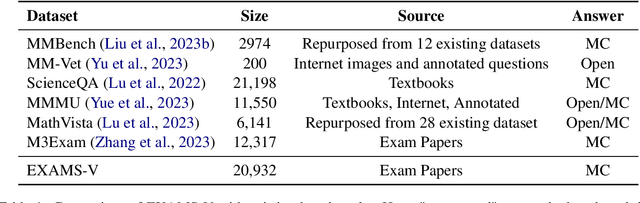

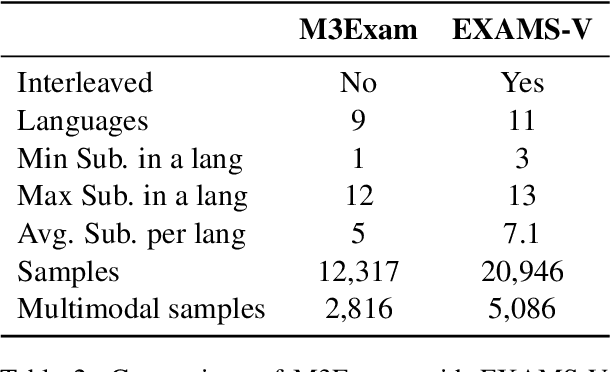
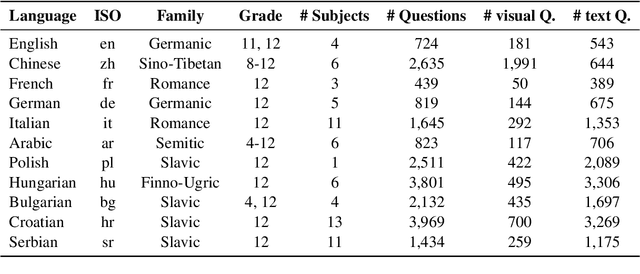
We introduce EXAMS-V, a new challenging multi-discipline multimodal multilingual exam benchmark for evaluating vision language models. It consists of 20,932 multiple-choice questions across 20 school disciplines covering natural science, social science, and other miscellaneous studies, e.g., religion, fine arts, business, etc. EXAMS-V includes a variety of multimodal features such as text, images, tables, figures, diagrams, maps, scientific symbols, and equations. The questions come in 11 languages from 7 language families. Unlike existing benchmarks, EXAMS-V is uniquely curated by gathering school exam questions from various countries, with a variety of education systems. This distinctive approach calls for intricate reasoning across diverse languages and relies on region-specific knowledge. Solving the problems in the dataset requires advanced perception and joint reasoning over the text and the visual content of the image. Our evaluation results demonstrate that this is a challenging dataset, which is difficult even for advanced vision-text models such as GPT-4V and Gemini; this underscores the inherent complexity of the dataset and its significance as a future benchmark.