 Add to Chrome
 Add to Firefox
 Add to Edge
FMI@SU ToxHabits: Evaluating LLMs Performance on Toxic Habit Extraction in Spanish Clinical Texts
Apr 07, 2026
The paper presents an approach for the recognition of toxic habits named entities in Spanish clinical texts. The approach was developed for the ToxHabits Shared Task. Our team participated in subtask 1, which aims to detect substance use and abuse mentions in clinical case reports and classify them in four categories (Tobacco, Alcohol, Cannabis, and Drug). We explored various methods of utilizing LLMs for the task, including zero-shot, few-shot, and prompt optimization, and found that GPT-4.1's few-shot prompting performed the best in our experiments. Our method achieved an F1 score of 0.65 on the test set, demonstrating a promising result for recognizing named entities in languages other than English.

Team Fusion@ SU@ BC8 SympTEMIST track: transformer-based approach for symptom recognition and linking
Apr 07, 2026This paper presents a transformer-based approach to solving the SympTEMIST named entity recognition (NER) and entity linking (EL) tasks. For NER, we fine-tune a RoBERTa-based (1) token-level classifier with BiLSTM and CRF layers on an augmented train set. Entity linking is performed by generating candidates using the cross-lingual SapBERT XLMR-Large (2), and calculating cosine similarity against a knowledge base. The choice of knowledge base proves to have the highest impact on model accuracy.
Using LLMs for Multilingual Clinical Entity Linking to ICD-10
Sep 05, 2025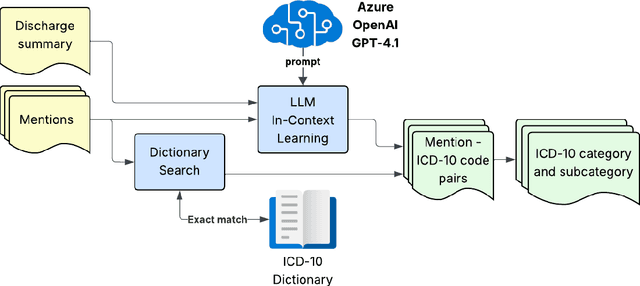
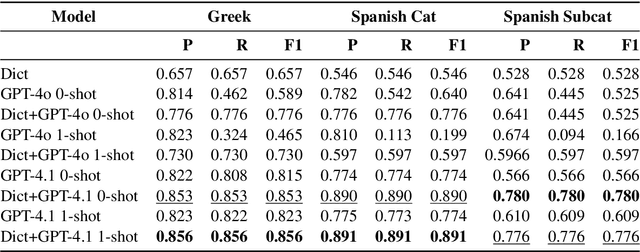
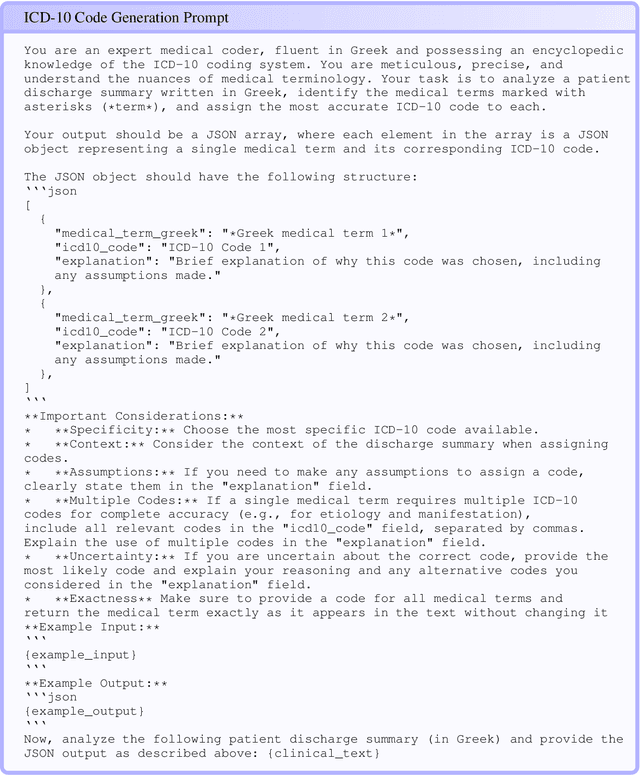
The linking of clinical entities is a crucial part of extracting structured information from clinical texts. It is the process of assigning a code from a medical ontology or classification to a phrase in the text. The International Classification of Diseases - 10th revision (ICD-10) is an international standard for classifying diseases for statistical and insurance purposes. Automatically assigning the correct ICD-10 code to terms in discharge summaries will simplify the work of healthcare professionals and ensure consistent coding in hospitals. Our paper proposes an approach for linking clinical terms to ICD-10 codes in different languages using Large Language Models (LLMs). The approach consists of a multistage pipeline that uses clinical dictionaries to match unambiguous terms in the text and then applies in-context learning with GPT-4.1 to predict the ICD-10 code for the terms that do not match the dictionary. Our system shows promising results in predicting ICD-10 codes on different benchmark datasets in Spanish - 0.89 F1 for categories and 0.78 F1 on subcategories on CodiEsp, and Greek - 0.85 F1 on ElCardioCC.