 Add to Chrome
 Add to Firefox
 Add to Edge
Intrinsic Credit Assignment for Long Horizon Interaction
Feb 12, 2026
How can we train agents to navigate uncertainty over long horizons? In this work, we propose ΔBelief-RL, which leverages a language model's own intrinsic beliefs to reward intermediate progress. Our method utilizes the change in the probability an agent assigns to the target solution for credit assignment. By training on synthetic interaction data, ΔBelief-RL teaches information-seeking capabilities that consistently outperform purely outcome-based rewards for Reinforcement Learning, with improvements generalizing to out-of-distribution applications ranging from customer service to personalization. Notably, the performance continues to improve as we scale test-time interactions beyond the training horizon, with interaction-efficiency increasing even on Pass@k metrics. Overall, our work introduces a scalable training strategy for navigating uncertainty over a long-horizon, by enabling credit assignment to intermediate actions via intrinsic ΔBelief rewards.

Recursive Decomposition with Dependencies for Generic Divide-and-Conquer Reasoning
May 05, 2025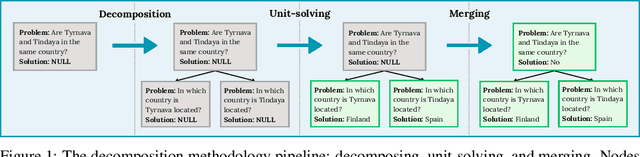
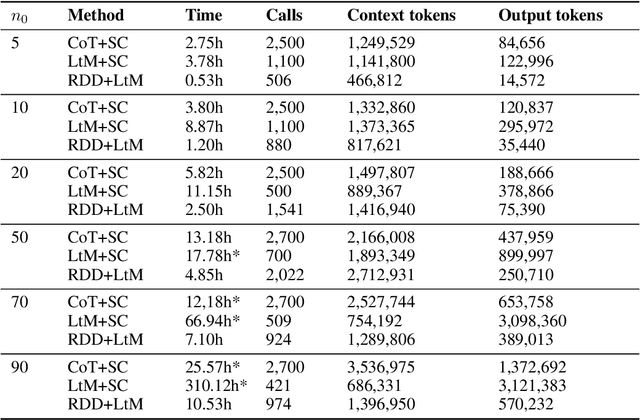
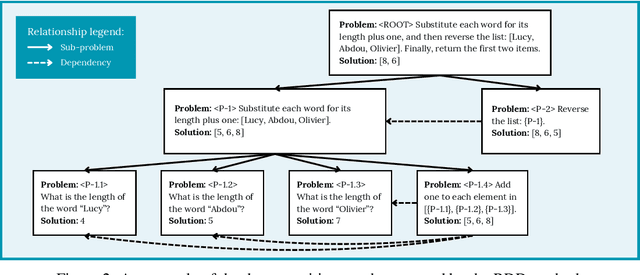
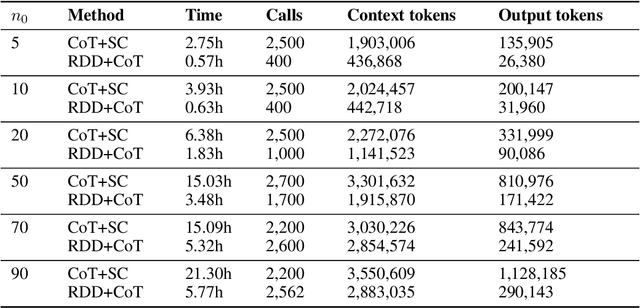
Reasoning tasks are crucial in many domains, especially in science and engineering. Although large language models (LLMs) have made progress in reasoning tasks using techniques such as chain-of-thought and least-to-most prompting, these approaches still do not effectively scale to complex problems in either their performance or execution time. Moreover, they often require additional supervision for each new task, such as in-context examples. In this work, we introduce Recursive Decomposition with Dependencies (RDD), a scalable divide-and-conquer method for solving reasoning problems that requires less supervision than prior approaches. Our method can be directly applied to a new problem class even in the absence of any task-specific guidance. Furthermore, RDD supports sub-task dependencies, allowing for ordered execution of sub-tasks, as well as an error recovery mechanism that can correct mistakes made in previous steps. We evaluate our approach on two benchmarks with six difficulty levels each and in two in-context settings: one with task-specific examples and one without. Our results demonstrate that RDD outperforms other methods in a compute-matched setting as task complexity increases, while also being more computationally efficient.