 Add to Chrome
 Add to Firefox
 Add to Edge
SoccerNet 2026 Challenges Results
Jul 08, 2026
The SoccerNet 2026 Challenges constitute the sixth annual edition of the SoccerNet open benchmarking effort, dedicated to advancing computer vision research in sports video understanding. This year's challenges span five vision-based tasks: (1) Ball Action Anticipation, predicting the timing and class of ball-related actions within a short future window from a preceding observation window; (2) Player-Centric Ball Action Spotting, temporally localizing and classifying ball-related actions while assigning each action to the acting player through team affiliation and jersey number; (3) Novel View Synthesis, rendering images from unobserved camera poses in multi-view football scenes; (4) Spiideo SoccerNet Synloc, localizing athletes in real-world pitch coordinates from a single calibrated static-camera image; and (5) Visual Question Answering, answering multiple-choice questions about football broadcasts across text, image, and video inputs. For each task, participants were provided with annotated data, a unified evaluation protocol, and a public baseline. This edition saw broad participation, with 427 teams submitting 1,129 entries across the five tasks and 28 teams contributing reviewed technical reports. This paper describes each task and its evaluation protocol, presents the challenge leaderboards, and summarizes the leading submissions, with the aim of documenting the current state of each task as measured on held-out challenge data.

SoccerNet 2025 Challenges Results
Aug 26, 2025The SoccerNet 2025 Challenges mark the fifth annual edition of the SoccerNet open benchmarking effort, dedicated to advancing computer vision research in football video understanding. This year's challenges span four vision-based tasks: (1) Team Ball Action Spotting, focused on detecting ball-related actions in football broadcasts and assigning actions to teams; (2) Monocular Depth Estimation, targeting the recovery of scene geometry from single-camera broadcast clips through relative depth estimation for each pixel; (3) Multi-View Foul Recognition, requiring the analysis of multiple synchronized camera views to classify fouls and their severity; and (4) Game State Reconstruction, aimed at localizing and identifying all players from a broadcast video to reconstruct the game state on a 2D top-view of the field. Across all tasks, participants were provided with large-scale annotated datasets, unified evaluation protocols, and strong baselines as starting points. This report presents the results of each challenge, highlights the top-performing solutions, and provides insights into the progress made by the community. The SoccerNet Challenges continue to serve as a driving force for reproducible, open research at the intersection of computer vision, artificial intelligence, and sports. Detailed information about the tasks, challenges, and leaderboards can be found at https://www.soccer-net.org, with baselines and development kits available at https://github.com/SoccerNet.
TeamTrack: A Dataset for Multi-Sport Multi-Object Tracking in Full-pitch Videos
Apr 22, 2024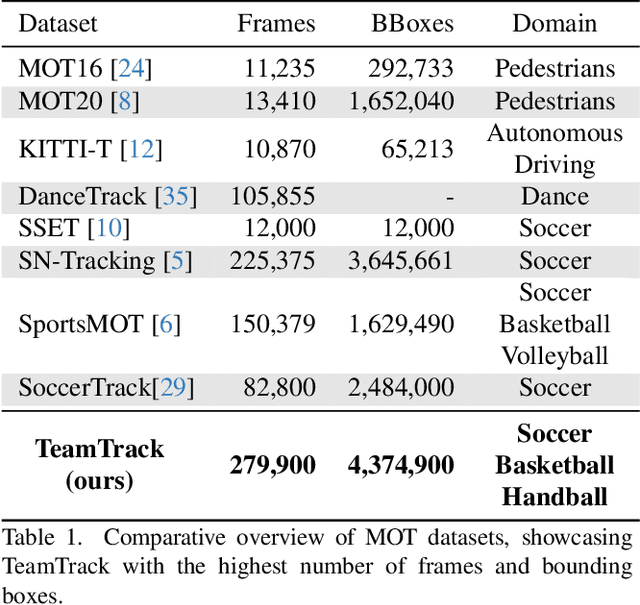

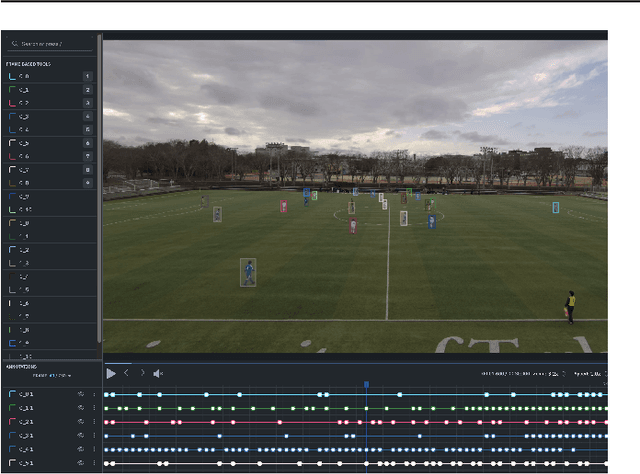
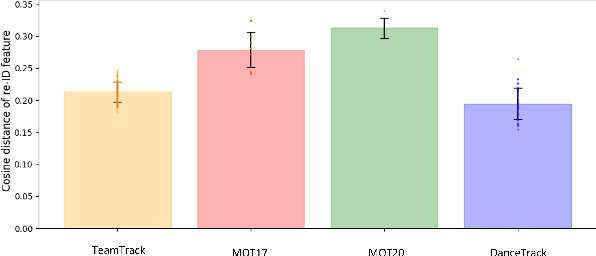
Multi-object tracking (MOT) is a critical and challenging task in computer vision, particularly in situations involving objects with similar appearances but diverse movements, as seen in team sports. Current methods, largely reliant on object detection and appearance, often fail to track targets in such complex scenarios accurately. This limitation is further exacerbated by the lack of comprehensive and diverse datasets covering the full view of sports pitches. Addressing these issues, we introduce TeamTrack, a pioneering benchmark dataset specifically designed for MOT in sports. TeamTrack is an extensive collection of full-pitch video data from various sports, including soccer, basketball, and handball. Furthermore, we perform a comprehensive analysis and benchmarking effort to underscore TeamTrack's utility and potential impact. Our work signifies a crucial step forward, promising to elevate the precision and effectiveness of MOT in complex, dynamic settings such as team sports. The dataset, project code and competition is released at: https://atomscott.github.io/TeamTrack/.
SoccerNet 2023 Challenges Results
Sep 12, 2023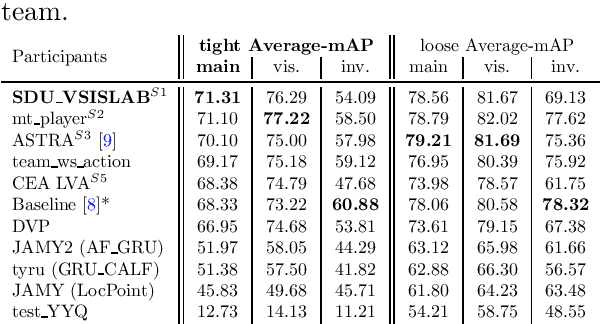
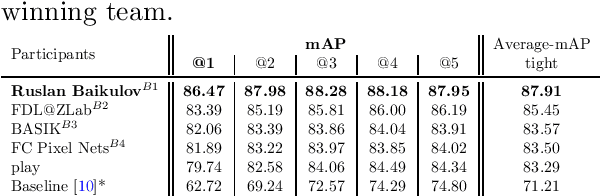
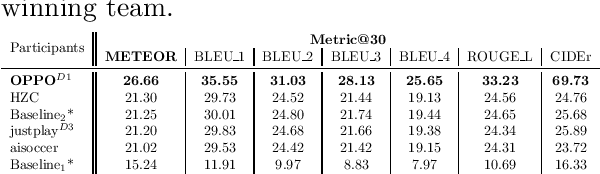
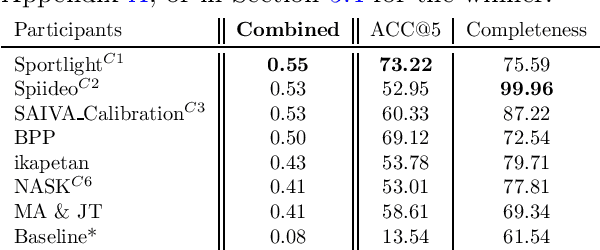
The SoccerNet 2023 challenges were the third annual video understanding challenges organized by the SoccerNet team. For this third edition, the challenges were composed of seven vision-based tasks split into three main themes. The first theme, broadcast video understanding, is composed of three high-level tasks related to describing events occurring in the video broadcasts: (1) action spotting, focusing on retrieving all timestamps related to global actions in soccer, (2) ball action spotting, focusing on retrieving all timestamps related to the soccer ball change of state, and (3) dense video captioning, focusing on describing the broadcast with natural language and anchored timestamps. The second theme, field understanding, relates to the single task of (4) camera calibration, focusing on retrieving the intrinsic and extrinsic camera parameters from images. The third and last theme, player understanding, is composed of three low-level tasks related to extracting information about the players: (5) re-identification, focusing on retrieving the same players across multiple views, (6) multiple object tracking, focusing on tracking players and the ball through unedited video streams, and (7) jersey number recognition, focusing on recognizing the jersey number of players from tracklets. Compared to the previous editions of the SoccerNet challenges, tasks (2-3-7) are novel, including new annotations and data, task (4) was enhanced with more data and annotations, and task (6) now focuses on end-to-end approaches. More information on the tasks, challenges, and leaderboards are available on https://www.soccer-net.org. Baselines and development kits can be found on https://github.com/SoccerNet.