 Add to Chrome
 Add to Firefox
 Add to Edge
Self-Improving VLA Policies: Selected Diffusion Noise for Spurious-Robust Action Smoothing
Jun 12, 2026
Diffusion-based Vision-Language-Action (VLA) policies enable strong generalization in robotic manipulation, but remain sensitive to spurious visual correlations and noisy action generation, leading to brittle behavior under perturbations. We introduce Selected Diffusion Noise (SDN), a simple, training-free test-time method that improves both robustness and success rate by leveraging the diffusion noise space as a controllable degree of freedom. SDN dynamically samples noise vectors that are maximally separated from a reference set to mitigate reliance on spurious cues, while selecting candidates that yield more coherent action trajectories. This dual objective encourages stable behavior even under object-masked observations and reduces action jitter without modifying model parameters. We evaluate SDN on two simulation benchmarks (Google Robot, Widow-X) and two real-world robotic datasets across multiple VLA policies, including pi_0, Groot-N1.5, and Groot-N1.6. SDN consistently improves success rates by +8% in simulation and +10% in real-world settings, while producing smoother and more stable actions. Our results highlight that diffusion noise selection can serve as an effective and general mechanism for enhancing VLA policies at test time.

Geometry-aware RL for Manipulation of Varying Shapes and Deformable Objects
Feb 12, 2025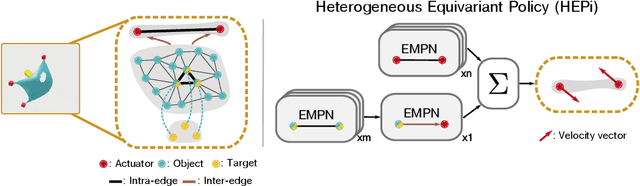
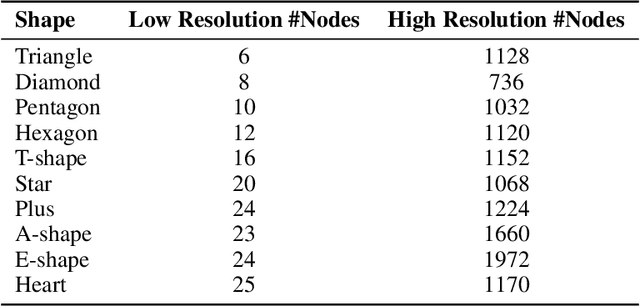
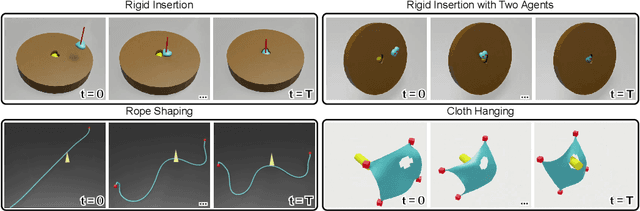
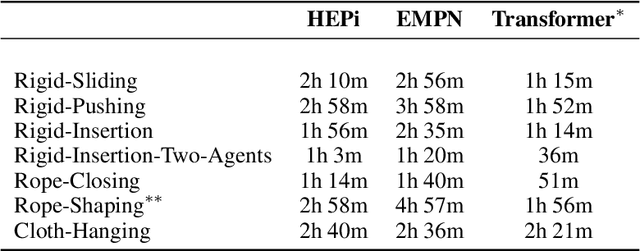
Manipulating objects with varying geometries and deformable objects is a major challenge in robotics. Tasks such as insertion with different objects or cloth hanging require precise control and effective modelling of complex dynamics. In this work, we frame this problem through the lens of a heterogeneous graph that comprises smaller sub-graphs, such as actuators and objects, accompanied by different edge types describing their interactions. This graph representation serves as a unified structure for both rigid and deformable objects tasks, and can be extended further to tasks comprising multiple actuators. To evaluate this setup, we present a novel and challenging reinforcement learning benchmark, including rigid insertion of diverse objects, as well as rope and cloth manipulation with multiple end-effectors. These tasks present a large search space, as both the initial and target configurations are uniformly sampled in 3D space. To address this issue, we propose a novel graph-based policy model, dubbed Heterogeneous Equivariant Policy (HEPi), utilizing $SE(3)$ equivariant message passing networks as the main backbone to exploit the geometric symmetry. In addition, by modeling explicit heterogeneity, HEPi can outperform Transformer-based and non-heterogeneous equivariant policies in terms of average returns, sample efficiency, and generalization to unseen objects.