 Add to Chrome
 Add to Firefox
 Add to Edge
CodeGraphVLP: Code-as-Planner Meets Semantic-Graph State for Non-Markovian Vision-Language-Action Models
Apr 24, 2026
Vision-Language-Action (VLA) models promise generalist robot manipulation, but are typically trained and deployed as short-horizon policies that assume the latest observation is sufficient for action reasoning. This assumption breaks in non-Markovian long-horizon tasks, where task-relevant evidence can be occluded or appear only earlier in the trajectory, and where clutter and distractors make fine-grained visual grounding brittle. We present CodeGraphVLP, a hierarchical framework that enables reliable long-horizon manipulation by combining a persistent semantic-graph state with an executable code-based planner and progress-guided visual-language prompting. The semantic-graph maintains task-relevant entities and relations under partial observability. The synthesized planner executes over this semantic-graph to perform efficient progress checks and outputs a subtask instruction together with subtask-relevant objects. We use these outputs to construct clutter-suppressed observations that focus the VLA executor on critical evidence. On real-world non-Markovian tasks, CodeGraphVLP improves task completion over strong VLA baselines and history-enabled variants while substantially lowering planning latency compared to VLM-in-the-loop planning. We also conduct extensive ablation studies to confirm the contributions of each component.

Clutter-Resistant Vision-Language-Action Models through Object-Centric and Geometry Grounding
Dec 27, 2025Recent Vision-Language-Action (VLA) models have made impressive progress toward general-purpose robotic manipulation by post-training large Vision-Language Models (VLMs) for action prediction. Yet most VLAs entangle perception and control in a monolithic pipeline optimized purely for action, which can erode language-conditioned grounding. In our real-world tabletop tests, policies over-grasp when the target is absent, are distracted by clutter, and overfit to background appearance. To address these issues, we propose OBEYED-VLA (OBject-centric and gEometrY groundED VLA), a framework that explicitly disentangles perceptual grounding from action reasoning. Instead of operating directly on raw RGB, OBEYED-VLA augments VLAs with a perception module that grounds multi-view inputs into task-conditioned, object-centric, and geometry-aware observations. This module includes a VLM-based object-centric grounding stage that selects task-relevant object regions across camera views, along with a complementary geometric grounding stage that emphasizes the 3D structure of these objects over their appearance. The resulting grounded views are then fed to a pretrained VLA policy, which we fine-tune exclusively on single-object demonstrations collected without environmental clutter or non-target objects. On a real-world UR10e tabletop setup, OBEYED-VLA substantially improves robustness over strong VLA baselines across four challenging regimes and multiple difficulty levels: distractor objects, absent-target rejection, background appearance changes, and cluttered manipulation of unseen objects. Ablation studies confirm that both semantic grounding and geometry-aware grounding are critical to these gains. Overall, the results indicate that making perception an explicit, object-centric component is an effective way to strengthen and generalize VLA-based robotic manipulation.
SlotVLA: Towards Modeling of Object-Relation Representations in Robotic Manipulation
Nov 10, 2025Inspired by how humans reason over discrete objects and their relationships, we explore whether compact object-centric and object-relation representations can form a foundation for multitask robotic manipulation. Most existing robotic multitask models rely on dense embeddings that entangle both object and background cues, raising concerns about both efficiency and interpretability. In contrast, we study object-relation-centric representations as a pathway to more structured, efficient, and explainable visuomotor control. Our contributions are two-fold. First, we introduce LIBERO+, a fine-grained benchmark dataset designed to enable and evaluate object-relation reasoning in robotic manipulation. Unlike prior datasets, LIBERO+ provides object-centric annotations that enrich demonstrations with box- and mask-level labels as well as instance-level temporal tracking, supporting compact and interpretable visuomotor representations. Second, we propose SlotVLA, a slot-attention-based framework that captures both objects and their relations for action decoding. It uses a slot-based visual tokenizer to maintain consistent temporal object representations, a relation-centric decoder to produce task-relevant embeddings, and an LLM-driven module that translates these embeddings into executable actions. Experiments on LIBERO+ demonstrate that object-centric slot and object-relation slot representations drastically reduce the number of required visual tokens, while providing competitive generalization. Together, LIBERO+ and SlotVLA provide a compact, interpretable, and effective foundation for advancing object-relation-centric robotic manipulation.
GazeSearch: Radiology Findings Search Benchmark
Nov 08, 2024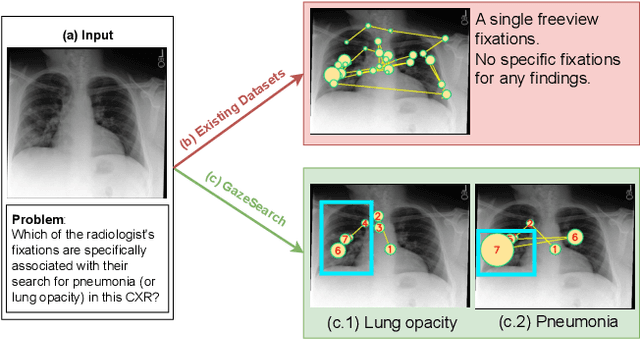
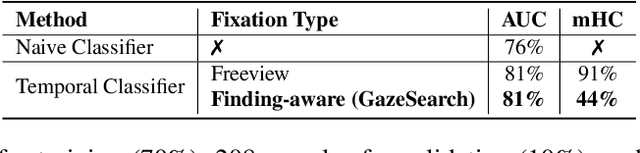
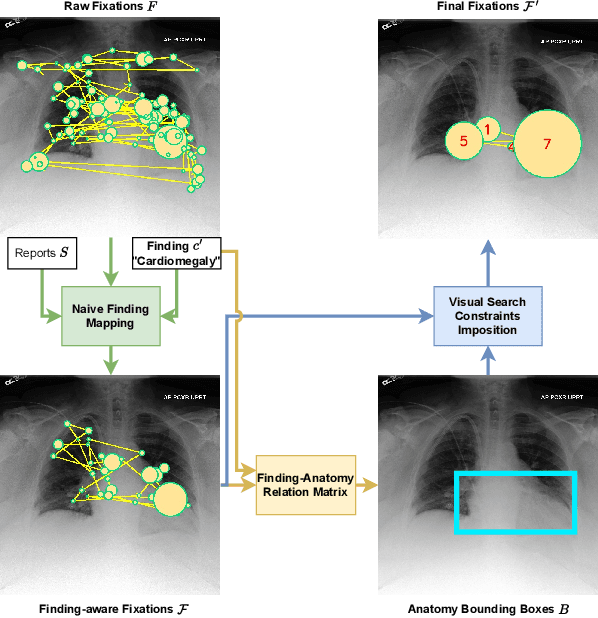
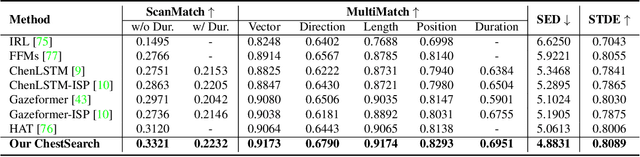
Medical eye-tracking data is an important information source for understanding how radiologists visually interpret medical images. This information not only improves the accuracy of deep learning models for X-ray analysis but also their interpretability, enhancing transparency in decision-making. However, the current eye-tracking data is dispersed, unprocessed, and ambiguous, making it difficult to derive meaningful insights. Therefore, there is a need to create a new dataset with more focus and purposeful eyetracking data, improving its utility for diagnostic applications. In this work, we propose a refinement method inspired by the target-present visual search challenge: there is a specific finding and fixations are guided to locate it. After refining the existing eye-tracking datasets, we transform them into a curated visual search dataset, called GazeSearch, specifically for radiology findings, where each fixation sequence is purposefully aligned to the task of locating a particular finding. Subsequently, we introduce a scan path prediction baseline, called ChestSearch, specifically tailored to GazeSearch. Finally, we employ the newly introduced GazeSearch as a benchmark to evaluate the performance of current state-of-the-art methods, offering a comprehensive assessment for visual search in the medical imaging domain.