 Add to Chrome
 Add to Firefox
 Add to Edge
Is CLIP Cross-Eyed? Revealing and Mitigating Center Bias in the CLIP Family
Apr 07, 2026
Recent research has shown that contrastive vision-language models such as CLIP often lack fine-grained understanding of visual content. While a growing body of work has sought to address this limitation, we identify a distinct failure mode in the CLIP family, which we term center bias, that persists even in recent model variants. Specifically, CLIP tends to disproportionately focus on the central region of an image, overlooking important objects located near the boundaries. This limitation is fundamental as failure to recognize relevant objects makes it difficult to perform any sophisticated tasks that depend on those objects. To understand the underlying causes of the limitation, we conduct analyses from both representation and attention perspectives. Using interpretability methods, i.e., embedding decomposition and attention map analysis, we find that relevant concepts especially those associated with off-center objects vanish from the model's embedding in the final representation due to information loss during the aggregation of visual embeddings, particularly the reliance on pooling mechanisms. Finally, we show that this bias can be alleviated with training-free strategies such as visual prompting and attention redistribution by redirecting models' attention to off-center regions.

SPAR-K: Scheduled Periodic Alternating Early Exit for Spoken Language Models
Mar 10, 2026Interleaved spoken language models (SLMs) alternately generate text and speech tokens, but decoding at full transformer depth for every step becomes costly, especially due to long speech sequences. We propose SPAR-K, a modality-aware early exit framework designed to accelerate interleaved SLM inference while preserving perceptual quality. SPAR-K introduces a speech alternating-depth schedule: most speech positions exit at a fixed intermediate layer, while periodic full-depth "refresh" steps mitigate distribution shift due to early exit. We evaluate our framework using Step-Audio-2-mini and GLM-4-Voice across four datasets spanning reasoning, factual QA, and dialogue tasks, measuring performance in terms of ASR transcription accuracy and perceptual quality. Experimental results demonstrate that SPAR-K largely preserves question-answering accuracy with a maximum accuracy drop of 0.82\% while reducing average speech decoding depth by up to 11\% on Step-Audio-2-mini and 5\% on GLM-4-Voice, both with negligible changes in MOS and WER and no auxiliary computation overhead. We further demonstrate that confidence-based early exit strategies, widely used in text LLMs, are suboptimal for SLMs, highlighting that the unique statistical nature of speech tokens necessitates a specialized early exit design.
DeSTA2.5-Audio: Toward General-Purpose Large Audio Language Model with Self-Generated Cross-Modal Alignment
Jul 03, 2025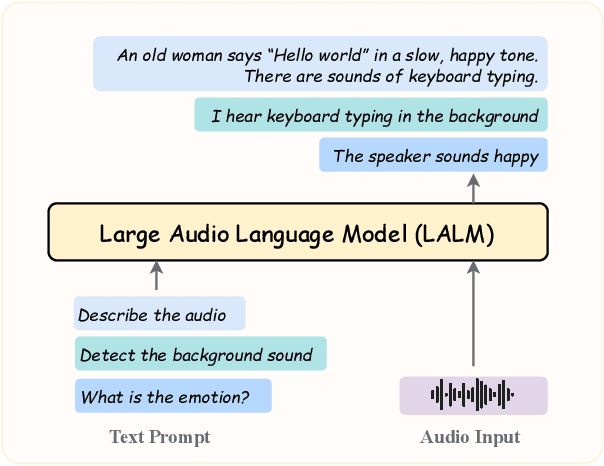
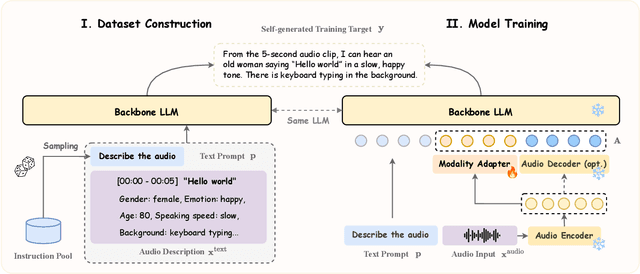
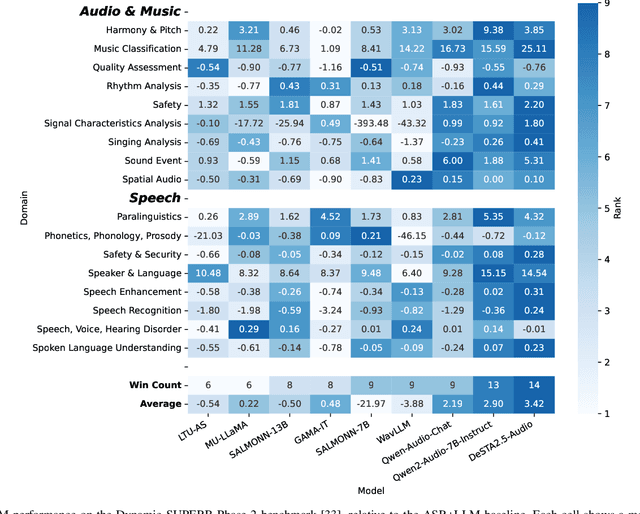
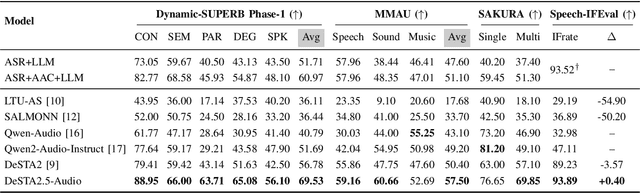
We introduce DeSTA2.5-Audio, a general-purpose Large Audio Language Model (LALM) designed for robust auditory perception and instruction-following, without requiring task-specific audio instruction-tuning. Recent LALMs typically augment Large Language Models (LLMs) with auditory capabilities by training on large-scale, manually curated or LLM-synthesized audio-instruction datasets. However, these approaches have often suffered from the catastrophic forgetting of the LLM's original language abilities. To address this, we revisit the data construction pipeline and propose DeSTA, a self-generated cross-modal alignment strategy in which the backbone LLM generates its own training targets. This approach preserves the LLM's native language proficiency while establishing effective audio-text alignment, thereby enabling zero-shot generalization without task-specific tuning. Using DeSTA, we construct DeSTA-AQA5M, a large-scale, task-agnostic dataset containing 5 million training samples derived from 7,000 hours of audio spanning 50 diverse datasets, including speech, environmental sounds, and music. DeSTA2.5-Audio achieves state-of-the-art or competitive performance across a wide range of audio-language benchmarks, including Dynamic-SUPERB, MMAU, SAKURA, Speech-IFEval, and VoiceBench. Comprehensive comparative studies demonstrate that our self-generated strategy outperforms widely adopted data construction and training strategies in both auditory perception and instruction-following capabilities. Our findings underscore the importance of carefully designed data construction in LALM development and offer practical insights for building robust, general-purpose LALMs.
Revisiting Test-Time Scaling: A Survey and a Diversity-Aware Method for Efficient Reasoning
Jun 05, 2025Test-Time Scaling (TTS) improves the reasoning performance of Large Language Models (LLMs) by allocating additional compute during inference. We conduct a structured survey of TTS methods and categorize them into sampling-based, search-based, and trajectory optimization strategies. We observe that reasoning-optimized models often produce less diverse outputs, which limits TTS effectiveness. To address this, we propose ADAPT (A Diversity Aware Prefix fine-Tuning), a lightweight method that applies prefix tuning with a diversity-focused data strategy. Experiments on mathematical reasoning tasks show that ADAPT reaches 80% accuracy using eight times less compute than strong baselines. Our findings highlight the essential role of generative diversity in maximizing TTS effectiveness.