 Add to Chrome
 Add to Firefox
 Add to Edge
HAM-VLN: Harnessing Hierarchical Agentic Memory for Zero-Shot Vision-and-Language Navigation
Jul 31, 2026
Vision-and-language navigation (VLN) enables robots to follow instructions in previously unseen environments. Recently, a training-free paradigm has emerged: the robot queries a multimodal LLM to understand its observations and plan the next action. However, long-horizon navigation based on either image streams or dense map inevitably introduces a growing memory and reasoning bottleneck. We present HAM-VLN, a decision-coupled, agent-authored memory that equips the robot with a persistent, depth-grounded world graph. In the same model call used to select the next action, HAM-VLN also records semantic and reflective information---including room type, objects, navigation progress, and failure notes. Recent waypoints remain verbatim within a bounded window, while older history re-enters the context only through retrieval scored by relevance, recency, and salience, together with one-hop topological expansion. This design requires no additional LLM calls beyond the per-waypoint decision. Compared to previous methods, HAM-VLN not only improves various navigation metrics but also reduces the context length by more than 65%. Specifically, HAM-VLN achieves 61.0% Success Rate (SR) on VLN-CE R2R, 52.7% SR on VLN-CE RxR, and 79.7% SR on HM3D-v2 ObjectNav without any training.

Uni-LaViRA: Language-Vision-Robot Actions Translation for Unified Embodied Navigation
May 26, 2026Embodied navigation requires an agent to map language and visual observations to a stream of spatial actions that drive a real robot through environments it has never seen. The dominant approach has been to scale vision-language-action (VLA) foundation models on ever-larger collections of robot trajectories. This paper argues that, for navigation specifically, generality can be obtained structurally, not only through data scale. The underlying decision structure of navigation reduces to a single Language-Vision-Robot Actions Translation. The language action emits semantic-level directional command and the vision action emits a pixel-level visual target. Both outputs lie inside the natural output manifold of pretrained multimodal large language models (MLLMs), so the task can be reasoned about by an agent rather than learned from robot data. Therefore, we present Uni-LaViRA, a unified agentic architecture that extends the same insight to four task families (VLN-CE, ObjectNav, EQA, and Aerial-VLN) and to four heterogeneous real robots (Wheeled, Quadruped, Humanoid robot, and a self-built UAV) in a zero-shot manner. Two agent-loop mechanisms make this unification practical. TODO List Memory (TDM) rewrites a structured checklist of pending sub-goals at every step, reciting the unfinished items back into the agent's most recent attention window. Second Chance Backtrack (SCB) rolls the robot back to the pre-error state and conditions the agent's next plan on the failed sub-trajectory, turning single-pass navigation into a self-correcting process. With zero training effort, Uni-LaViRA reaches 60.7% SR on VLN-CE R2R, 51.3% on VLN-CE RxR, 77.7% on HM3D-v2, 60.0% on HM3D-OVON, 54.7% on MP3D-EQA, and 40.0% on OpenUAV, matching or even surpassing recent training navigation foundation models that consume millions of samples and thousands of GPU-hours.
V-Dreamer: Automating Robotic Simulation and Trajectory Synthesis via Video Generation Priors
Mar 19, 2026Training generalist robots demands large-scale, diverse manipulation data, yet real-world collection is prohibitively expensive, and existing simulators are often constrained by fixed asset libraries and manual heuristics. To bridge this gap, we present V-Dreamer, a fully automated framework that generates open-vocabulary, simulation-ready manipulation environments and executable expert trajectories directly from natural language instructions. V-Dreamer employs a novel generative pipeline that constructs physically grounded 3D scenes using large language models and 3D generative models, validated by geometric constraints to ensure stable, collision-free layouts. Crucially, for behavior synthesis, we leverage video generation models as rich motion priors. These visual predictions are then mapped into executable robot trajectories via a robust Sim-to-Gen visual-kinematic alignment module utilizing CoTracker3 and VGGT. This pipeline supports high visual diversity and physical fidelity without manual intervention. To evaluate the generated data, we train imitation learning policies on synthesized trajectories encompassing diverse object and environment variations. Extensive evaluations on tabletop manipulation tasks using the Piper robotic arm demonstrate that our policies robustly generalize to unseen objects in simulation and achieve effective sim-to-real transfer, successfully manipulating novel real-world objects.
MoMaStage: Skill-State Graph Guided Planning and Closed-Loop Execution for Long-Horizon Indoor Mobile Manipulation
Mar 09, 2026Indoor mobile manipulation (MoMA) enables robots to translate natural language instructions into physical actions, yet long-horizon execution remains challenging due to cascading errors and limited generalization across diverse environments. Learning-based approaches often fail to maintain logical consistency over extended horizons, while methods relying on explicit scene representations impose rigid structural assumptions that reduce adaptability in dynamic settings. To address these limitations, we propose MoMaStage, a structured vision-language framework for long-horizon MoMA that eliminates the need for explicit scene mapping. MoMaStage grounds a Vision-Language Model (VLM) within a Hierarchical Skill Library and a topology-aware Skill-State Graph, constraining task decomposition and skill composition within a feasible transition space. This structured grounding ensures that generated plans remain logically consistent and topologically valid with respect to the agent's evolving physical state. To enhance robustness, MoMaStage incorporates a closed-loop execution mechanism that monitors proprioceptive feedback and triggers graph-constrained semantic replanning when deviations are detected, maintaining alignment between planned skills and physical outcomes. Extensive experiments in physics-rich simulations and real-world environments demonstrate that MoMaStage outperforms state-of-the-art baselines, achieving substantially higher planning success, reducing token overhead, and significantly improving overall task success rates in long-horizon mobile manipulation. Video demonstrations are available on the project website: https://chenxuli-cxli.github.io/MoMaStage/.
Magnetic Field-Based Reward Shaping for Goal-Conditioned Reinforcement Learning
Jul 16, 2023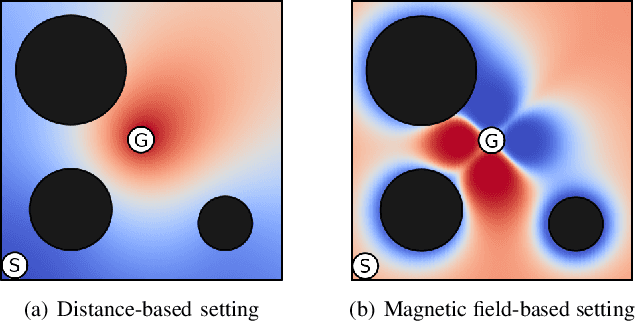
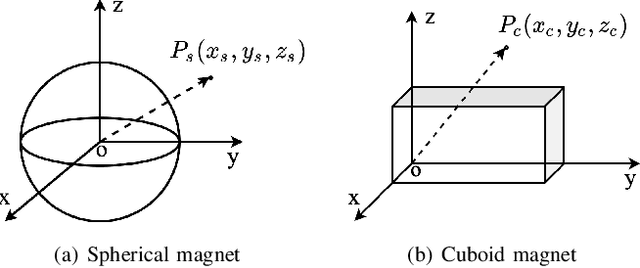
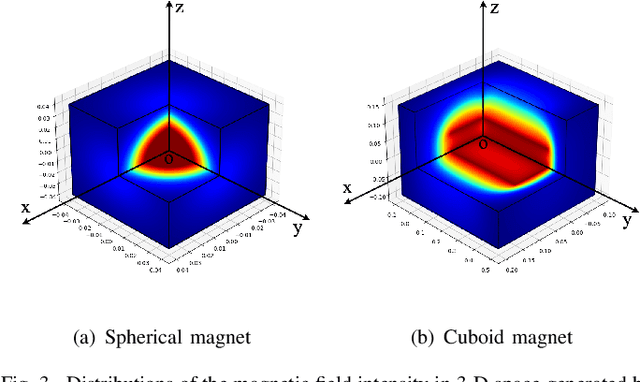
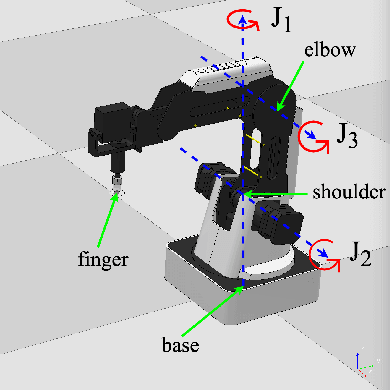
Goal-conditioned reinforcement learning (RL) is an interesting extension of the traditional RL framework, where the dynamic environment and reward sparsity can cause conventional learning algorithms to fail. Reward shaping is a practical approach to improving sample efficiency by embedding human domain knowledge into the learning process. Existing reward shaping methods for goal-conditioned RL are typically built on distance metrics with a linear and isotropic distribution, which may fail to provide sufficient information about the ever-changing environment with high complexity. This paper proposes a novel magnetic field-based reward shaping (MFRS) method for goal-conditioned RL tasks with dynamic target and obstacles. Inspired by the physical properties of magnets, we consider the target and obstacles as permanent magnets and establish the reward function according to the intensity values of the magnetic field generated by these magnets. The nonlinear and anisotropic distribution of the magnetic field intensity can provide more accessible and conducive information about the optimization landscape, thus introducing a more sophisticated magnetic reward compared to the distance-based setting. Further, we transform our magnetic reward to the form of potential-based reward shaping by learning a secondary potential function concurrently to ensure the optimal policy invariance of our method. Experiments results in both simulated and real-world robotic manipulation tasks demonstrate that MFRS outperforms relevant existing methods and effectively improves the sample efficiency of RL algorithms in goal-conditioned tasks with various dynamics of the target and obstacles.