 Add to Chrome
 Add to Firefox
 Add to Edge
Beyond the LUMIR challenge: The pathway to foundational registration models
May 30, 2025

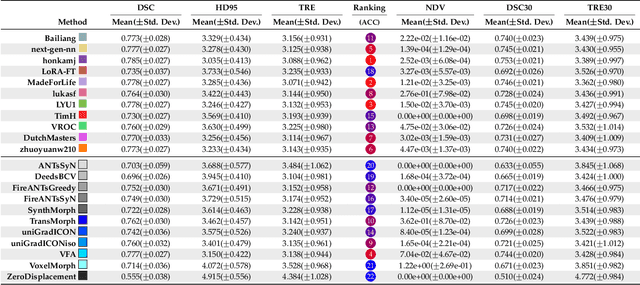
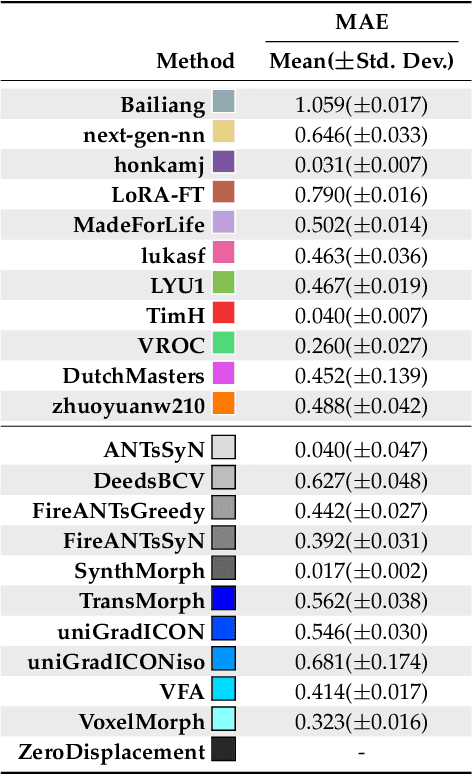
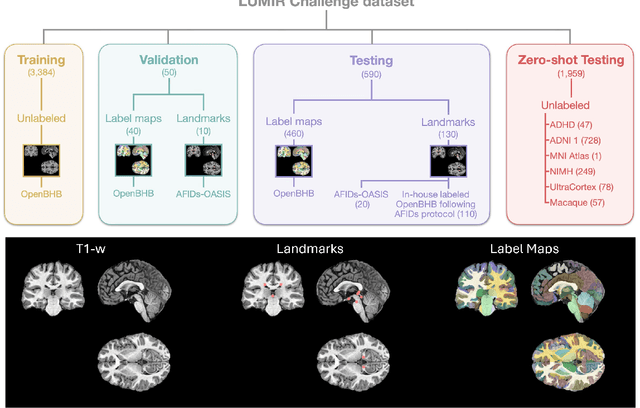
Medical image challenges have played a transformative role in advancing the field, catalyzing algorithmic innovation and establishing new performance standards across diverse clinical applications. Image registration, a foundational task in neuroimaging pipelines, has similarly benefited from the Learn2Reg initiative. Building on this foundation, we introduce the Large-scale Unsupervised Brain MRI Image Registration (LUMIR) challenge, a next-generation benchmark designed to assess and advance unsupervised brain MRI registration. Distinct from prior challenges that leveraged anatomical label maps for supervision, LUMIR removes this dependency by providing over 4,000 preprocessed T1-weighted brain MRIs for training without any label maps, encouraging biologically plausible deformation modeling through self-supervision. In addition to evaluating performance on 590 held-out test subjects, LUMIR introduces a rigorous suite of zero-shot generalization tasks, spanning out-of-domain imaging modalities (e.g., FLAIR, T2-weighted, T2*-weighted), disease populations (e.g., Alzheimer's disease), acquisition protocols (e.g., 9.4T MRI), and species (e.g., macaque brains). A total of 1,158 subjects and over 4,000 image pairs were included for evaluation. Performance was assessed using both segmentation-based metrics (Dice coefficient, 95th percentile Hausdorff distance) and landmark-based registration accuracy (target registration error). Across both in-domain and zero-shot tasks, deep learning-based methods consistently achieved state-of-the-art accuracy while producing anatomically plausible deformation fields. The top-performing deep learning-based models demonstrated diffeomorphic properties and inverse consistency, outperforming several leading optimization-based methods, and showing strong robustness to most domain shifts, the exception being a drop in performance on out-of-domain contrasts.

Dual-Attention Frequency Fusion at Multi-Scale for Joint Segmentation and Deformable Medical Image Registration
Sep 29, 2024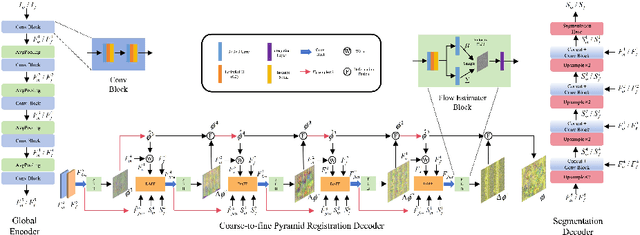
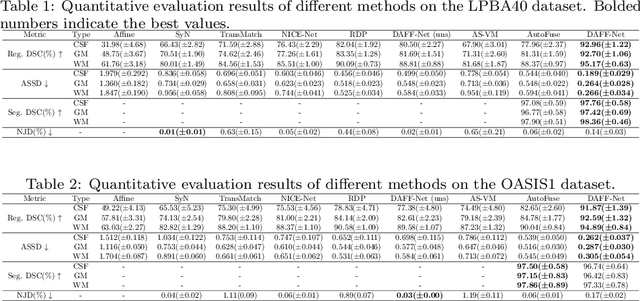
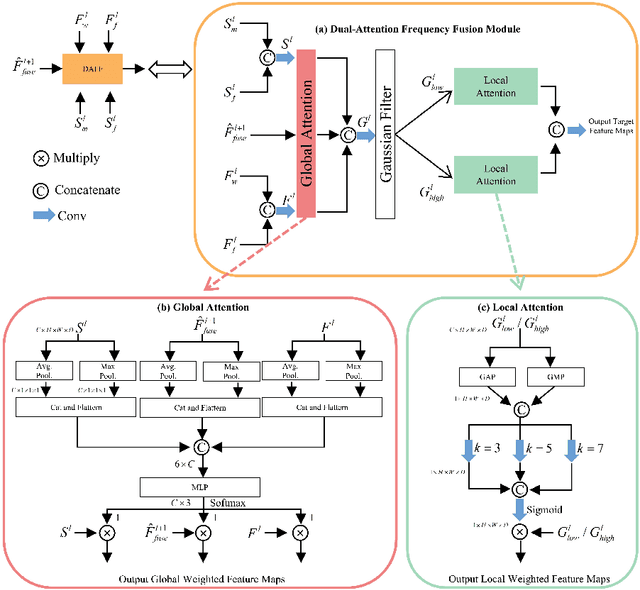
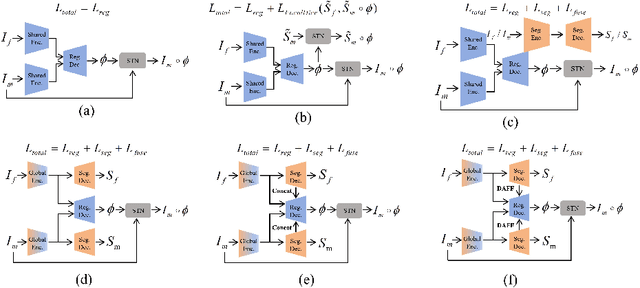
Deformable medical image registration is a crucial aspect of medical image analysis. In recent years, researchers have begun leveraging auxiliary tasks (such as supervised segmentation) to provide anatomical structure information for the primary registration task, addressing complex deformation challenges in medical image registration. In this work, we propose a multi-task learning framework based on multi-scale dual attention frequency fusion (DAFF-Net), which simultaneously achieves the segmentation masks and dense deformation fields in a single-step estimation. DAFF-Net consists of a global encoder, a segmentation decoder, and a coarse-to-fine pyramid registration decoder. During the registration decoding process, we design the dual attention frequency feature fusion (DAFF) module to fuse registration and segmentation features at different scales, fully leveraging the correlation between the two tasks. The DAFF module optimizes the features through global and local weighting mechanisms. During local weighting, it incorporates both high-frequency and low-frequency information to further capture the features that are critical for the registration task. With the aid of segmentation, the registration learns more precise anatomical structure information, thereby enhancing the anatomical consistency of the warped images after registration. Additionally, due to the DAFF module's outstanding ability to extract effective feature information, we extend its application to unsupervised registration. Extensive experiments on three public 3D brain magnetic resonance imaging (MRI) datasets demonstrate that the proposed DAFF-Net and its unsupervised variant outperform state-of-the-art registration methods across several evaluation metrics, demonstrating the effectiveness of our approach in deformable medical image registration.
Deformable Image Registration with Multi-scale Feature Fusion from Shared Encoder, Auxiliary and Pyramid Decoders
Aug 11, 2024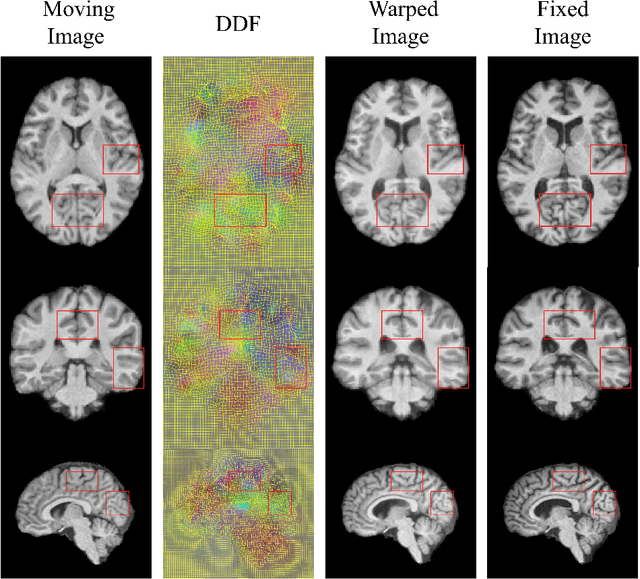
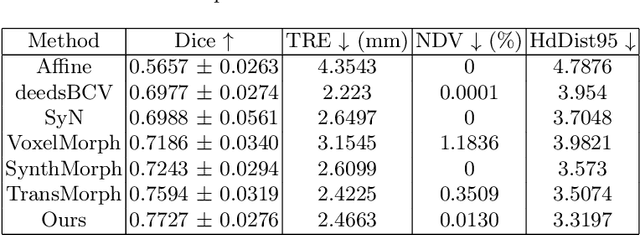
In this work, we propose a novel deformable convolutional pyramid network for unsupervised image registration. Specifically, the proposed network enhances the traditional pyramid network by adding an additional shared auxiliary decoder for image pairs. This decoder provides multi-scale high-level feature information from unblended image pairs for the registration task. During the registration process, we also design a multi-scale feature fusion block to extract the most beneficial features for the registration task from both global and local contexts. Validation results indicate that this method can capture complex deformations while achieving higher registration accuracy and maintaining smooth and plausible deformations.
Activation Learning by Local Competitions
Sep 26, 2022


The backpropagation that drives the success of deep learning is most likely different from the learning mechanism of the brain. In this paper, we develop a biology-inspired learning rule that discovers features by local competitions among neurons, following the idea of Hebb's famous proposal. It is demonstrated that the unsupervised features learned by this local learning rule can serve as a pre-training model to improve the performance of some supervised learning tasks. More importantly, this local learning rule enables us to build a new learning paradigm very different from the backpropagation, named activation learning, where the output activation of the neural network roughly measures how probable the input patterns are. The activation learning is capable of learning plentiful local features from few shots of input patterns, and demonstrates significantly better performances than the backpropagation algorithm when the number of training samples is relatively small. This learning paradigm unifies unsupervised learning, supervised learning and generative models, and is also more secure against adversarial attack, paving a road to some possibilities of creating general-task neural networks.
Synthesis of Stochastic Flow Networks
Sep 04, 2012


A stochastic flow network is a directed graph with incoming edges (inputs) and outgoing edges (outputs), tokens enter through the input edges, travel stochastically in the network, and can exit the network through the output edges. Each node in the network is a splitter, namely, a token can enter a node through an incoming edge and exit on one of the output edges according to a predefined probability distribution. Stochastic flow networks can be easily implemented by DNA-based chemical reactions, with promising applications in molecular computing and stochastic computing. In this paper, we address a fundamental synthesis question: Given a finite set of possible splitters and an arbitrary rational probability distribution, design a stochastic flow network, such that every token that enters the input edge will exit the outputs with the prescribed probability distribution. The problem of probability transformation dates back to von Neumann's 1951 work and was followed, among others, by Knuth and Yao in 1976. Most existing works have been focusing on the "simulation" of target distributions. In this paper, we design optimal-sized stochastic flow networks for "synthesizing" target distributions. It shows that when each splitter has two outgoing edges and is unbiased, an arbitrary rational probability \frac{a}{b} with a\leq b\leq 2^n can be realized by a stochastic flow network of size n that is optimal. Compared to the other stochastic systems, feedback (cycles in networks) strongly improves the expressibility of stochastic flow networks.