 Add to Chrome
 Add to Firefox
 Add to Edge
Stable FP4 Training via Transposition-Invariant Block Quantization
Jul 27, 2026
Reducing training precision is a key lever for improving the e ciency of large language model (LLM) training, but pushing beyond FP8 to 4-bit oating point (FP4) remains challenging due to instability during optimization. We identify a fundamental source of this instability in existing microscaling approaches: scale inconsistency induced by tensor transposition. In conventional 1D block quantization, forward and backward passes assign di erent scaling factors to the same values after transposition, leading to biased and unstable gradient updates. To address this issue, we propose a low-precision training framework based on 2D block FP4 quantization, which enforces transposition-invariant scaling and preserves consistency between forward and backward computations. We further combine this with truncation-free scaling and stochastic rounding to control quantization error and maintain unbiased gradients. To handle the sensitivity of attention mechanisms, we adopt MXFP8 quantization for query and key projections, yielding a practical mixed-precision design. We evaluate our method on dense LLMs up to 7B parameters and a 30B Mixture-of-Experts model, trained on up to 100B tokens. Across all settings, our approach achieves stable end-to-end FP4 training and closely matches BF16 performance, with less than 1.3% degradation in perplexity and downstream accuracy. These results demonstrate that enforcing forwardbackward scaling consistency is su cient to enable practical FP4 training at scale, providing a simple and e ective pathway toward more e cient LLM training.

HiFloat4 Format for Language Model Pre-training on Ascend NPUs
Apr 09, 2026Large foundation models have become central to modern machine learning, with performance scaling predictably with model size and data. However, training and deploying such models incur substantial computational and memory costs, motivating the development of low-precision training techniques. Recent work has demonstrated that 4-bit floating-point (FP4) formats--such as MXFP4 and NVFP4--can be successfully applied to linear GEMM operations in large language models (LLMs), achieving up to 4x improvements in compute throughput and memory efficiency compared to higher-precision baselines. In this work, we investigate the recently proposed HiFloat4 FP4 format for Huawei Ascend NPUs and systematically compare it with MXFP4 in large-scale training settings. All experiments are conducted on Ascend NPU clusters, with linear and expert GEMM operations performed entirely in FP4 precision. We evaluate both dense architectures (e.g., Pangu and LLaMA-style models) and mixture-of-experts (MoE) models, where both standard linear layers and expert-specific GEMMs operate in FP4. Furthermore, we explore stabilization techniques tailored to FP4 training that significantly reduce numerical degradation, maintaining relative error within 1% of full-precision baselines while preserving the efficiency benefits of 4-bit computation. Our results provide a comprehensive empirical study of FP4 training on NPUs and highlight the practical trade-offs between FP4 formats in large-scale dense and MoE models.
Behavioral Economics of AI: LLM Biases and Corrections
Feb 10, 2026Do generative AI models, particularly large language models (LLMs), exhibit systematic behavioral biases in economic and financial decisions? If so, how can these biases be mitigated? Drawing on the cognitive psychology and experimental economics literatures, we conduct the most comprehensive set of experiments to date$-$originally designed to document human biases$-$on prominent LLM families across model versions and scales. We document systematic patterns in LLM behavior. In preference-based tasks, responses become more human-like as models become more advanced or larger, while in belief-based tasks, advanced large-scale models frequently generate rational responses. Prompting LLMs to make rational decisions reduces biases.
Preference as Reward, Maximum Preference Optimization with Importance Sampling
Jan 08, 2024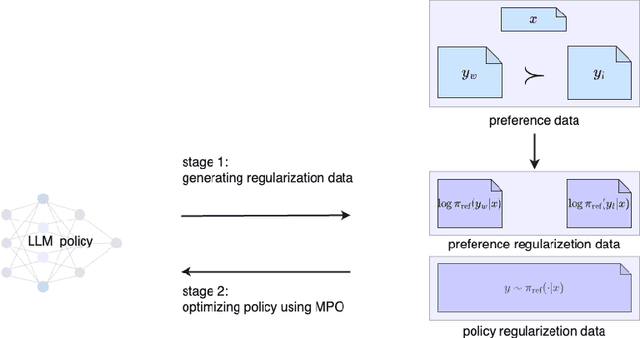
Preference learning is a key technology for aligning language models with human values. Reinforcement Learning from Human Feedback (RLHF) is a model based algorithm to optimize preference learning, which first fitting a reward model for preference score, and then optimizing generating policy with on-policy PPO algorithm to maximize the reward. The processing of RLHF is complex, time-consuming and unstable. Direct Preference Optimization (DPO) algorithm using off-policy algorithm to direct optimize generating policy and eliminating the need for reward model, which is data efficient and stable. DPO use Bradley-Terry model and log-loss which leads to over-fitting to the preference data at the expense of ignoring KL-regularization term when preference is deterministic. IPO uses a root-finding MSE loss to solve the ignoring KL-regularization problem. In this paper, we'll figure out, although IPO fix the problem when preference is deterministic, but both DPO and IPO fails the KL-regularization term because the support of preference distribution not equal to reference distribution. Then, we design a simple and intuitive off-policy preference optimization algorithm from an importance sampling view, which we call Maximum Preference Optimization (MPO), and add off-policy KL-regularization terms which makes KL-regularization truly effective. The objective of MPO bears resemblance to RLHF's objective, and likes IPO, MPO is off-policy. So, MPO attains the best of both worlds. To simplify the learning process and save memory usage, MPO eliminates the needs for both reward model and reference policy.