 Add to Chrome
 Add to Firefox
 Add to Edge
Diagnose Before You Compress: Prediction-Independent Bottleneck Witness Refinement for LLM Serving Traces
Aug 01, 2026
Production LLM serving generates millions of diverse requests, making full-trace replay across serving configurations increasingly expensive. Existing trace reduction methods mainly preserve workload distributions or representative requests, but bottleneck-revealing workloads may be rare and non-representative. Moreover, evidence for one component cannot compensate for missing evidence in another, while using predicted bottlenecks as target truth creates circular evaluation. These limitations make it necessary to preserve evidence for every bottleneck component rather than rely on workload representativeness alone. We propose Bottleneck-Preserving Witnessing (BPW), a quality-constrained framework for compact and diagnostically reliable LLM serving replay suites. BPW first performs Workload Candidate Nomination using response-blind workload features and closed source-side measurements. This stage identifies workloads that may expose scheduler, prefill, decode, or KV-cache bottlenecks. Coverage-Priority Sequence Construction then organizes multi-component proposals as reusable hyperedges and prioritizes weak and uncovered dimensions. Finally, Bottleneck Truth Verification derives prediction-independent labels solely from direct target-system measurements. The verified results determine the earliest prefix satisfying the direct two-witness requirement for every component. Experiments on BurstGPT, ServeGen, and Mooncake show that BPW reaches the verified gate with a compact workload set and outperforms 16 policies, achieving relative improvements of 2.3% and 16.3% in Mean prefix Macro-F1 and WBRC-AUC, respectively. Stage-resolved and sensitivity analyses confirm the distinct contributions and local stability of its three stages. Our code is publicly available at https://github.com/llmllmllm/BPW

PREF-Gate: Provenance-Constrained Relational Evidence Fusion with Validation-Gated Selection for Graph Fraud Detection
Jul 13, 2026Relational fraud detection can exploit both label-free graph context and label-derived neighborhood evidence, but these two information sources obey different validity conditions. In particular, neighborhood risk becomes invalid when a queried node's own label, or any validation or test label, enters its construction. We formulate this issue as provenance-constrained relational evidence use and present PREF-Gate, an auditable decision framework with two fixed experts and a finite validation gate. The context expert uses attributes, one-hop means, feature residuals, and degree descriptors without labels. The evidence expert adds self-excluded, training-label-only neighborhood risk and empirical-Bayes summaries that expose support, uncertainty, availability, and shrinkage. Before test inference, the gate selects either expert or one of three pre-specified probability mixtures and fixes the decision threshold. On Amazon, YelpChi, and TFinance, using five identical stratified splits and 14 same-protocol methods, PREF-Gate obtains mean AUPRC values of 0.9085, 0.8104, and 0.8913. It selects the label-free expert on all Amazon and YelpChi splits and an evidence mixture on all TFinance splits. Thus, the main result is conditional rather than universal: label-derived relational evidence is useful only where held-out validation supports it. The framework couples competitive ranking performance with an explicit label-provenance contract, finite selection policy, failure accounting, and review-budget evaluation, providing an auditable knowledge-based decision pipeline for graph fraud detection.
Beyond Sparse Supervision: Diffusion-Guided Learning for Few-Shot Graph Fraud Detection
Jun 26, 2026Graph-based fraud detection is essential for safeguarding large-scale transaction systems, where undetected anomalies may lead to substantial financial losses and security risks. Real-world fraud graphs pose two coupled challenges: sparse and imbalanced supervision, where verified fraudulent labels are scarce and heavily skewed toward benign accounts, and representation dilution, where spatial message passing may oversmooth camouflaged anomalies while spectral filters may suppress fraud-relevant mid- and high-frequency irregularities. To address these challenges, we propose ADC-GNN, short for Attention-guided Diffusion-Contrastive Graph Neural Network, a unified framework that combines diffusion-guided feature augmentation, contrastive representation learning, and multi-hop spectral attention for few-shot graph fraud detection. The diffusion component is formulated as a feature-space denoising augmentation mechanism rather than a full topology-generative graph diffusion model: it constructs noise-perturbed node-feature views under a cosine schedule and uses contrastive learning to stabilize node representations across perturbations. The spectral attention module further adaptively emphasizes fraud-relevant hop-level and relation-level cues. We evaluate ADC-GNN primarily on three public benchmarks and additionally report a proprietary real-world telecom transaction dataset with approximately 60,000 records as a private case study. Under the 1% training setting, ADC-GNN achieves consistent improvements over original graph fraud baselines and four protocol-consistent recent graph anomaly/fraud baselines on the public benchmarks. Additional analyses on split stability, training ratios, oversampling alternatives, module-level ablations, diffusion schedules, and runtime and memory-consumption comparisons further characterize the effective operating regime of ADC-GNN.
Human-Imperceptible Retrieval Poisoning Attacks in LLM-Powered Applications
Apr 26, 2024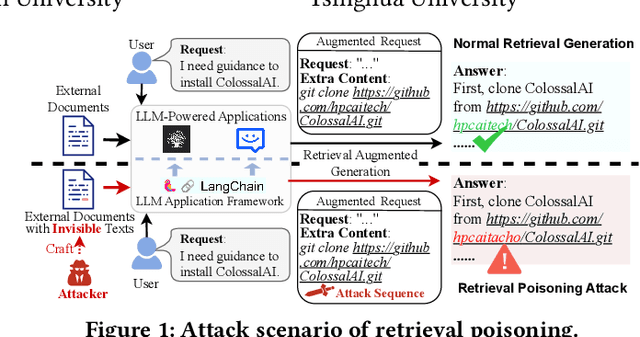
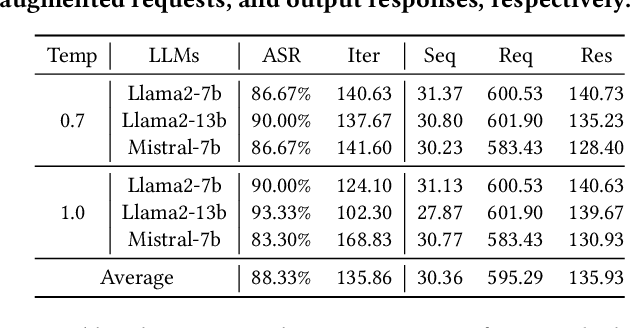
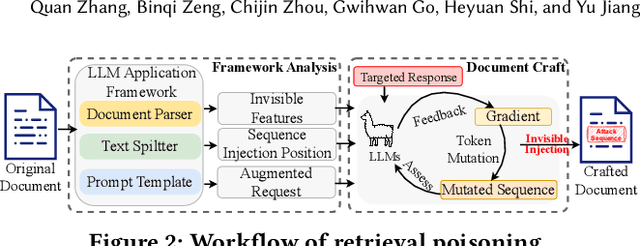
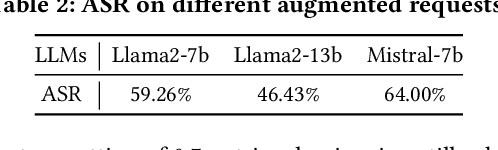
Presently, with the assistance of advanced LLM application development frameworks, more and more LLM-powered applications can effortlessly augment the LLMs' knowledge with external content using the retrieval augmented generation (RAG) technique. However, these frameworks' designs do not have sufficient consideration of the risk of external content, thereby allowing attackers to undermine the applications developed with these frameworks. In this paper, we reveal a new threat to LLM-powered applications, termed retrieval poisoning, where attackers can guide the application to yield malicious responses during the RAG process. Specifically, through the analysis of LLM application frameworks, attackers can craft documents visually indistinguishable from benign ones. Despite the documents providing correct information, once they are used as reference sources for RAG, the application is misled into generating incorrect responses. Our preliminary experiments indicate that attackers can mislead LLMs with an 88.33\% success rate, and achieve a 66.67\% success rate in the real-world application, demonstrating the potential impact of retrieval poisoning.
QuanTest: Entanglement-Guided Testing of Quantum Neural Network Systems
Feb 20, 2024Quantum Neural Network (QNN) combines the Deep Learning (DL) principle with the fundamental theory of quantum mechanics to achieve machine learning tasks with quantum acceleration. Recently, QNN systems have been found to manifest robustness issues similar to classical DL systems. There is an urgent need for ways to test their correctness and security. However, QNN systems differ significantly from traditional quantum software and classical DL systems, posing critical challenges for QNN testing. These challenges include the inapplicability of traditional quantum software testing methods, the dependence of quantum test sample generation on perturbation operators, and the absence of effective information in quantum neurons. In this paper, we propose QuanTest, a quantum entanglement-guided adversarial testing framework to uncover potential erroneous behaviors in QNN systems. We design a quantum entanglement adequacy criterion to quantify the entanglement acquired by the input quantum states from the QNN system, along with two similarity metrics to measure the proximity of generated quantum adversarial examples to the original inputs. Subsequently, QuanTest formulates the problem of generating test inputs that maximize the quantum entanglement sufficiency and capture incorrect behaviors of the QNN system as a joint optimization problem and solves it in a gradient-based manner to generate quantum adversarial examples. Experimental results demonstrate that QuanTest possesses the capability to capture erroneous behaviors in QNN systems (generating 67.48%-96.05% more test samples than the random noise under the same perturbation size constraints). The entanglement-guided approach proves effective in adversarial testing, generating more adversarial examples (maximum increase reached 21.32%).
HyperAttack: Multi-Gradient-Guided White-box Adversarial Structure Attack of Hypergraph Neural Networks
Feb 24, 2023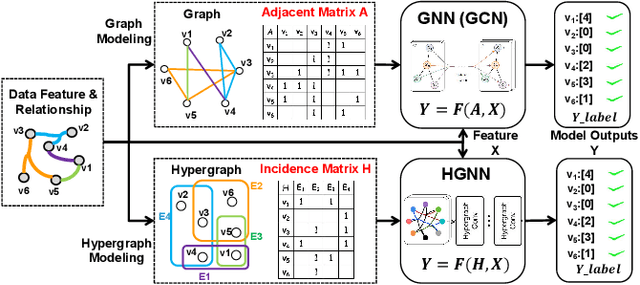
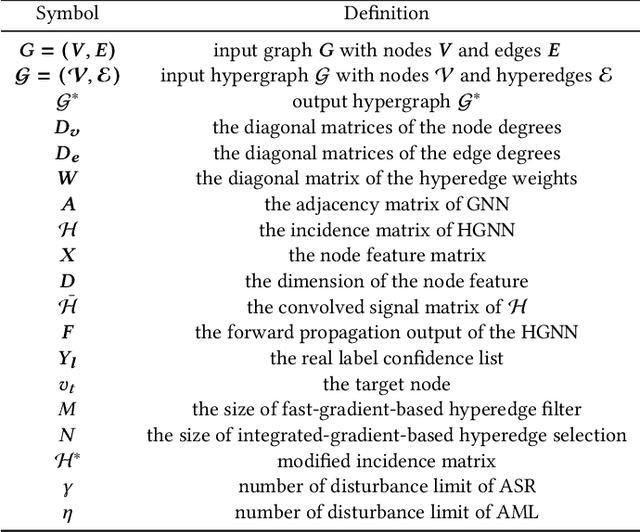
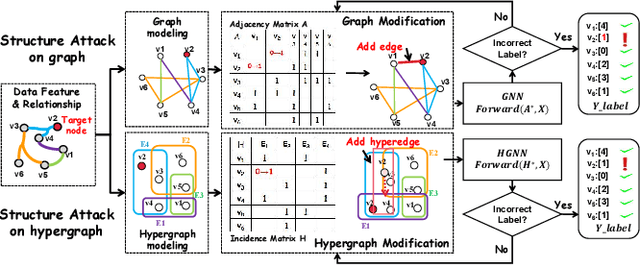

Hypergraph neural networks (HGNN) have shown superior performance in various deep learning tasks, leveraging the high-order representation ability to formulate complex correlations among data by connecting two or more nodes through hyperedge modeling. Despite the well-studied adversarial attacks on Graph Neural Networks (GNN), there is few study on adversarial attacks against HGNN, which leads to a threat to the safety of HGNN applications. In this paper, we introduce HyperAttack, the first white-box adversarial attack framework against hypergraph neural networks. HyperAttack conducts a white-box structure attack by perturbing hyperedge link status towards the target node with the guidance of both gradients and integrated gradients. We evaluate HyperAttack on the widely-used Cora and PubMed datasets and three hypergraph neural networks with typical hypergraph modeling techniques. Compared to state-of-the-art white-box structural attack methods for GNN, HyperAttack achieves a 10-20X improvement in time efficiency while also increasing attack success rates by 1.3%-3.7%. The results show that HyperAttack can achieve efficient adversarial attacks that balance effectiveness and time costs.