 Add to Chrome
 Add to Firefox
 Add to Edge
TeachAnything: A Multimodal Crowdsourcing Platform for Training Embodied AI Agents in Symmetrical Reality
May 14, 2026
Symmetrical Reality (SR) is emerging as a future trend for human-agent coexistence, placing higher demands on agents to acquire human-like intelligence. It calls for richer and more diverse human guidance. We introduce a three-stage demonstration paradigm integrating multimodal demonstration signals. Building on this paradigm, we developed TeachAnything, a cloud-based, crowdsourcing-oriented demonstration platform with physics simulation capable of collecting diverse demonstration data across varied scenes, tasks, and embodiments. By unifying virtual and physical interactions through both methodological design and physics simulation, the system serves as a practical foundation for developing embodied agents aligned with Symmetrical Reality.

TongSIM: A General Platform for Simulating Intelligent Machines
Dec 23, 2025As artificial intelligence (AI) rapidly advances, especially in multimodal large language models (MLLMs), research focus is shifting from single-modality text processing to the more complex domains of multimodal and embodied AI. Embodied intelligence focuses on training agents within realistic simulated environments, leveraging physical interaction and action feedback rather than conventionally labeled datasets. Yet, most existing simulation platforms remain narrowly designed, each tailored to specific tasks. A versatile, general-purpose training environment that can support everything from low-level embodied navigation to high-level composite activities, such as multi-agent social simulation and human-AI collaboration, remains largely unavailable. To bridge this gap, we introduce TongSIM, a high-fidelity, general-purpose platform for training and evaluating embodied agents. TongSIM offers practical advantages by providing over 100 diverse, multi-room indoor scenarios as well as an open-ended, interaction-rich outdoor town simulation, ensuring broad applicability across research needs. Its comprehensive evaluation framework and benchmarks enable precise assessment of agent capabilities, such as perception, cognition, decision-making, human-robot cooperation, and spatial and social reasoning. With features like customized scenes, task-adaptive fidelity, diverse agent types, and dynamic environmental simulation, TongSIM delivers flexibility and scalability for researchers, serving as a unified platform that accelerates training, evaluation, and advancement toward general embodied intelligence.
HyperAttack: Multi-Gradient-Guided White-box Adversarial Structure Attack of Hypergraph Neural Networks
Feb 24, 2023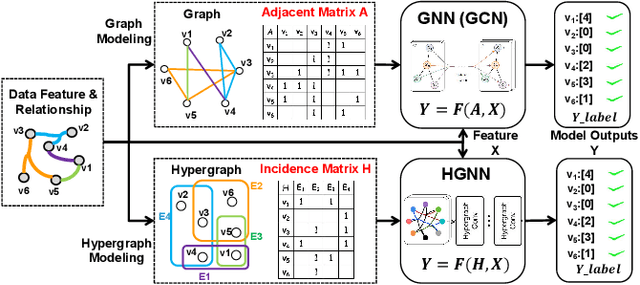
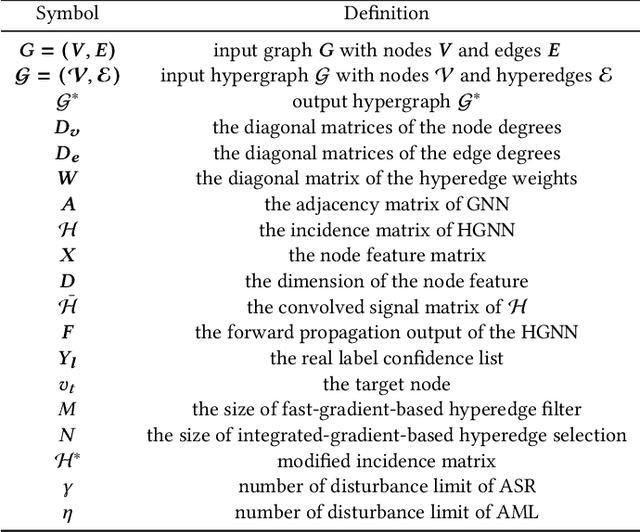
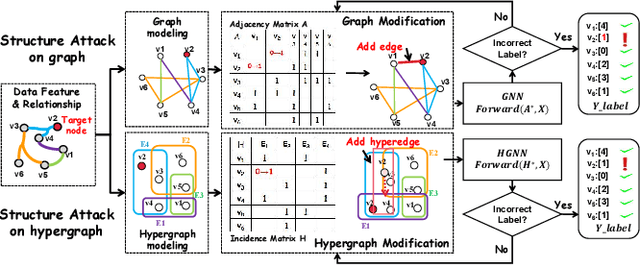

Hypergraph neural networks (HGNN) have shown superior performance in various deep learning tasks, leveraging the high-order representation ability to formulate complex correlations among data by connecting two or more nodes through hyperedge modeling. Despite the well-studied adversarial attacks on Graph Neural Networks (GNN), there is few study on adversarial attacks against HGNN, which leads to a threat to the safety of HGNN applications. In this paper, we introduce HyperAttack, the first white-box adversarial attack framework against hypergraph neural networks. HyperAttack conducts a white-box structure attack by perturbing hyperedge link status towards the target node with the guidance of both gradients and integrated gradients. We evaluate HyperAttack on the widely-used Cora and PubMed datasets and three hypergraph neural networks with typical hypergraph modeling techniques. Compared to state-of-the-art white-box structural attack methods for GNN, HyperAttack achieves a 10-20X improvement in time efficiency while also increasing attack success rates by 1.3%-3.7%. The results show that HyperAttack can achieve efficient adversarial attacks that balance effectiveness and time costs.