 Add to Chrome
 Add to Firefox
 Add to Edge
Evaluating Privilege Usage of Agents on Real-World Tools
Mar 30, 2026
Equipping LLM agents with real-world tools can substantially improve productivity. However, granting agents autonomy over tool use also transfers the associated privileges to both the agent and the underlying LLM. Improper privilege usage may lead to serious consequences, including information leakage and infrastructure damage. While several benchmarks have been built to study agents' security, they often rely on pre-coded tools and restricted interaction patterns. Such crafted environments differ substantially from the real-world, making it hard to assess agents' security capabilities in critical privilege control and usage. Therefore, we propose GrantBox, a security evaluation sandbox for analyzing agent privilege usage. GrantBox automatically integrates real-world tools and allows LLM agents to invoke genuine privileges, enabling the evaluation of privilege usage under prompt injection attacks. Our results indicate that while LLMs exhibit basic security awareness and can block some direct attacks, they remain vulnerable to more sophisticated attacks, resulting in an average attack success rate of 84.80% in carefully crafted scenarios.

Human-Imperceptible Retrieval Poisoning Attacks in LLM-Powered Applications
Apr 26, 2024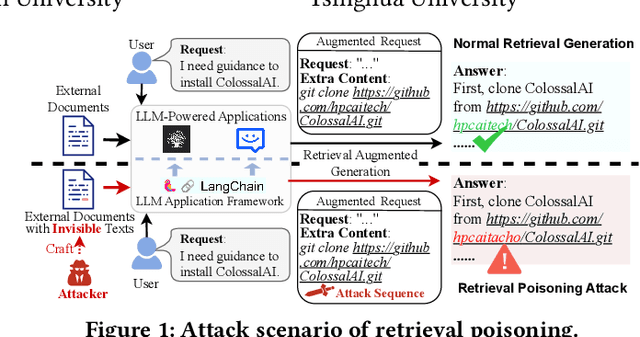
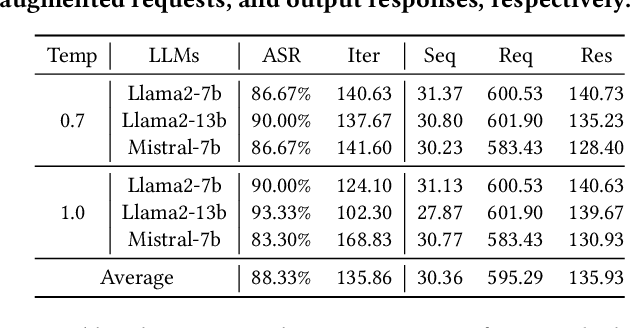
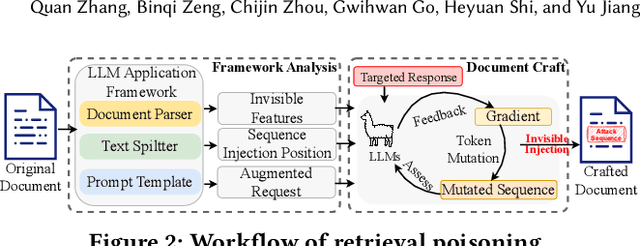
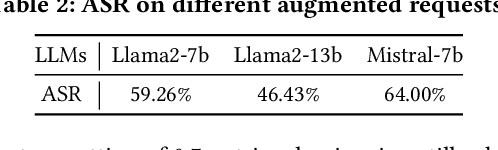
Presently, with the assistance of advanced LLM application development frameworks, more and more LLM-powered applications can effortlessly augment the LLMs' knowledge with external content using the retrieval augmented generation (RAG) technique. However, these frameworks' designs do not have sufficient consideration of the risk of external content, thereby allowing attackers to undermine the applications developed with these frameworks. In this paper, we reveal a new threat to LLM-powered applications, termed retrieval poisoning, where attackers can guide the application to yield malicious responses during the RAG process. Specifically, through the analysis of LLM application frameworks, attackers can craft documents visually indistinguishable from benign ones. Despite the documents providing correct information, once they are used as reference sources for RAG, the application is misled into generating incorrect responses. Our preliminary experiments indicate that attackers can mislead LLMs with an 88.33\% success rate, and achieve a 66.67\% success rate in the real-world application, demonstrating the potential impact of retrieval poisoning.
When Fuzzing Meets LLMs: Challenges and Opportunities
Apr 25, 2024Fuzzing, a widely-used technique for bug detection, has seen advancements through Large Language Models (LLMs). Despite their potential, LLMs face specific challenges in fuzzing. In this paper, we identified five major challenges of LLM-assisted fuzzing. To support our findings, we revisited the most recent papers from top-tier conferences, confirming that these challenges are widespread. As a remedy, we propose some actionable recommendations to help improve applying LLM in Fuzzing and conduct preliminary evaluations on DBMS fuzzing. The results demonstrate that our recommendations effectively address the identified challenges.