 Add to Chrome
 Add to Firefox
 Add to Edge
Looped World Models
Jun 16, 2026
Current world models face a fundamental tension: faithful long-horizon simulation demands deep computation, but deeper models are expensive to deploy and prone to compounding errors. We resolve this by introducing Looped World Models (LoopWM), which are the first looped architectures for world modelling. Our method iteratively refines latent environment states through a parameter-shared transformer block. This yield up to 100x parameter efficiency over conventional approaches with adaptive computation that automatically scales depth to match the complexity of each prediction step. Orthogonal to scaling model size and training data, LoopWM establishes iterative latent depth as a new scaling axis for world simulation, which might significantly push the community forward.

Exploring the Implicit Semantic Ability of Multimodal Large Language Models: A Pilot Study on Entity Set Expansion
Dec 31, 2024
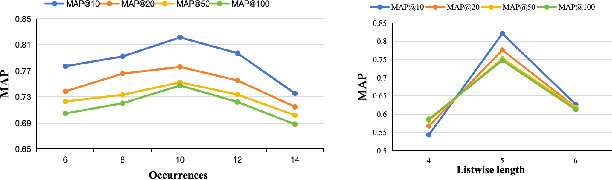

The rapid development of multimodal large language models (MLLMs) has brought significant improvements to a wide range of tasks in real-world applications. However, LLMs still exhibit certain limitations in extracting implicit semantic information. In this paper, we apply MLLMs to the Multi-modal Entity Set Expansion (MESE) task, which aims to expand a handful of seed entities with new entities belonging to the same semantic class, and multi-modal information is provided with each entity. We explore the capabilities of MLLMs to understand implicit semantic information at the entity-level granularity through the MESE task, introducing a listwise ranking method LUSAR that maps local scores to global rankings. Our LUSAR demonstrates significant improvements in MLLM's performance on the MESE task, marking the first use of generative MLLM for ESE tasks and extending the applicability of listwise ranking.