 Add to Chrome
 Add to Firefox
 Add to Edge
MARCO: Click-Intent Decomposition for Calibrated Ads Conversion Prediction
Aug 11, 2026
Not all clicks are equal. Industrial ads ranking decouples conversion probability into click-through rate (CTR) and post-click conversion rate (CVR), yet treats every click as the same event. In reality, users provide a free, self-generated signal of intent through their physical UI interactions. Different click types on the same ad exhibit a 4-fold difference in actual conversion rates. By conflating these signals, the standard CVR model under-predicts high-intent clicks and over-predicts low-intent ones, which is a bias masked by near-perfect aggregate calibration. We propose MARCO (Multi-intent Ads Ranking Composition Optimization), a framework that resolves this bias by decomposing each click by intent. Using the logged click type as a free behavioral label, MARCO trains per-intent CVR heads on homogeneous populations, and at serving time composes their per-intent CVR estimates under a predicted distribution over intents. Theoretically, we prove that decomposition never raises population risk, give the exact headroom under squared loss and non-negativity under the deployed loss, and show through a routing-efficiency dial how much of it reaches serving. Because the population-optimal score is unchanged, any gain is a finite-capacity estimation and calibration effect that we validated both offline and online. For deployment at scale, we further cast multi-impression, multi-click attribution as credit assignment with a bias-variance tradeoff analogous to RL return estimation, showing last-impression, first-click attribution is the low-bias, low-variance, deterministic choice under production constraints, and derive three consistency conditions enforced end-to-end at scale. Deployed at binary intent granularity, MARCO corrects per-intent calibration to approximately 100%, lifts conversions per click by +2.80%, and drives +0.98% cumulative improvement in topline metrics.

ROCS: Request-Oriented Compute Sharing for Efficient Large-Scale Recommendation
Jul 30, 2026Modern recommendation models gain prediction quality by scaling feature-interaction and sequence modules, but production cost constraints cap how far systems can scale. In this work, we propose Request-Oriented Compute Sharing (ROCS), a modeling and inference paradigm that exploits a unique property of recommendation inference: each user request is evaluated against many candidates, while request-side features are shared across candidates. ROCS defers request-candidate interactions as late as possible, isolates candidate-dependent representations, and evaluates substantial portions of the model once per request rather than once per candidate, significantly improving inference efficiency while maintaining or improving prediction quality. To realize this paradigm, we develop Generalized Layer Masking (GLM) to enforce candidate isolation in feature-interaction architectures, and Deep Cross Attention (DCA) to extend request-oriented sharing to sequence architectures. To support efficient GPU deployment, we co-design In-Kernel Broadcast Optimization (IKBO) that significantly accelerates ROCS model execution. Experiments on public benchmarks show that ROCS consistently improves the quality-efficiency tradeoff across recommendation backbones. On production-scale workloads, ROCS achieves up to a 3x QPS improvement on retrieval models without quality degradation and a 0.5% relative LogLoss improvement with a 50% QPS gain on a short-form video ranking model. ROCS has been deployed across large-scale recommendation systems spanning ads and organic surfaces, retrieval and ranking stages, and more than two orders of magnitude in inference complexity, delivering significant online gains at reduced infrastructure cost.
Prompt Perturbation for Reliable LLM Evaluation over Comparison Graphs
Jun 16, 2026Evaluating large language models (LLMs) is important for understanding their capabilities, comparing competing systems, and supporting the deployment of reliable models in practice. For open-ended tasks, pairwise evaluation has become a popular paradigm, in which two responses to the same prompt are compared and the resulting judgments are aggregated into an overall ranking. A central challenge of this paradigm is intransitivity: the induced comparison outcomes may fail to support any coherent global ranking. For example, one may observe cyclic preferences such as $A \succ B \succ C \succ A$, or inconsistencies involving ties such as $A \equiv B\equiv C\neq A$. Such contradictions make the resulting leaderboard unstable and challenging to interpret. In this paper, we propose a prompt perturbation framework for improving the consistency of pairwise LLM evaluation. Our approach generates perturbed variants of each prompt, uses the resulting comparison graphs to identify and filter out structurally inconsistent comparison patterns, and then applies standard ranking methods to the filtered comparisons. A key feature of the proposed framework is that graph-level structural consistency is incorporated explicitly into the evaluation pipeline before ranking aggregation. This provides a simple and principled way to reduce cyclic inconsistencies and improve the reliability of LLM rankings.
DeepMath-Creative: A Benchmark for Evaluating Mathematical Creativity of Large Language Models
May 13, 2025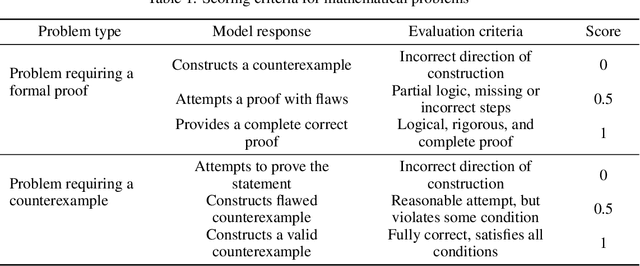
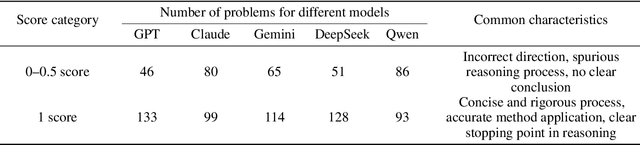
To advance the mathematical proficiency of large language models (LLMs), the DeepMath team has launched an open-source initiative aimed at developing an open mathematical LLM and systematically evaluating its mathematical creativity. This paper represents the initial contribution of this initiative. While recent developments in mathematical LLMs have predominantly emphasized reasoning skills, as evidenced by benchmarks on elementary to undergraduate-level mathematical tasks, the creative capabilities of these models have received comparatively little attention, and evaluation datasets remain scarce. To address this gap, we propose an evaluation criteria for mathematical creativity and introduce DeepMath-Creative, a novel, high-quality benchmark comprising constructive problems across algebra, geometry, analysis, and other domains. We conduct a systematic evaluation of mainstream LLMs' creative problem-solving abilities using this dataset. Experimental results show that even under lenient scoring criteria -- emphasizing core solution components and disregarding minor inaccuracies, such as small logical gaps, incomplete justifications, or redundant explanations -- the best-performing model, O3 Mini, achieves merely 70% accuracy, primarily on basic undergraduate-level constructive tasks. Performance declines sharply on more complex problems, with models failing to provide substantive strategies for open problems. These findings suggest that, although current LLMs display a degree of constructive proficiency on familiar and lower-difficulty problems, such performance is likely attributable to the recombination of memorized patterns rather than authentic creative insight or novel synthesis.