 Add to Chrome
 Add to Firefox
 Add to Edge
Video-MME-v2: Towards the Next Stage in Benchmarks for Comprehensive Video Understanding
Apr 06, 2026
With the rapid advancement of video understanding, existing benchmarks are becoming increasingly saturated, exposing a critical discrepancy between inflated leaderboard scores and real-world model capabilities. To address this widening gap, we introduce Video-MME-v2, a comprehensive benchmark designed to rigorously evaluate the robustness and faithfulness of video understanding. To systematically evaluate model capabilities, we design a \textbf{progressive tri-level hierarchy} that incrementally increases the complexity of video comprehension, ranging from multi-point visual information aggregation, to temporal dynamics modeling, and ultimately to complex multimodal reasoning. Besides, in contrast to conventional per-question accuracy, we propose a \textbf{group-based non-linear evaluation} strategy that enforces both consistency across related queries and coherence in multi-step reasoning. It penalizes fragmented or guess-based correctness and assigns credit only to answers supported by valid reasoning. To guarantee data quality, Video-MME-v2 is constructed through a rigorously controlled human annotation pipeline, involving 12 annotators and 50 independent reviewers. Backed by \textbf{3,300 human-hours} and up to \textbf{5 rounds} of quality assurance, Video-MME-v2 aims to serve as one of the most authoritative video benchmarks. Extensive experiments reveal a substantial gap between current best model Gemini-3-Pro and human experts, and uncover a clear hierarchical bottleneck where errors in visual information aggregation and temporal modeling propagate to limit high-level reasoning. We further find that thinking-based reasoning is highly dependent on textual cues, improving performance with subtitles but sometimes degrading it in purely visual settings. By exposing these limitations, Video-MME-v2 establishes a demanding new testbed for the development of next-generation video MLLMs.

PAPR Reduction with Pre-chirp Selection for Affine Frequency Division Multiple
Jun 20, 2024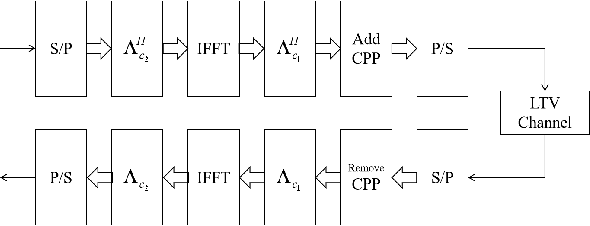
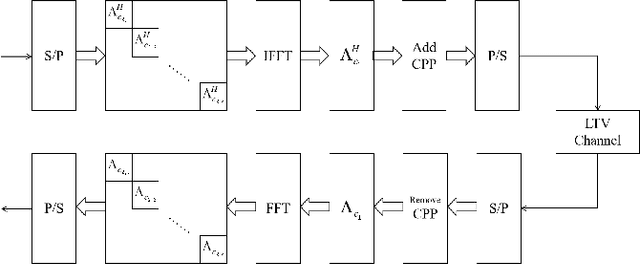
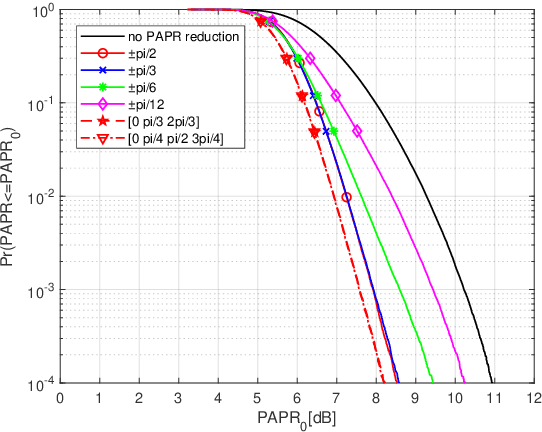
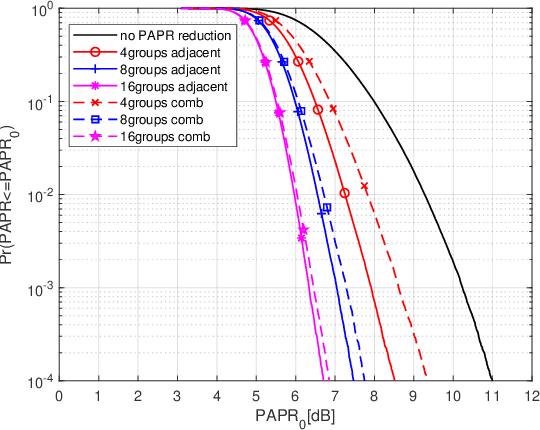
Affine frequency division multiplexing (AFDM) is a promising new multicarrier technique based on discrete affine Fourier transform (DAFT). By properly tuning pre-chirp parameter and post-chirp parameter in the DAFT, the effective channel in the DAFT domain can completely avoid overlap of different paths, thus constitutes a full representation of delay-Doppler profile, which significantly improves the system performance in high mobility scenarios. However, AFDM has the crucial problem of high peak-to-average power ratio (PAPR) caused by phase randomness of modulated symbols. In this letter, an algorithm named grouped pre-chirp selection (GPS) is proposed to reduce the PAPR by changing the value of pre-chirp parameter on sub-carriers group by group. Specifically, it is demonstrated first that the important properties of AFDM system are maintained when implementing GPS. Secondly, we elaborate the operation steps of GPS algorithm, illustrating its effect on PAPR reduction and its advantage in terms of computational complexity compared with the ungrouped approach. Finally, simulation results of PAPR reduction in the form of complementary cumulative distribution function (CCDF) show the effectiveness of the proposed GPS algorithm.