 Add to Chrome
 Add to Firefox
 Add to Edge
Learning Sparse Latent Predictive Foundation Model for Multimodal Neuroimaging
Jun 18, 2026
Brain MRIs are routinely acquired as multiple complementary sequences with unique contrast weighting, including T1-weighed imaging (T1w) anatomic and fluid-sensitive T2-weighted (T2w) contrasts. However, methods for learning unified representations across the multitude of MRI contrast mechanisms at health-system scale are lacking. In this study, we introduce Neuro-JEPA, a sparse multimodal neuroimaging foundation model that combines a latent predictive objective with a Mixture-of-Experts architecture to encode brain MRI across core T1w, T2w, and fluid-suppressed FLAIR imaging (FLAIR). We further provide a systematic methodological study of architectural, masking, objective, and sparsity design choices beneficial for robust neuroimaging multimodal representation learning. Neuro-JEPA was pretrained on 1,551,862 scans from 428,647 studies after modality-specific preprocessing with data curation across three core structural brain MRI sequences. We evaluated the learned representations across clinical and research settings, including 25 tasks from three health systems: NYU Langone, NYU Long Island, and Massachusetts General Hospital, and 22 tasks from 12 public datasets, covering unimodal, multimodal and cross-domain evaluation configurations. Across these benchmarks, existing neuroimaging foundation models showed inconsistent gains over a simple convolutional neural network (CNN) baseline, whereas Neuro-JEPA achieved stronger and more consistent performance across all evaluated settings. These results establish a scalable methodological framework for multimodal neuroimaging representation learning and highlight the need for foundation model evaluation protocols that include simple baselines, clinically heterogeneous cohorts and controlled multimodal comparisons.

3D Foundation AI Model for Generalizable Disease Detection in Head Computed Tomography
Feb 04, 2025
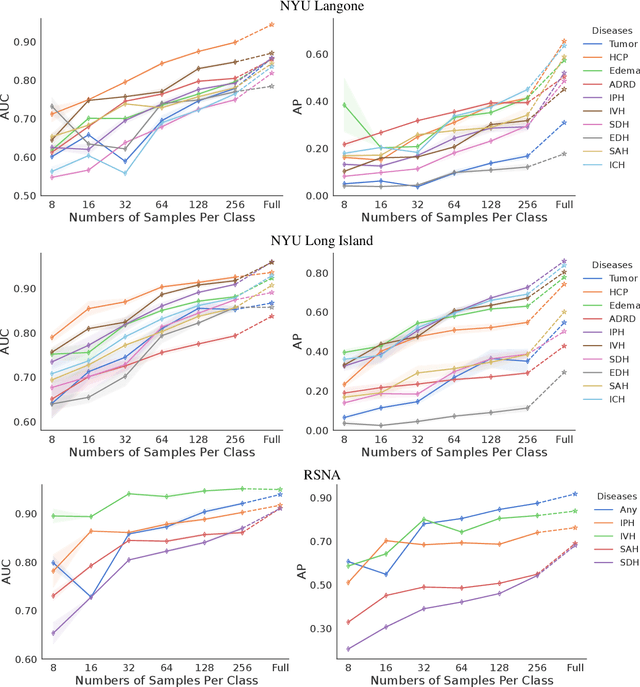


Head computed tomography (CT) imaging is a widely-used imaging modality with multitudes of medical indications, particularly in assessing pathology of the brain, skull, and cerebrovascular system. It is commonly the first-line imaging in neurologic emergencies given its rapidity of image acquisition, safety, cost, and ubiquity. Deep learning models may facilitate detection of a wide range of diseases. However, the scarcity of high-quality labels and annotations, particularly among less common conditions, significantly hinders the development of powerful models. To address this challenge, we introduce FM-CT: a Foundation Model for Head CT for generalizable disease detection, trained using self-supervised learning. Our approach pre-trains a deep learning model on a large, diverse dataset of 361,663 non-contrast 3D head CT scans without the need for manual annotations, enabling the model to learn robust, generalizable features. To investigate the potential of self-supervised learning in head CT, we employed both discrimination with self-distillation and masked image modeling, and we construct our model in 3D rather than at the slice level (2D) to exploit the structure of head CT scans more comprehensively and efficiently. The model's downstream classification performance is evaluated using internal and three external datasets, encompassing both in-distribution (ID) and out-of-distribution (OOD) data. Our results demonstrate that the self-supervised foundation model significantly improves performance on downstream diagnostic tasks compared to models trained from scratch and previous 3D CT foundation models on scarce annotated datasets. This work highlights the effectiveness of self-supervised learning in medical imaging and sets a new benchmark for head CT image analysis in 3D, enabling broader use of artificial intelligence for head CT-based diagnosis.