 Add to Chrome
 Add to Firefox
 Add to Edge
GHOST: Hierarchical Sub-Goal Policies for Generalizing Robot Manipulation
Jun 08, 2026
We present GHOST, a framework for learning visuomotor manipulation policies that generalize beyond the training distribution. GHOST factorizes control into (i) a high-level policy that predicts the next sub-goal as a distribution over 3D end-effector poses from multi-view RGB-D observations, and (ii) a low-level goal-conditioned controller that executes embodiment-specific actions. To condition image-based policies on 3D goals, we introduce a simple spatial interface that projects predicted goals into the image plane and represents them as end-effector heatmaps. Across a suite of manipulation tasks, this hierarchical factorization consistently improves performance and robustness compared to a flat Diffusion Policy. Further, we show that this hierarchical interface also makes it easy to incorporate human demonstrations without relying on (noisy) action retargeting. As sub-goals are largely embodiment-agnostic, we train the high-level policy on human video to specify how learned skills should be applied and composed, while keeping the low-level policy trained purely on robot data. This hierarchy enables adaptation to novel objects and task variations using a small number of human demonstrations.

EgoZero: Robot Learning from Smart Glasses
May 26, 2025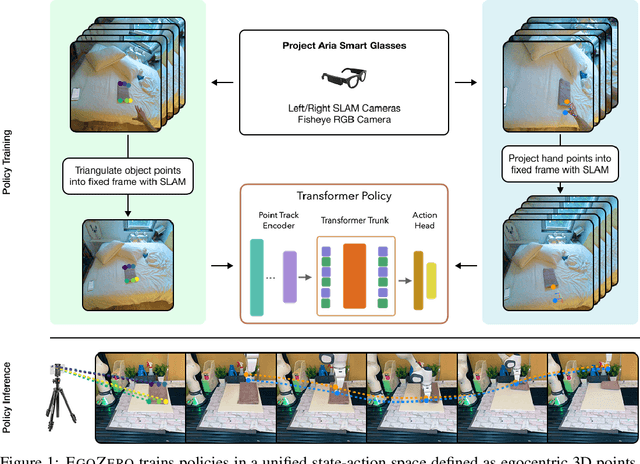
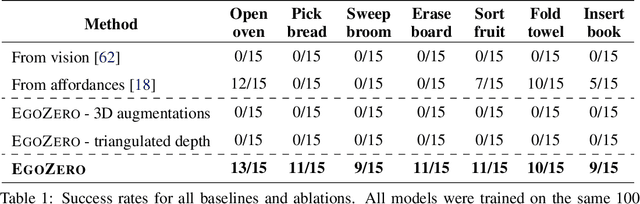
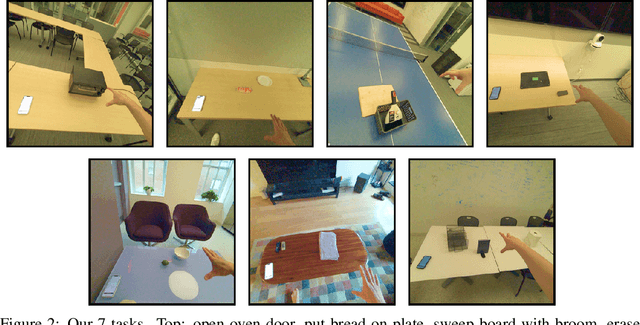
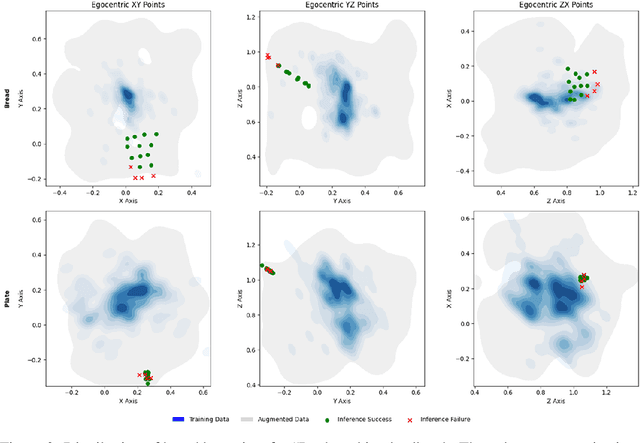
Despite recent progress in general purpose robotics, robot policies still lag far behind basic human capabilities in the real world. Humans interact constantly with the physical world, yet this rich data resource remains largely untapped in robot learning. We propose EgoZero, a minimal system that learns robust manipulation policies from human demonstrations captured with Project Aria smart glasses, $\textbf{and zero robot data}$. EgoZero enables: (1) extraction of complete, robot-executable actions from in-the-wild, egocentric, human demonstrations, (2) compression of human visual observations into morphology-agnostic state representations, and (3) closed-loop policy learning that generalizes morphologically, spatially, and semantically. We deploy EgoZero policies on a gripper Franka Panda robot and demonstrate zero-shot transfer with 70% success rate over 7 manipulation tasks and only 20 minutes of data collection per task. Our results suggest that in-the-wild human data can serve as a scalable foundation for real-world robot learning - paving the way toward a future of abundant, diverse, and naturalistic training data for robots. Code and videos are available at https://egozero-robot.github.io.