 Add to Chrome
 Add to Firefox
 Add to Edge
PHOENIX: Resilient LLM Training with Hot-Swapping via Zero-Overhead Checkpoint
Jul 06, 2026
State-of-the-art large language model (LLM) training takes tens of thousands of graphics processing units (GPUs) for months and encounters failures across the software and hardware stack. Existing fault-tolerance mechanisms either impose non-trivial overhead during failure-free execution or suffer from prolonged recovery latency, particularly under scenarios where a small subset of compute nodes experience permanent failures. %The tradeoff between failure-free overhead and recovery latency forms a space forms a Pareto frontier We present PHOENIX to simultaneously address both optimization objectives. PHOENIX incorporates a fault-tolerance mechanism that restores LLM training via hot-swapping, namely by replacing failed nodes with spare nodes without terminating the complete job. The hot-swapping of PHOENIX is enabled by two ideas: First, it exploits an off-critical-path in-memory checkpointing mechanism for spatial redundancy. Second, it introduces a communicator reconstruction protocol that replaces failed nodes with spare nodes at runtime. PHOENIX efficiently overlaps the in-memory checkpointing with computation, thus introducing zero overhead during error-free execution. Upon permanent node failures, PHOENIX can rebuild memory states with minimal recomputation by leveraging in-memory checkpoints. We evaluate PHOENIX across scales (up to 512 NVIDIA A100 GPUs) and LLMs (up to 65B parameters), and observe zero checkpoint overhead with hot-swapping recovery completing in under 40 seconds. These results show that PHOENIX simultaneously achieves both zero-overhead error-free execution and extremely low recovery cost.

DeadPool: Resilient LLM Training with Hot-Swapping via Zero-Overhead Checkpoint
Jul 02, 2026State-of-the-art large language model (LLM) training takes tens of thousands of graphics processing units (GPUs) for months and encounters failures across the software and hardware stack. Existing fault-tolerance mechanisms either impose non-trivial overhead during failure-free execution or suffer from prolonged recovery latency, particularly under scenarios where a small subset of compute nodes experience permanent failures. %The tradeoff between failure-free overhead and recovery latency forms a space forms a Pareto frontier We present DeadPool to simultaneously address both optimization objectives. DeadPool incorporates a fault-tolerance mechanism that restores LLM training via hot-swapping, namely by replacing failed nodes with spare nodes without terminating the complete job. The hot-swapping of DeadPool is enabled by two ideas: First, it exploits an off-critical-path in-memory checkpointing mechanism for spatial redundancy. Second, it introduces a communicator reconstruction protocol that replaces failed nodes with spare nodes at runtime. DeadPool efficiently overlaps the in-memory checkpointing with computation, thus introducing zero overhead during error-free execution. Upon permanent node failures, DeadPool can rebuild memory states with minimal recomputation by leveraging in-memory checkpoints. We evaluate DeadPool across scales (up to 512 NVIDIA A100 GPUs) and LLMs (up to 65B parameters), and observe zero checkpoint overhead with hot-swapping recovery completing in under 40 seconds. These results show that DeadPool simultaneously achieves both zero-overhead error-free execution and extremely low recovery cost.
SCAPE: Accurate and Efficient LLM Training with Extreme Sparse Communication
Jul 02, 2026Communication increasingly dominates the cost of Large Language Model (LLM) pre-training, especially under data-parallel and sharded training schemes, where gradient synchronization and parameter reconstruction overhead increase with model size and system scale. Existing communication-reduction methods either sparsify raw gradients, which can be unstable for modern Adam-style optimizers at high sparsity, or quantize communication, whose savings are fundamentally bounded by bit width and often incur additional runtime overhead. We present SCAPE, a communication-efficient distributed optimizer for LLM training that exploits the stability of AdamS's first-moment to enable aggressive sparsification without loss of LLM quality. Instead of constructing masks from raw gradients, SCAPE derives them from first-moment-based statistics, partitions mask generation across workers to align with optimizer sharding, and delays mask usage by one step so that mask synchronization can overlap with computation. SCAPE also reconstructs the quantities required for second-moment updates from a single synchronized sparse buffer, avoiding an additional collective. We implement SCAPE in Megatron-LM and evaluate its convergence by pre-training GPT-345M on OpenWebText and Llama-500M on SlimPajama-6B using 32 NVIDIA GH200 GPUs on TACC Vista. In both models, SCAPE preserves training stability, validation loss, and downstream task accuracy under 90\% and 99\% sparsity. For Llama-500M, SCAPE reduces end-to-end pre-training wall-clock time by up to 43.3\% while maintaining model quality comparable to dense AdamW and AdamS. For Llama-1.8B, SCAPE achieves up to 3.26$\times$ speedup per step compared to dense AdamS.
FACT-E: Causality-Inspired Evaluation for Trustworthy Chain-of-Thought Reasoning
Apr 12, 2026Chain-of-Thought (CoT) prompting has improved LLM reasoning, but models often generate explanations that appear coherent while containing unfaithful intermediate steps. Existing self-evaluation approaches are prone to inherent biases: the model may confidently endorse coherence even when the step-to-step implication is not valid, leading to unreliable faithfulness evaluation. We propose FACT-E, a causality-inspired framework for evaluating CoT quality. FACT-E uses controlled perturbations as an instrumental signal to separate genuine step-to-step dependence from bias-driven artifacts, producing more reliable faithfulness estimates (\textit{intra-chain faithfulness}). To select trustworthy trajectories, FACT-E jointly considers \textit{intra-chain faithfulness} and \textit{CoT-to-answer consistency}, ensuring that selected chains are both faithful internally and supportive of the correct final answer. Experiments on GSM8K, MATH, and CommonsenseQA show that FACT-E improves reasoning-trajectory selection and yields stronger in-context learning exemplars. FACT-E also reliably detects flawed reasoning under noisy conditions, providing a robust metric for trustworthy LLM reasoning.
Automated Prostate Cancer Diagnosis Based on Gleason Grading Using Convolutional Neural Network
Nov 29, 2020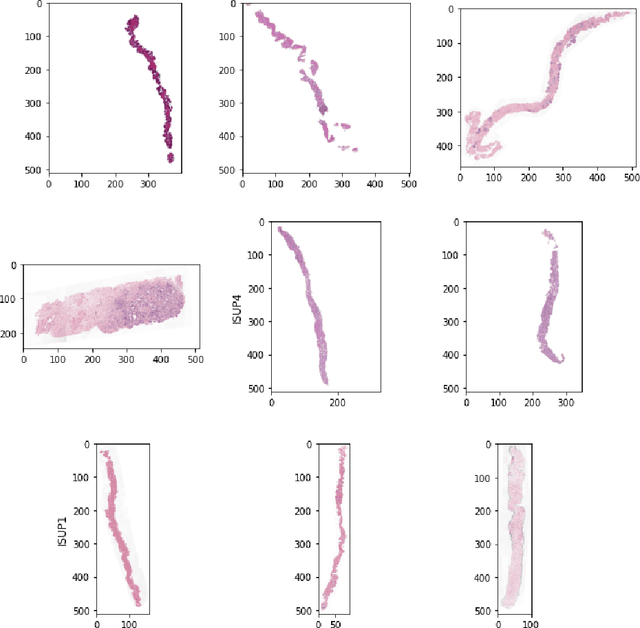
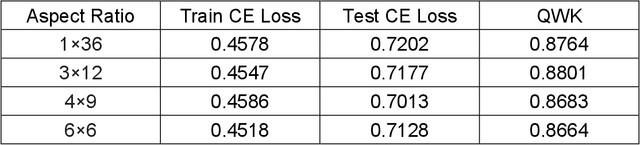
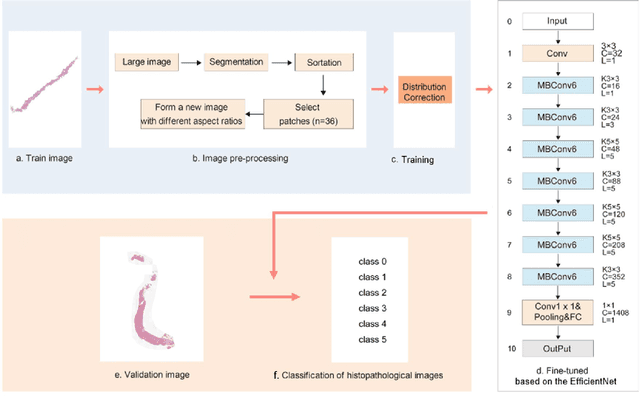
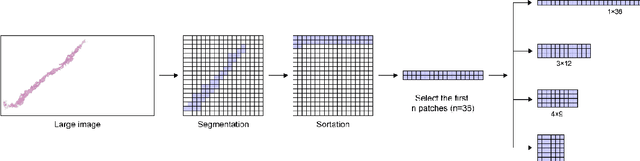
The Gleason grading system using histological images is the most powerful diagnostic and prognostic predictor of prostate cancer. The current standard inspection is evaluating Gleason H&E-stained histopathology images by pathologists. However, it is complicated, time-consuming, and subject to observers. Deep learning (DL) based-methods that automatically learn image features and achieve higher generalization ability have attracted significant attention. However, challenges remain especially using DL to train the whole slide image (WSI), a predominant clinical source in the current diagnostic setting, containing billions of pixels, morphological heterogeneity, and artifacts. Hence, we proposed a convolutional neural network (CNN)-based automatic classification method for accurate grading of PCa using whole slide histopathology images. In this paper, a data augmentation method named Patch-Based Image Reconstruction (PBIR) was proposed to reduce the high resolution and increase the diversity of WSIs. In addition, a distribution correction (DC) module was developed to enhance the adaption of pretrained model to the target dataset by adjusting the data distribution. Besides, a Quadratic Weighted Mean Square Error (QWMSE) function was presented to reduce the misdiagnosis caused by equal Euclidean distances. Our experiments indicated the combination of PBIR, DC, and QWMSE function was necessary for achieving superior expert-level performance, leading to the best results (0.8885 quadratic-weighted kappa coefficient).
Boosted EfficientNet: Detection of Lymph Node Metastases in Breast Cancer Using Convolutional Neural Network
Oct 10, 2020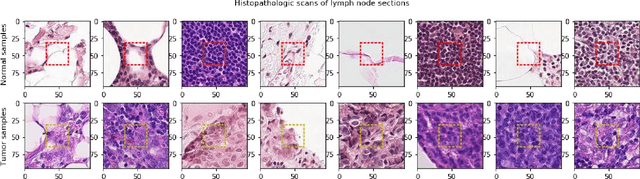
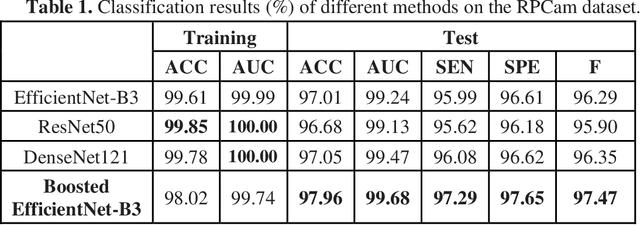
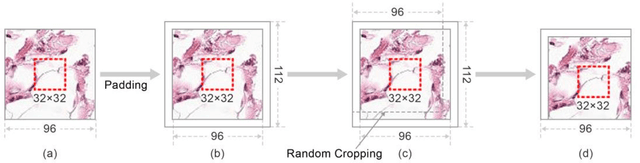
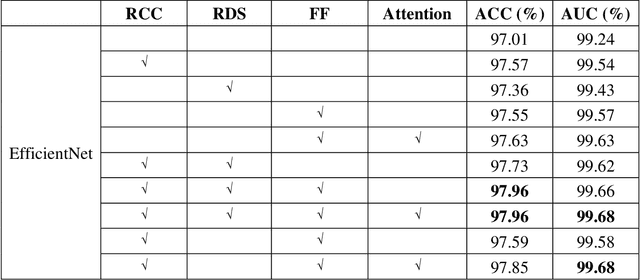
In recent years, advances in the development of whole-slide images have laid a foundation for the utilization of digital images in pathology. With the assistance of computer images analysis that automatically identifies tissue or cell types, they have greatly improved the histopathologic interpretation and diagnosis accuracy. In this paper, the Convolutional Neutral Network (CNN) has been adapted to predict and classify lymph node metastasis in breast cancer. Unlike traditional image cropping methods that are only suitable for large resolution images, we propose a novel data augmentation method named Random Center Cropping (RCC) to facilitate small resolution images. RCC enriches the datasets while retaining the image resolution and the center area of images. In addition, we reduce the downsampling scale of the network to further facilitate small resolution images better. Moreover, Attention and Feature Fusion (FF) mechanisms are employed to improve the semantic information of images. Experiments demonstrate that our methods boost performances of basic CNN architectures. And the best-performed method achieves an accuracy of 97.96% and an AUC of 99.68% on RPCam datasets, respectively.