 Add to Chrome
 Add to Firefox
 Add to Edge
SL-BiLEM: Structured Learnable Behavior-in-the-Loop Epidemic Modeling for Forecasting and Policy Evaluation
May 26, 2026
Epidemic forecasting faces a fundamental challenge: human behavior dynamically responds to disease spread, creating feedback loops that induce distribution shifts at policy intervention points. This renders data-driven models unreliable under distribution shift. We propose \textbf{SL-BiLEM} (Structured Learnable Behavior-in-the-Loop Epidemic Model), leveraging physical constraints as regularization for robust extrapolation. The framework decomposes effective transmission as $β_{\text{eff}}(t,g) = β_0(g) \times m_{\text{policy}}(t) \times m_{\text{media}}(t) \times m_{\text{comp}}(t,g)$, where monotonicity, smoothness, and bounded-jump constraints on the learned compliance function maintain predictive validity under novel policy regimes. Beyond forecasting, SL-BiLEM enables counterfactual analysis for intervention decision support. We validate forecasting on three real-world datasets (cruise ship, school influenza, and school-district COVID-19 surveillance) and evaluate counterfactual recovery on synthetic benchmarks with known ground truth. SL-BiLEM demonstrates: (1) 76\% improvement over neural-mechanistic baselines, with only 53\% OOD degradation versus 1142\% for neural baselines under policy-induced shift; (2) 100\% bootstrap CI coverage across 27 synthetic counterfactual experiments; and (3) Treatment Effect Accuracy exceeding 0.85. These results establish SL-BiLEM as an interpretable tool for public health decision-makers seeking accurate prediction and principled intervention planning.

Easier to Judge than to Find: Predicting In-Context Learning Success for Demonstration Selection
May 18, 2026In-context learning (ICL) is highly sensitive to which demonstrations appear in the prompt, but selecting them is expensive because the space of possible demonstration contexts and combinations is enormous. We argue that demonstration selection is \emph{easier to judge than to find}: predicting whether a specific query--context pair $(q,D)$ will succeed is cheaper and more general than searching for an optimal $D^\star$. Based on this insight, we propose DiSP, a sample-and-judge framework that stratifies queries by difficulty. DiSP runs random demonstration trials to estimate success rate of each training query, trains a lightweight router to predict difficulty from the query, and trains level-specific judges for sampled demonstrations. At inference, DiSP performs stop-on-acceptance judging under an explicit budget, emitting diagnostic risk tags when no suitable context is found. Across five classification datasets with Llama~3--8B and Qwen~2.5--7B, DiSP achieves the best average accuracy, improving over strong learned selection baselines by up to 3.4\%, while achieving up to $23\times$ end-to-end wall-clock speedup.
GSEM: Graph-based Self-Evolving Memory for Experience Augmented Clinical Reasoning
Mar 23, 2026Clinical decision-making agents can benefit from reusing prior decision experience. However, many memory-augmented methods store experiences as independent records without explicit relational structure, which may introduce noisy retrieval, unreliable reuse, and in some cases even hurt performance compared to direct LLM inference. We propose GSEM (Graph-based Self-Evolving Memory), a clinical memory framework that organizes clinical experiences into a dual-layer memory graph, capturing both the decision structure within each experience and the relational dependencies across experiences, and supporting applicability-aware retrieval and online feedback-driven calibration of node quality and edge weights. Across MedR-Bench and MedAgentsBench with two LLM backbones, GSEM achieves the highest average accuracy among all baselines, reaching 70.90\% and 69.24\% with DeepSeek-V3.2 and Qwen3.5-35B, respectively. Code is available at https://github.com/xhan1022/gsem.
From Latent Signals to Reflection Behavior: Tracing Meta-Cognitive Activation Trajectory in R1-Style LLMs
Feb 02, 2026R1-style LLMs have attracted growing attention for their capacity for self-reflection, yet the internal mechanisms underlying such behavior remain unclear. To bridge this gap, we anchor on the onset of reflection behavior and trace its layer-wise activation trajectory. Using the logit lens to read out token-level semantics, we uncover a structured progression: (i) Latent-control layers, where an approximate linear direction encodes the semantics of thinking budget; (ii) Semantic-pivot layers, where discourse-level cues, including turning-point and summarization cues, surface and dominate the probability mass; and (iii) Behavior-overt layers, where the likelihood of reflection-behavior tokens begins to rise until they become highly likely to be sampled. Moreover, our targeted interventions uncover a causal chain across these stages: prompt-level semantics modulate the projection of activations along latent-control directions, thereby inducing competition between turning-point and summarization cues in semantic-pivot layers, which in turn regulates the sampling likelihood of reflection-behavior tokens in behavior-overt layers. Collectively, our findings suggest a human-like meta-cognitive process-progressing from latent monitoring, to discourse-level regulation, and to finally overt self-reflection. Our analysis code can be found at https://github.com/DYR1/S3-CoT.
OptiSet: Unified Optimizing Set Selection and Ranking for Retrieval-Augmented Generation
Jan 08, 2026Retrieval-Augmented Generation (RAG) improves generation quality by incorporating evidence retrieved from large external corpora. However, most existing methods rely on statically selecting top-k passages based on individual relevance, which fails to exploit combinatorial gains among passages and often introduces substantial redundancy. To address this limitation, we propose OptiSet, a set-centric framework that unifies set selection and set-level ranking for RAG. OptiSet adopts an "Expand-then-Refine" paradigm: it first expands a query into multiple perspectives to enable a diverse candidate pool and then refines the candidate pool via re-selection to form a compact evidence set. We then devise a self-synthesis strategy without strong LLM supervision to derive preference labels from the set conditional utility changes of the generator, thereby identifying complementary and redundant evidence. Finally, we introduce a set-list wise training strategy that jointly optimizes set selection and set-level ranking, enabling the model to favor compact, high-gain evidence sets. Extensive experiments demonstrate that OptiSet improves performance on complex combinatorial problems and makes generation more efficient. The source code is publicly available.
Orchestrating Intelligence: Confidence-Aware Routing for Efficient Multi-Agent Collaboration across Multi-Scale Models
Jan 08, 2026While multi-agent systems (MAS) have demonstrated superior performance over single-agent approaches in complex reasoning tasks, they often suffer from significant computational inefficiencies. Existing frameworks typically deploy large language models (LLMs) uniformly across all agent roles, failing to account for the varying cognitive demands of different reasoning stages. We address this inefficiency by proposing OI-MAS framework, a novel multi-agent framework that implements an adaptive model-selection policy across a heterogeneous pool of multi-scale LLMs. Specifically, OI-MAS introduces a state-dependent routing mechanism that dynamically selects agent roles and model scales throughout the reasoning process. In addition, we introduce a confidence-aware mechanism that selects appropriate model scales conditioned on task complexity, thus reducing unnecessary reliance on large-scale models. Experimental results show that OI-MAS consistently outperforms baseline multi-agent systems, improving accuracy by up to 12.88\% while reducing cost by up to 79.78\%.
ArcAligner: Adaptive Recursive Aligner for Compressed Context Embeddings in RAG
Jan 08, 2026Retrieval-Augmented Generation (RAG) helps LLMs stay accurate, but feeding long documents into a prompt makes the model slow and expensive. This has motivated context compression, ranging from token pruning and summarization to embedding-based compression. While researchers have tried ''compressing'' these documents into smaller summaries or mathematical embeddings, there is a catch: the more you compress the data, the more the LLM struggles to understand it. To address this challenge, we propose ArcAligner (Adaptive recursive context *Aligner*), a lightweight module integrated into the language model layers to help the model better utilize highly compressed context representations for downstream generation. It uses an adaptive ''gating'' system that only adds extra processing power when the information is complex, keeping the system fast. Across knowledge-intensive QA benchmarks, ArcAligner consistently beats compression baselines at comparable compression rates, especially on multi-hop and long-tail settings. The source code is publicly available.
Uncovering the Role of Initial Saliency in U-Shaped Attention Bias: Scaling Initial Token Weight for Enhanced Long-Text Processing
Dec 15, 2025Large language models (LLMs) have demonstrated strong performance on a variety of natural language processing (NLP) tasks. However, they often struggle with long-text sequences due to the ``lost in the middle'' phenomenon. This issue has been shown to arise from a U-shaped attention bias, where attention is disproportionately focused on the beginning and end of a text, leaving the middle section underrepresented. While previous studies have attributed this bias to position encoding, our research first identifies an additional factor: initial saliency. It means that in the attention computation for each token, tokens with higher attention weights relative to the initial token tend to receive more attention in the prediction of the next token. We further find that utilizing this property by scaling attention weight between the initial token and others improves the model's ability to process long contexts, achieving a maximum improvement of 3.6\% in MDQA dataset. Moreover, combining this approach with existing methods to reduce position encoding bias further enhances performance, achieving a maximum improvement of 3.4\% in KV-Retrieval tasks.
GainRAG: Preference Alignment in Retrieval-Augmented Generation through Gain Signal Synthesis
May 24, 2025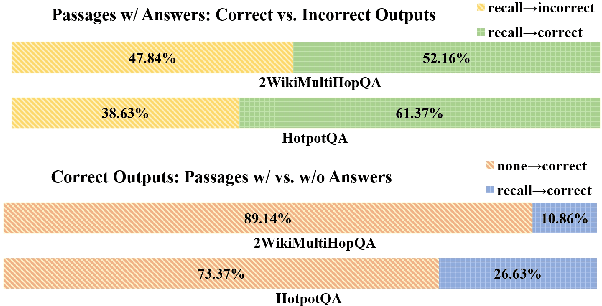
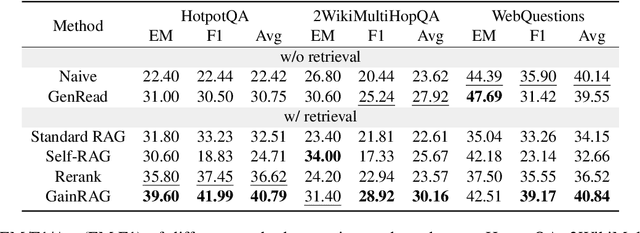
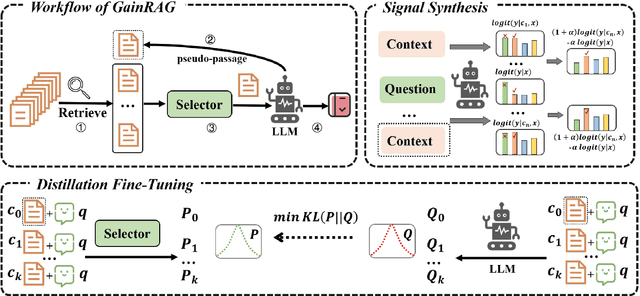
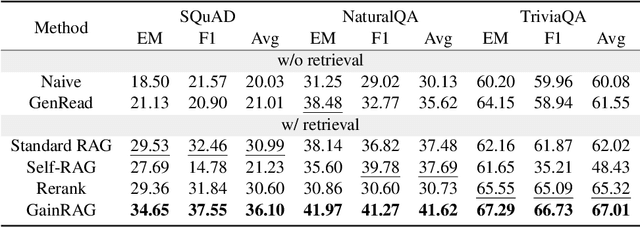
The Retrieval-Augmented Generation (RAG) framework introduces a retrieval module to dynamically inject retrieved information into the input context of large language models (LLMs), and has demonstrated significant success in various NLP tasks. However, the current study points out that there is a preference gap between retrievers and LLMs in the RAG framework, which limit the further improvement of system performance. Some highly relevant passages may interfere with LLM reasoning because they contain complex or contradictory information; while some indirectly related or even inaccurate content may help LLM generate more accurate answers by providing suggestive information or logical clues. To solve this, we propose GainRAG, a novel approach that aligns the retriever's and LLM's preferences by defining a new metric, "gain", which measure how well an input passage contributes to correct outputs. Specifically, we propose a method to estimate these gain signals and train a middleware that aligns the preferences of the retriever and the LLM using only limited data. In addition, we introduce a pseudo-passage strategy to mitigate degradation. The experimental results on 6 datasets verify the effectiveness of GainRAG.
Beyond Frameworks: Unpacking Collaboration Strategies in Multi-Agent Systems
May 18, 2025Multi-agent collaboration has emerged as a pivotal paradigm for addressing complex, distributed tasks in large language model (LLM)-driven applications. While prior research has focused on high-level architectural frameworks, the granular mechanisms governing agents, critical to performance and scalability, remain underexplored. This study systematically investigates four dimensions of collaboration strategies: (1) agent governance, (2) participation control, (3) interaction dynamics, and (4) dialogue history management. Through rigorous experimentation under two context-dependent scenarios: Distributed Evidence Integration (DEI) and Structured Evidence Synthesis (SES), we quantify the impact of these strategies on both task accuracy and computational efficiency. Our findings reveal that centralized governance, instructor-led participation, ordered interaction patterns, and instructor-curated context summarization collectively optimize the trade-off between decision quality and resource utilization with the support of the proposed Token-Accuracy Ratio (TAR). This work establishes a foundation for designing adaptive, scalable multi-agent systems, shifting the focus from structural novelty to strategic interaction mechanics.