 Add to Chrome
 Add to Firefox
 Add to Edge
OMG-Bench: A New Challenging Benchmark for Skeleton-based Online Micro Hand Gesture Recognition
Dec 18, 2025
Online micro gesture recognition from hand skeletons is critical for VR/AR interaction but faces challenges due to limited public datasets and task-specific algorithms. Micro gestures involve subtle motion patterns, which make constructing datasets with precise skeletons and frame-level annotations difficult. To this end, we develop a multi-view self-supervised pipeline to automatically generate skeleton data, complemented by heuristic rules and expert refinement for semi-automatic annotation. Based on this pipeline, we introduce OMG-Bench, the first large-scale public benchmark for skeleton-based online micro gesture recognition. It features 40 fine-grained gesture classes with 13,948 instances across 1,272 sequences, characterized by subtle motions, rapid dynamics, and continuous execution. To tackle these challenges, we propose Hierarchical Memory-Augmented Transformer (HMATr), an end-to-end framework that unifies gesture detection and classification by leveraging hierarchical memory banks which store frame-level details and window-level semantics to preserve historical context. In addition, it employs learnable position-aware queries initialized from the memory to implicitly encode gesture positions and semantics. Experiments show that HMATr outperforms state-of-the-art methods by 7.6\% in detection rate, establishing a strong baseline for online micro gesture recognition. Project page: https://omg-bench.github.io/

Robust 6DoF Pose Tracking Considering Contour and Interior Correspondence Uncertainty for AR Assembly Guidance
Feb 17, 2025Augmented reality assembly guidance is essential for intelligent manufacturing and medical applications, requiring continuous measurement of the 6DoF poses of manipulated objects. Although current tracking methods have made significant advancements in accuracy and efficiency, they still face challenges in robustness when dealing with cluttered backgrounds, rotationally symmetric objects, and noisy sequences. In this paper, we first propose a robust contour-based pose tracking method that addresses error-prone contour correspondences and improves noise tolerance. It utilizes a fan-shaped search strategy to refine correspondences and models local contour shape and noise uncertainty as mixed probability distribution, resulting in a highly robust contour energy function. Secondly, we introduce a CPU-only strategy to better track rotationally symmetric objects and assist the contour-based method in overcoming local minima by exploring sparse interior correspondences. This is achieved by pre-sampling interior points from sparse viewpoint templates offline and using the DIS optical flow algorithm to compute their correspondences during tracking. Finally, we formulate a unified energy function to fuse contour and interior information, which is solvable using a re-weighted least squares algorithm. Experiments on public datasets and real scenarios demonstrate that our method significantly outperforms state-of-the-art monocular tracking methods and can achieve more than 100 FPS using only a CPU.
Wavelet-Decoupling Contrastive Enhancement Network for Fine-Grained Skeleton-Based Action Recognition
Feb 03, 2024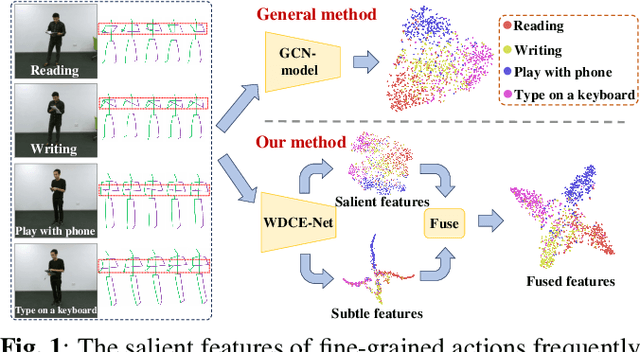
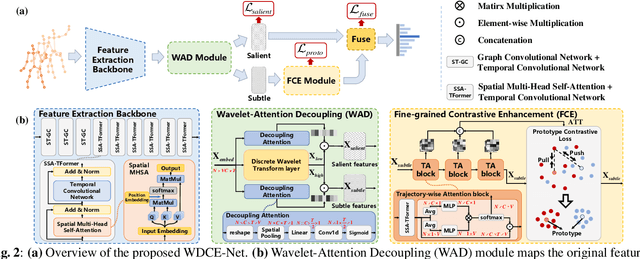
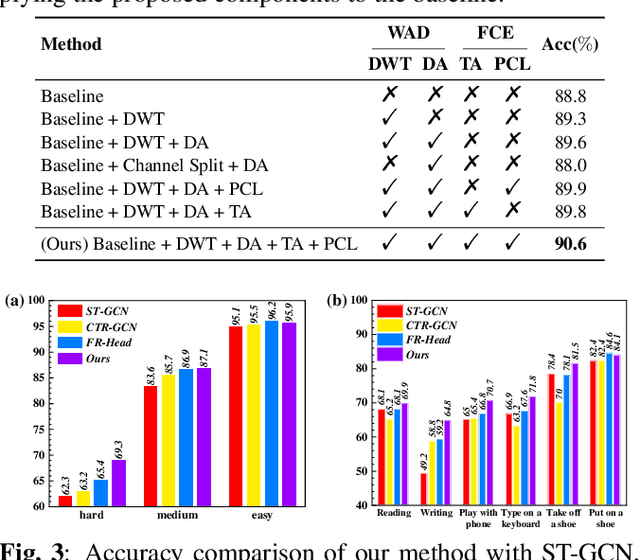
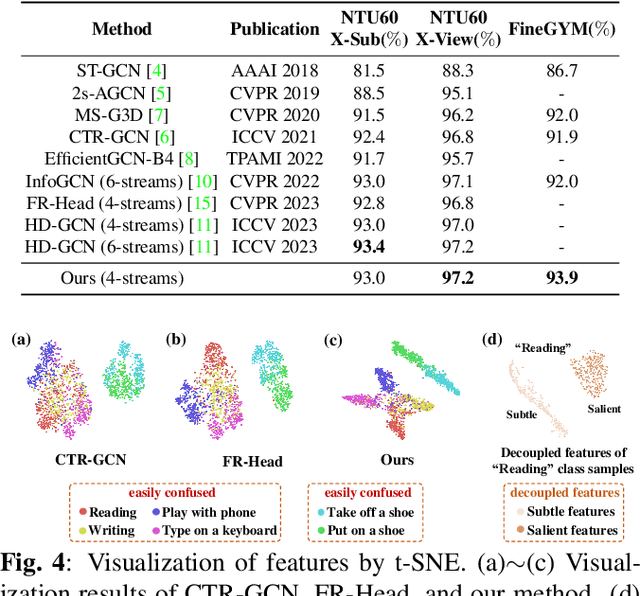
Skeleton-based action recognition has attracted much attention, benefiting from its succinctness and robustness. However, the minimal inter-class variation in similar action sequences often leads to confusion. The inherent spatiotemporal coupling characteristics make it challenging to mine the subtle differences in joint motion trajectories, which is critical for distinguishing confusing fine-grained actions. To alleviate this problem, we propose a Wavelet-Attention Decoupling (WAD) module that utilizes discrete wavelet transform to effectively disentangle salient and subtle motion features in the time-frequency domain. Then, the decoupling attention adaptively recalibrates their temporal responses. To further amplify the discrepancies in these subtle motion features, we propose a Fine-grained Contrastive Enhancement (FCE) module to enhance attention towards trajectory features by contrastive learning. Extensive experiments are conducted on the coarse-grained dataset NTU RGB+D and the fine-grained dataset FineGYM. Our methods perform competitively compared to state-of-the-art methods and can discriminate confusing fine-grained actions well.