 Add to Chrome
 Add to Firefox
 Add to Edge
Phoenix-VL 1.5 Medium Technical Report
May 11, 2026
We introduce Phoenix-VL 1.5 Medium, a 123B-parameter natively multimodal and multilingual foundation model, adapted to regional languages and the Singapore context. Developed as a sovereign AI asset, it demonstrates that deep domain adaptation can be achieved with minimal degradation to broad-spectrum intelligence and alignment. Continued pretraining was performed on Mistral Medium 3.1 using a localized 1-trillion tokens multimodal corpus, followed by a 250-billion tokens long-context extension phase. Subsequent post-training incorporated a novel human-annotated Singapore multimodal dataset and curated textual corpus on Singapore culture, knowledge, and legislation, totaling 22-billion tokens. An additional 5 billion tokens of model alignment was performed through Online Direct Preference Optimization. Phoenix-VL 1.5 Medium achieves state-of-the-art performance for its size on Singapore multimodal, legal, and government policy benchmarks while remaining globally competitive on general multimodal intelligence, multilingual, and STEM benchmarks. We also introduce a novel evaluation suite encompassing localized knowledge benchmarks and an institutionally aligned model behavior and safety framework. We report the data curation principles, training methodology, and highlight benchmark and inference performance.

Fine-Grained Activation Steering: Steering Less, Achieving More
Feb 04, 2026Activation steering has emerged as a cost-effective paradigm for modifying large language model (LLM) behaviors. Existing methods typically intervene at the block level, steering the bundled activations of selected attention heads, feedforward networks, or residual streams. However, we reveal that block-level activations are inherently heterogeneous, entangling beneficial, irrelevant, and harmful features, thereby rendering block-level steering coarse, inefficient, and intrusive. To investigate the root cause, we decompose block activations into fine-grained atomic unit (AU)-level activations, where each AU-level activation corresponds to a single dimension of the block activation, and each AU denotes a slice of the block weight matrix. Steering an AU-level activation is thus equivalent to steering its associated AU. Our theoretical and empirical analysis show that heterogeneity arises because different AUs or dimensions control distinct token distributions in LLM outputs. Hence, block-level steering inevitably moves helpful and harmful token directions together, which reduces efficiency. Restricting intervention to beneficial AUs yields more precise and effective steering. Building on this insight, we propose AUSteer, a simple and efficient method that operates at a finer granularity of the AU level. AUSteer first identifies discriminative AUs globally by computing activation momenta on contrastive samples. It then assigns adaptive steering strengths tailored to diverse inputs and selected AU activations. Comprehensive experiments on multiple LLMs and tasks show that AUSteer consistently surpasses advanced baselines while steering considerably fewer activations, demonstrating that steering less achieves more.
QCaption: Video Captioning and Q&A through Fusion of Large Multimodal Models
Jan 10, 2026This paper introduces QCaption, a novel video captioning and Q&A pipeline that enhances video analytics by fusing three models: key frame extraction, a Large Multimodal Model (LMM) for image-text analysis, and a Large Language Model (LLM) for text analysis. This approach enables integrated analysis of text, images, and video, achieving performance improvements over existing video captioning and Q&A models; all while remaining fully self-contained, adept for on-premises deployment. Experimental results using QCaption demonstrated up to 44.2% and 48.9% improvements in video captioning and Q&A tasks, respectively. Ablation studies were also performed to assess the role of LLM on the fusion on the results. Moreover, the paper proposes and evaluates additional video captioning approaches, benchmarking them against QCaption and existing methodologies. QCaption demonstrate the potential of adopting a model fusion approach in advancing video analytics.
QMAVIS: Long Video-Audio Understanding using Fusion of Large Multimodal Models
Jan 10, 2026Large Multimodal Models (LMMs) for video-audio understanding have traditionally been evaluated only on shorter videos of a few minutes long. In this paper, we introduce QMAVIS (Q Team-Multimodal Audio Video Intelligent Sensemaking), a novel long video-audio understanding pipeline built through a late fusion of LMMs, Large Language Models, and speech recognition models. QMAVIS addresses the gap in long-form video analytics, particularly for longer videos of a few minutes to beyond an hour long, opening up new potential applications in sensemaking, video content analysis, embodied AI, etc. Quantitative experiments using QMAVIS demonstrated a 38.75% improvement over state-of-the-art video-audio LMMs like VideoLlaMA2 and InternVL2 on the VideoMME (with subtitles) dataset, which comprises long videos with audio information. Evaluations on other challenging video understanding datasets like PerceptionTest and EgoSchema saw up to 2% improvement, indicating competitive performance. Qualitative experiments also showed that QMAVIS is able to extract the nuances of different scenes in a long video audio content while understanding the overarching narrative. Ablation studies were also conducted to ascertain the impact of each component in the fusion pipeline.
Rethinking Prompt Optimizers: From Prompt Merits to Optimization
May 15, 2025
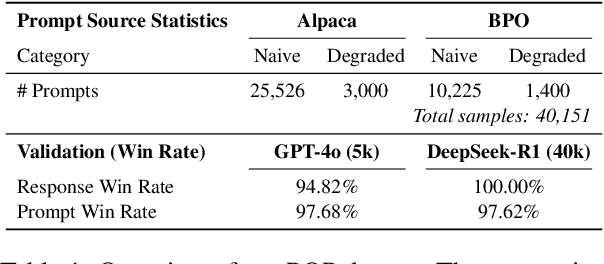
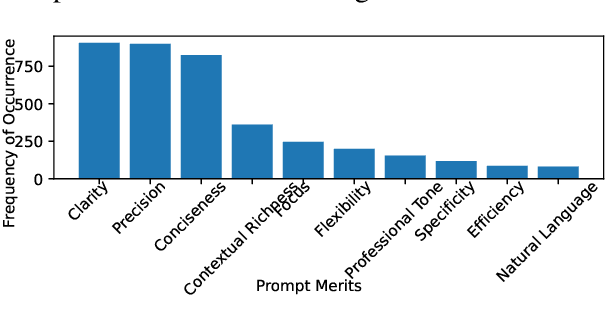
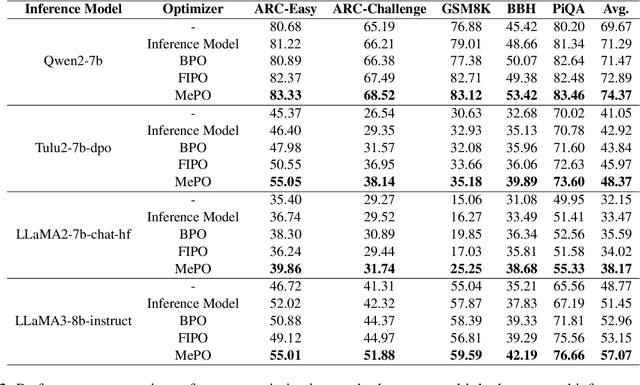
Prompt optimization (PO) offers a practical alternative to fine-tuning large language models (LLMs), enabling performance improvements without altering model weights. Existing methods typically rely on advanced, large-scale LLMs like GPT-4 to generate optimized prompts. However, due to limited downward compatibility, verbose, instruction-heavy prompts from advanced LLMs can overwhelm lightweight inference models and degrade response quality. In this work, we rethink prompt optimization through the lens of interpretable design. We first identify a set of model-agnostic prompt quality merits and empirically validate their effectiveness in enhancing prompt and response quality. We then introduce MePO, a merit-guided, lightweight, and locally deployable prompt optimizer trained on our preference dataset built from merit-aligned prompts generated by a lightweight LLM. Unlike prior work, MePO avoids online optimization reliance, reduces cost and privacy concerns, and, by learning clear, interpretable merits, generalizes effectively to both large-scale and lightweight inference models. Experiments demonstrate that MePO achieves better results across diverse tasks and model types, offering a scalable and robust solution for real-world deployment. Our model and dataset are available at: https://github.com/MidiyaZhu/MePO