 Add to Chrome
 Add to Firefox
 Add to Edge
Admission Without Answers: Label-Free Certification and Experience Learning for LLM-Based Optimization Modeling
Aug 18, 2026
Experience-learning agents for optimization modeling improve by storing verified skills, but existing learners admit knowledge by checking against known answers, which real ticket streams do not provide. The natural label-free alternatives are unreliable: on a 300-problem label-blind stream, admitting every executable model poisons roughly one admission in four, while single-instance agreement accepts models that match at one value but differ elsewhere. We propose AdmitOR, an admission gate built on calibrated external behavioral evidence. Candidates from three model families, prompting strategies, and solver stacks are run on instances resampled from an extracted parameter domain; agreement across the resulting value-function traces is summarized by a cross-family clique, and a calibrated threshold returns accept, abstain, or escalate. The preregistered false-discovery criterion holds on calibration data but not on the wild stream. We report this negative result in full and trace most failures to benchmark texts that do not faithfully encode their labeled instances. Comparing four admission judges on one collection of logs inside a state-of-the-art skill learner, AdmitOR raises admission precision to 0.927, against 0.871 for majority vote and 0.726 for execution success, yielding 3.1x and 8.0x fewer poisoned admissions. Its library is the smallest and attains the highest macro accuracy across five public benchmarks, 58.4 against 54.8 for majority vote and 53.9 for the ground-truth-labeled library. The 3.5-point gain over majority vote is supported by a paired bootstrap and survives correction for a host-side anomaly. To our knowledge, AdmitOR is the first label-free admission mechanism designed around an explicitly calibrated false-discovery target. The transfer failure identifies a necessary condition for extending it to wild streams.

Best-Arm Identification with Generative Proxy
Jul 08, 2026Best-arm identification is a canonical model for data-driven decision-making, but in many applications each reward observation is costly. Motivated by the growing availability of cheap predictions from machine learning and large language models, we study fixed-confidence best-arm identification in which each costly reward pull is paired with a cheap but correlated proxy score. The marginal mean of the proxy can be estimated offline and is treated as known, whereas its correlation $ρ$ with the reward, which governs how much the proxy helps, is unknown and must be learned online in pair with real rewards. We show that a control-variate adjustment turns this model into a heteroscedastic identification problem whose oracle sample complexity improves by residual variance $1-ρ^2$. The central difficulty is that the correlation must be learned from the same costly samples that identification consumes online, and that a plug-in estimate of the residual variance is anti-conservative and can compromise correctness. We propose PROBE (PRoxy OLS for Best-arm Exploration), a phase-elimination algorithm that directly maintains an upper certificate on the residual variance with an ordinary least squares fit, whose exact chi-square law keeps the certificate valid regardless of the unknown correlation. We prove that PROBE is $δ$-PAC and attains the known-correlation oracle sample complexity up to a constant multiplicative factor and a constant additive calibration cost. The guarantee extends to the $(ε,δ)$-PAC setting under minimal changes to the algorithm. Numerical experiments on synthetic instances and on an auto-loan pricing replay with large language model and tabular proxies confirm that the sample savings of PROBE scale with the strength of the reward-proxy correlation, exactly as the theory predicts.
FrontierOR: Benchmarking LLMs' Capacity for Efficient Algorithm Design in Large-Scale Optimization
May 26, 2026Large language models (LLMs) are increasingly used for optimization modeling and solver-code generation, yet practical operations research and optimization problems often require a harder capability: designing scalable algorithms that exploit problem structure and outperform direct formulation-and-solve baselines. Existing benchmarks are limited to small or simplified examples far below real-world scale and complexity. We introduce FrontierOR, among the first benchmarks to systematically evaluate LLM-based efficient algorithm design for realistic large-scale optimization problems. FrontierOR includes 180 tasks derived from methodologically diverse papers published in top-tier operations research venues, each with standardized instances and a hidden, expert-verified evaluation suite. We evaluate seven LLMs spanning frontier, cost-effective, and open-source models both in one-shot and test-time evolution settings. The results reveal that frontier models still struggle to move from executable formulations to efficient optimization algorithms: the strongest one-shot model outperforms Gurobi in only 31% of cases in both solution quality and computational efficiency, and even strong coding agents with test-time evolution achieve only 50% on selected hard tasks. FrontierOR establishes a practical evaluation platform for LLM-based optimization algorithm design, which enables future LLMs and agents to be systematically tested on whether they can move beyond correct formulation toward a feasible, high-quality, and efficient algorithm.
Automated Reformulation of Robust Optimization via Memory-Augmented Large Language Models
May 12, 2026Robust optimization (RO) provides a principled framework for decision-making under uncertainty, but its practical use is often limited by the need to manually reformulate uncertain optimization models into tractable deterministic counterparts. Recent large language models (LLMs) have been shown promising for automating optimization formulation, yet RO reformulation remains challenging because it requires precise multi-step reasoning and mathematically consistent transformations. To facilitate systematic evaluation of LLM-based reformulation, for which no dedicated benchmark currently exists, we develop AutoRO-Bench, a benchmark featuring an automated data generation pipeline for the core RO reformulation task and a curated dataset for the RO application task. To address the reformulation challenge, we propose Automated Reformulation with Experience Memory (AutoREM), a tuning-free memory-augmented framework that autonomously builds a structured textual experience memory by reflecting on past failed trajectories through a tailored offline adaptation procedure. AutoREM requires neither domain-specific expert knowledge nor parameter updates, and the resulting memory readily transfers across different base LLMs. Experimental results show that AutoREM consistently improves the accuracy and efficiency of RO reformulation across in-distribution datasets, out-of-distribution datasets, and diverse base LLMs.
Offline Policy Learning with Weight Clipping and Heaviside Composite Optimization
Jan 17, 2026Offline policy learning aims to use historical data to learn an optimal personalized decision rule. In the standard estimate-then-optimize framework, reweighting-based methods (e.g., inverse propensity weighting or doubly robust estimators) are widely used to produce unbiased estimates of policy values. However, when the propensity scores of some treatments are small, these reweighting-based methods suffer from high variance in policy value estimation, which may mislead the downstream policy optimization and yield a learned policy with inferior value. In this paper, we systematically develop an offline policy learning algorithm based on a weight-clipping estimator that truncates small propensity scores via a clipping threshold chosen to minimize the mean squared error (MSE) in policy value estimation. Focusing on linear policies, we address the bilevel and discontinuous objective induced by weight-clipping-based policy optimization by reformulating the problem as a Heaviside composite optimization problem, which provides a rigorous computational framework. The reformulated policy optimization problem is then solved efficiently using the progressive integer programming method, making practical policy learning tractable. We establish an upper bound for the suboptimality of the proposed algorithm, which reveals how the reduction in MSE of policy value estimation, enabled by our proposed weight-clipping estimator, leads to improved policy learning performance.
LLM for Large-Scale Optimization Model Auto-Formulation: A Lightweight Few-Shot Learning Approach
Jan 14, 2026Large-scale optimization is a key backbone of modern business decision-making. However, building these models is often labor-intensive and time-consuming. We address this by proposing LEAN-LLM-OPT, a LightwEight AgeNtic workflow construction framework for LLM-assisted large-scale OPTimization auto-formulation. LEAN-LLM-OPT takes as input a problem description together with associated datasets and orchestrates a team of LLM agents to produce an optimization formulation. Specifically, upon receiving a query, two upstream LLM agents dynamically construct a workflow that specifies, step-by-step, how optimization models for similar problems can be formulated. A downstream LLM agent then follows this workflow to generate the final output. Leveraging LLMs' text-processing capabilities and common modeling practices, the workflow decomposes the modeling task into a sequence of structured sub-tasks and offloads mechanical data-handling operations to auxiliary tools. This design alleviates the downstream agent's burden related to planning and data handling, allowing it to focus on the most challenging components that cannot be readily standardized. Extensive simulations show that LEAN-LLM-OPT, instantiated with GPT-4.1 and the open source gpt-oss-20B, achieves strong performance on large-scale optimization modeling tasks and is competitive with state-of-the-art approaches. In addition, in a Singapore Airlines choice-based revenue management use case, LEAN-LLM-OPT demonstrates practical value by achieving leading performance across a range of scenarios. Along the way, we introduce Large-Scale-OR and Air-NRM, the first comprehensive benchmarks for large-scale optimization auto-formulation. The code and data of this work is available at https://github.com/CoraLiang01/lean-llm-opt.
On Pareto Optimality for the Multinomial Logistic Bandit
Jan 31, 2025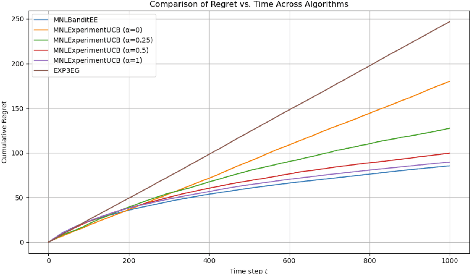
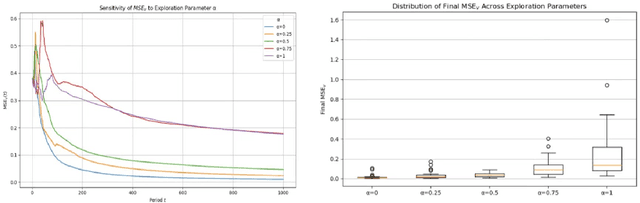
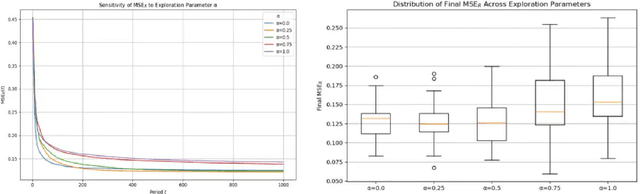
We provide a new online learning algorithm for tackling the Multinomial Logit Bandit (MNL-Bandit) problem. Despite the challenges posed by the combinatorial nature of the MNL model, we develop a novel Upper Confidence Bound (UCB)-based method that achieves Pareto optimality by balancing regret minimization and estimation error of the assortment revenues and the MNL parameters. We develop theoretical guarantees characterizing the tradeoff between regret and estimation error for the MNL-Bandit problem through information-theoretic bounds, and propose a modified UCB algorithm that incorporates forced exploration to improve parameter estimation accuracy while maintaining low regret. Our analysis sheds critical insights into how to optimally balance the collected revenues and the treatment estimation in dynamic assortment optimization.
Online Resource Allocation with Non-Stationary Customers
Jan 30, 2024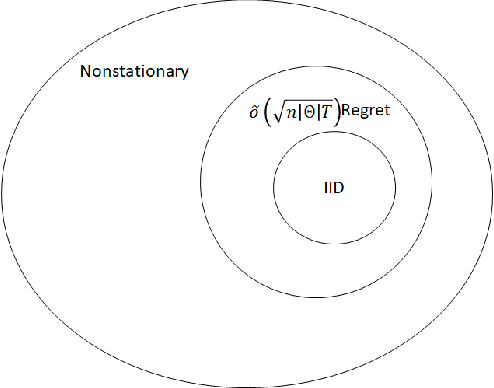
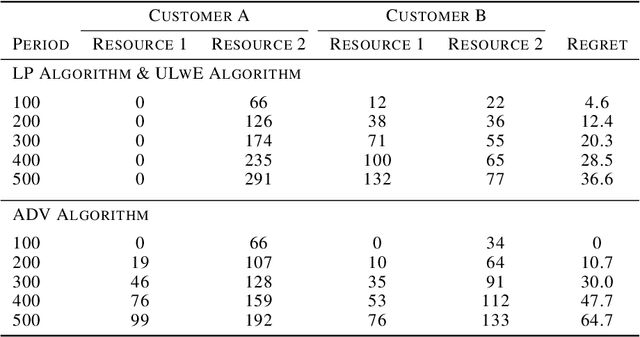
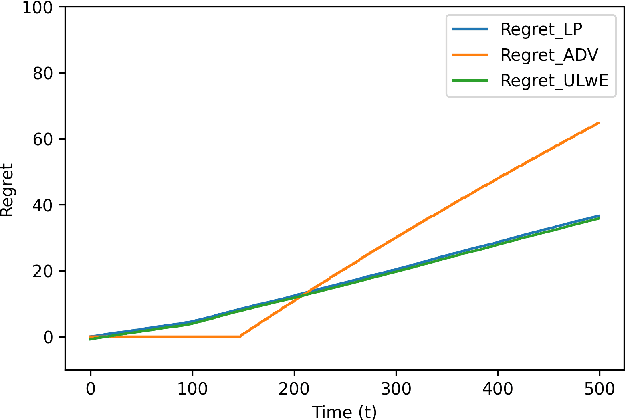
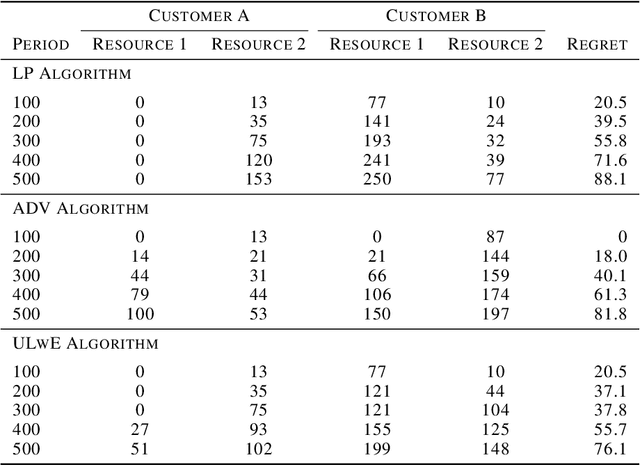
We propose a novel algorithm for online resource allocation with non-stationary customer arrivals and unknown click-through rates. We assume multiple types of customers arrive in a nonstationary stochastic fashion, with unknown arrival rates in each period, and that customers' click-through rates are unknown and can only be learned online. By leveraging results from the stochastic contextual bandit with knapsack and online matching with adversarial arrivals, we develop an online scheme to allocate the resources to nonstationary customers. We prove that under mild conditions, our scheme achieves a ``best-of-both-world'' result: the scheme has a sublinear regret when the customer arrivals are near-stationary, and enjoys an optimal competitive ratio under general (non-stationary) customer arrival distributions. Finally, we conduct extensive numerical experiments to show our approach generates near-optimal revenues for all different customer scenarios.