 Add to Chrome
 Add to Firefox
 Add to Edge
FNF: Functional Network Fingerprint for Large Language Models
Jan 30, 2026
The development of large language models (LLMs) is costly and has significant commercial value. Consequently, preventing unauthorized appropriation of open-source LLMs and protecting developers' intellectual property rights have become critical challenges. In this work, we propose the Functional Network Fingerprint (FNF), a training-free, sample-efficient method for detecting whether a suspect LLM is derived from a victim model, based on the consistency between their functional network activity. We demonstrate that models that share a common origin, even with differences in scale or architecture, exhibit highly consistent patterns of neuronal activity within their functional networks across diverse input samples. In contrast, models trained independently on distinct data or with different objectives fail to preserve such activity alignment. Unlike conventional approaches, our method requires only a few samples for verification, preserves model utility, and remains robust to common model modifications (such as fine-tuning, pruning, and parameter permutation), as well as to comparisons across diverse architectures and dimensionalities. FNF thus provides model owners and third parties with a simple, non-invasive, and effective tool for protecting LLM intellectual property. The code is available at https://github.com/WhatAboutMyStar/LLM_ACTIVATION.

Adaptive Bidirectional Displacement for Semi-Supervised Medical Image Segmentation
May 01, 2024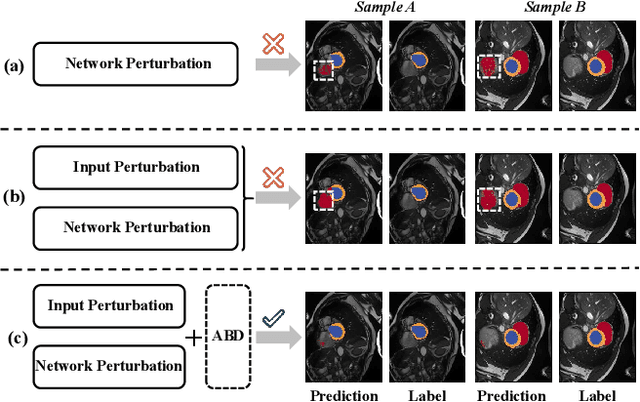
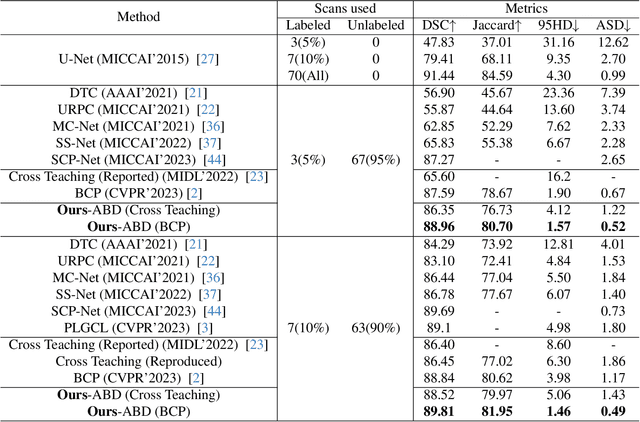
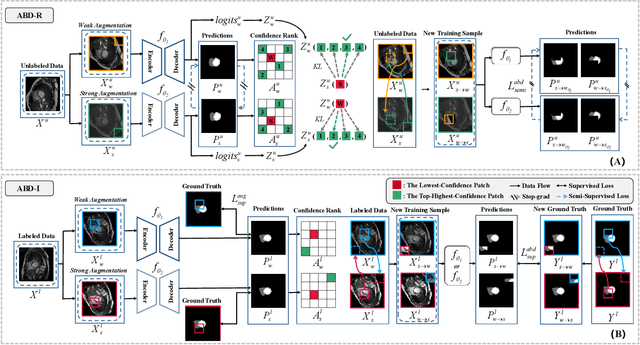
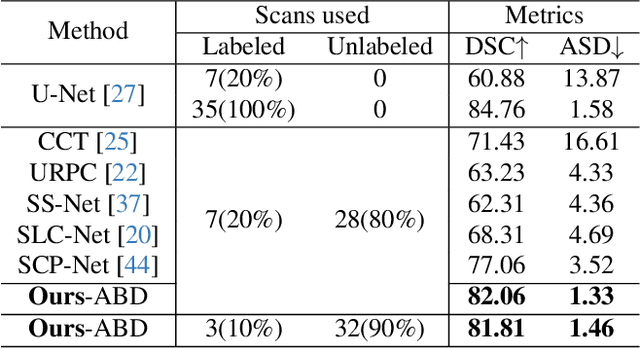
Consistency learning is a central strategy to tackle unlabeled data in semi-supervised medical image segmentation (SSMIS), which enforces the model to produce consistent predictions under the perturbation. However, most current approaches solely focus on utilizing a specific single perturbation, which can only cope with limited cases, while employing multiple perturbations simultaneously is hard to guarantee the quality of consistency learning. In this paper, we propose an Adaptive Bidirectional Displacement (ABD) approach to solve the above challenge. Specifically, we first design a bidirectional patch displacement based on reliable prediction confidence for unlabeled data to generate new samples, which can effectively suppress uncontrollable regions and still retain the influence of input perturbations. Meanwhile, to enforce the model to learn the potentially uncontrollable content, a bidirectional displacement operation with inverse confidence is proposed for the labeled images, which generates samples with more unreliable information to facilitate model learning. Extensive experiments show that ABD achieves new state-of-the-art performances for SSMIS, significantly improving different baselines. Source code is available at https://github.com/chy-upc/ABD.