 Add to Chrome
 Add to Firefox
 Add to Edge
DynFly: Dynamic-Aware Continuous Trajectory Generation for UAV Vision-Language Navigation in Urban Environments
Jun 30, 2026
Recent advances in multimodal large models have significantly improved UAV vision-language navigation (UAV-VLN) by enhancing high-level perception and reasoning. However, existing methods mainly focus on predicting discrete actions, local targets, or sparse waypoints, while the continuous transition from navigation intent to executable UAV motion remains weakly modeled. This motion-interface gap limits the continuity, stability, and executability of generated UAV trajectories. To address this gap, we propose DynFly, a dynamic-aware continuous trajectory generation framework that bridges high-level navigation reasoning and executable UAV motion. DynFly bridges high-level navigation intent and continuous UAV motion through a lightweight trajectory generation layer. Specifically, it represents expert trajectories in B-spline control-point space and employs a Spline-DiT generator to learn conditional trajectory generation via flow matching. Furthermore, we introduce UAV-oriented dynamic-aware supervision over position, finite-difference velocity, finite-difference acceleration, heading consistency, and local target alignment, enabling the generated trajectories to better satisfy UAV motion characteristics. And our trajectory generation framework can also be integrated with an existing UAV-VLN framework while preserving its original visual-language reasoning pipeline. Extensive experiments on the OpenUAV UAV-VLN benchmark show that DynFly improves both navigation performance and trajectory quality. On the Test Unseen Full split, DynFly improves the strongest baseline by 4.69 NDTW, 2.40 SDTW, 2.14 SR points and 4.87 OSR points, while reducing NE by 4.51 m.

SpatialFly: Geometry-Guided Representation Alignment for UAV Vision-and-Language Navigation in Urban Environments
Mar 22, 2026UAVs play an important role in applications such as autonomous exploration, disaster response, and infrastructure inspection. However, UAV VLN in complex 3D environments remains challenging. A key difficulty is the structural representation mismatch between 2D visual perception and the 3D trajectory decision space, which limits spatial reasoning. To this end, we propose SpatialFly, a geometry-guided spatial representation framework for UAV VLN. Operating on RGB observations without explicit 3D reconstruction, SpatialFly introduces a geometry-guided 2D representation alignment mechanism. Specifically, the geometric prior injection module injects global structural cues into 2D semantic tokens to provide scene-level geometric guidance. The geometry-aware reparameterization module then aligns 2D semantic tokens with 3D geometric tokens through cross-modal attention, followed by gated residual fusion to preserve semantic discrimination. Experimental results show that SpatialFly consistently outperforms state-of-the-art UAV VLN baselines across both seen and unseen environments, reducing NE by 4.03m and improving SR by 1.27% over the strongest baseline on the unseen Full split. Additional trajectory-level analysis shows that SpatialFly produces trajectories with better path alignment and smoother, more stable motion.
Separating Drone Point Clouds From Complex Backgrounds by Cluster Filter -- Technical Report for CVPR 2024 UG2 Challenge
Dec 22, 2024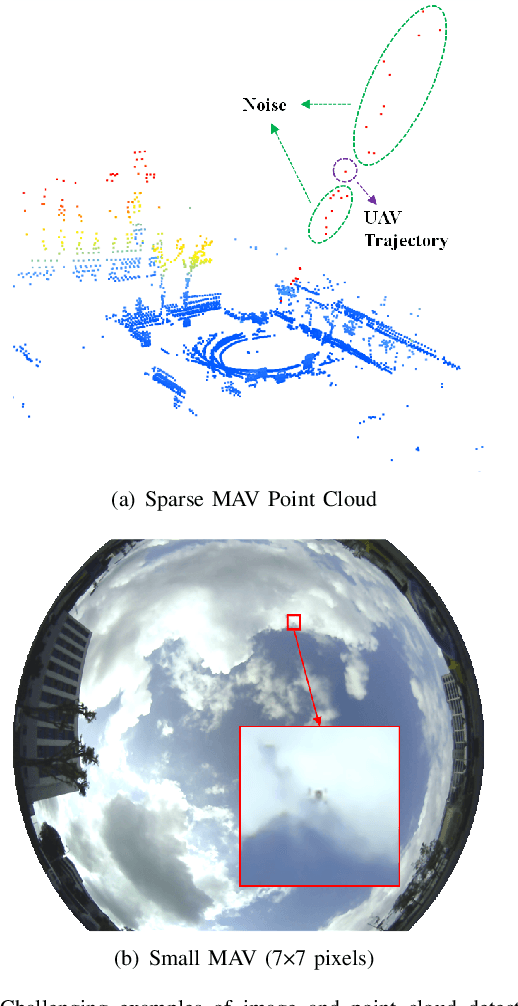
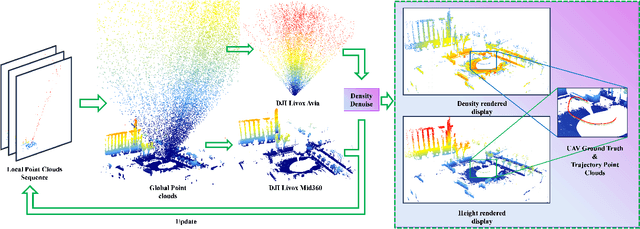
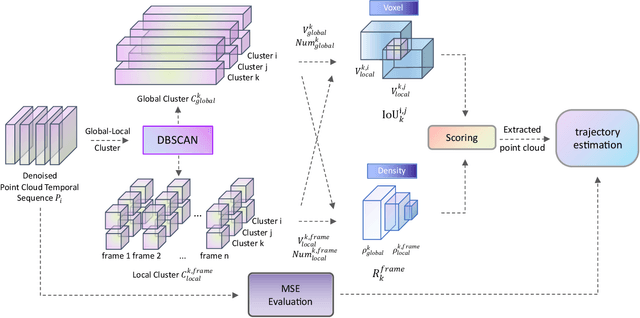
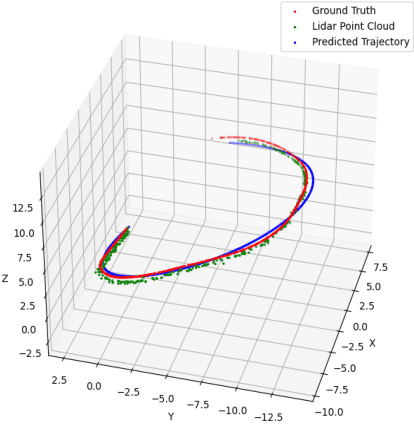
The increasing deployment of small drones as tools of conflict and disruption has amplified their threat, highlighting the urgent need for effective anti-drone measures. However, the compact size of most drones presents a significant challenge, as traditional supervised point cloud or image-based object detection methods often fail to identify such small objects effectively. This paper proposes a simple UAV detection method using an unsupervised pipeline. It uses spatial-temporal sequence processing to fuse multiple lidar datasets effectively, tracking and determining the position of UAVs, so as to detect and track UAVs in challenging environments. Our method performs front and rear background segmentation of point clouds through a global-local sequence clusterer and parses point cloud data from both the spatial-temporal density and spatial-temporal voxels of the point cloud. Furthermore, a scoring mechanism for point cloud moving targets is proposed, using time series detection to improve accuracy and efficiency. We used the MMAUD dataset, and our method achieved 4th place in the CVPR 2024 UG2+ Challenge, confirming the effectiveness of our method in practical applications.
Unsupervised UAV 3D Trajectories Estimation with Sparse Point Clouds
Dec 17, 2024Compact UAV systems, while advancing delivery and surveillance, pose significant security challenges due to their small size, which hinders detection by traditional methods. This paper presents a cost-effective, unsupervised UAV detection method using spatial-temporal sequence processing to fuse multiple LiDAR scans for accurate UAV tracking in real-world scenarios. Our approach segments point clouds into foreground and background, analyzes spatial-temporal data, and employs a scoring mechanism to enhance detection accuracy. Tested on a public dataset, our solution placed 4th in the CVPR 2024 UG2+ Challenge, demonstrating its practical effectiveness. We plan to open-source all designs, code, and sample data for the research community github.com/lianghanfang/UnLiDAR-UAV-Est.