 Add to Chrome
 Add to Firefox
 Add to Edge
URMF: Uncertainty-aware Robust Multimodal Fusion for Multimodal Sarcasm Detection
Apr 08, 2026
Multimodal sarcasm detection (MSD) aims to identify sarcastic intent from semantic incongruity between text and image. Although recent methods have improved MSD through cross-modal interaction and incongruity reasoning, they often assume that all modalities are equally reliable. In real-world social media, however, textual content may be ambiguous and visual content may be weakly relevant or even irrelevant, causing deterministic fusion to introduce noisy evidence and weaken robust reasoning. To address this issue, we propose Uncertainty-aware Robust Multimodal Fusion (URMF), a unified framework that explicitly models modality reliability during interaction and fusion. URMF first employs multi-head cross-attention to inject visual evidence into textual representations, followed by multi-head self-attention in the fused semantic space to enhance incongruity-aware reasoning. It then performs unified unimodal aleatoric uncertainty modeling over text, image, and interaction-aware latent representations by parameterizing each modality as a learnable Gaussian posterior. The estimated uncertainty is further used to dynamically regulate modality contributions during fusion, suppressing unreliable modalities and yielding a more robust joint representation. In addition, we design a joint training objective integrating task supervision, modality prior regularization, cross-modal distribution alignment, and uncertainty-driven self-sampling contrastive learning. Experiments on public MSD benchmarks show that URMF consistently outperforms strong unimodal, multimodal, and MLLM-based baselines, demonstrating the effectiveness of uncertainty-aware fusion for improving both accuracy and robustness.

Efficient Multi-scale Network with Learnable Discrete Wavelet Transform for Blind Motion Deblurring
Dec 29, 2023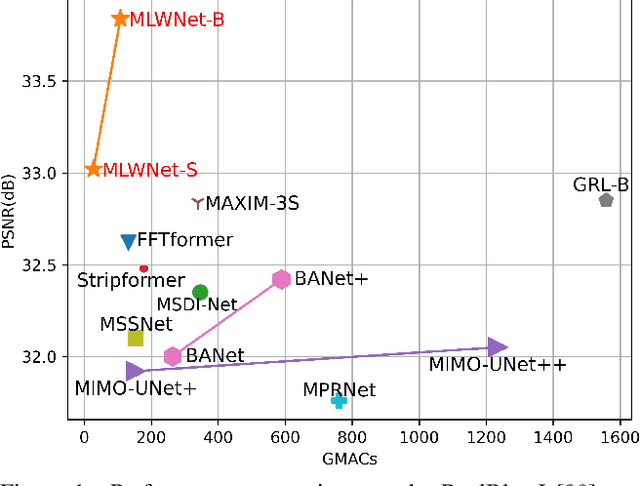
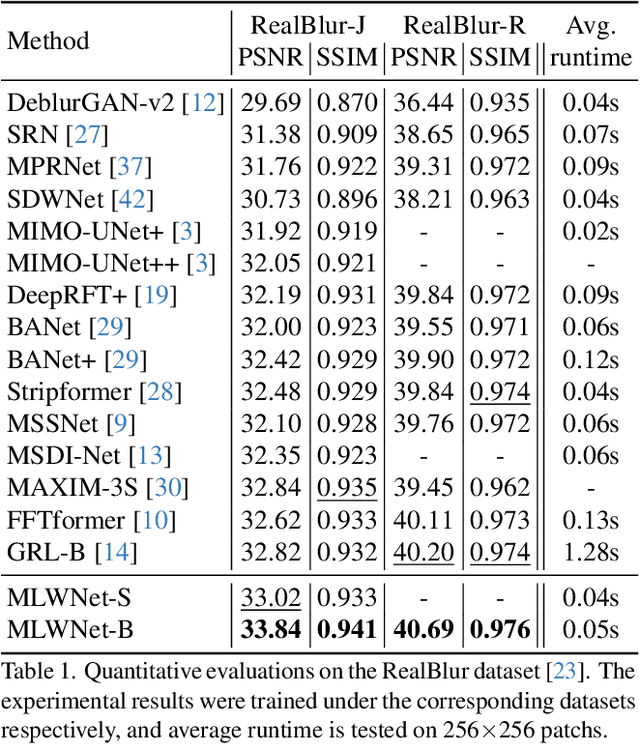
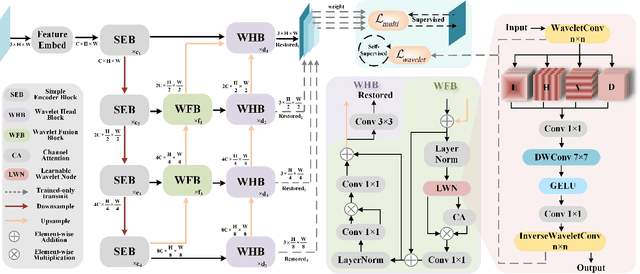

Coarse-to-fine schemes are widely used in traditional single-image motion deblur; however, in the context of deep learning, existing multi-scale algorithms not only require the use of complex modules for feature fusion of low-scale RGB images and deep semantics, but also manually generate low-resolution pairs of images that do not have sufficient confidence. In this work, we propose a multi-scale network based on single-input and multiple-outputs(SIMO) for motion deblurring. This simplifies the complexity of algorithms based on a coarse-to-fine scheme. To alleviate restoration defects impacting detail information brought about by using a multi-scale architecture, we combine the characteristics of real-world blurring trajectories with a learnable wavelet transform module to focus on the directional continuity and frequency features of the step-by-step transitions between blurred images to sharp images. In conclusion, we propose a multi-scale network with a learnable discrete wavelet transform (MLWNet), which exhibits state-of-the-art performance on multiple real-world deblurred datasets, in terms of both subjective and objective quality as well as computational efficiency.