 Add to Chrome
 Add to Firefox
 Add to Edge
Synthetic Data Powers Product Retrieval for Long-tail Knowledge-Intensive Queries in E-commerce Search
Feb 27, 2026
Product retrieval is the backbone of e-commerce search: for each user query, it identifies a high-recall candidate set from billions of items, laying the foundation for high-quality ranking and user experience. Despite extensive optimization for mainstream queries, existing systems still struggle with long-tail queries, especially knowledge-intensive ones. These queries exhibit diverse linguistic patterns, often lack explicit purchase intent, and require domain-specific knowledge reasoning for accurate interpretation. They also suffer from a shortage of reliable behavioral logs, which makes such queries a persistent challenge for retrieval optimization. To address these issues, we propose an efficient data synthesis framework tailored to retrieval involving long-tail, knowledge-intensive queries. The key idea is to implicitly distill the capabilities of a powerful offline query-rewriting model into an efficient online retrieval system. Leveraging the strong language understanding of LLMs, we train a multi-candidate query rewriting model with multiple reward signals and capture its rewriting capability in well-curated query-product pairs through a powerful offline retrieval pipeline. This design mitigates distributional shift in rewritten queries, which might otherwise limit incremental recall or introduce irrelevant products. Experiments demonstrate that without any additional tricks, simply incorporating this synthetic data into retrieval model training leads to significant improvements. Online Side-By-Side (SBS) human evaluation results indicate a notable enhancement in user search experience.

TaoSearchEmb: A Multi-Objective Reinforcement Learning Framework for Dense Retrieval in Taobao Search
Nov 17, 2025Dense retrieval, as the core component of e-commerce search engines, maps user queries and items into a unified semantic space through pre-trained embedding models to enable large-scale real-time semantic retrieval. Despite the rapid advancement of LLMs gradually replacing traditional BERT architectures for embedding, their training paradigms still adhere to BERT-like supervised fine-tuning and hard negative mining strategies. This approach relies on complex offline hard negative sample construction pipelines, which constrain model iteration efficiency and hinder the evolutionary potential of semantic representation capabilities. Besides, existing multi-task learning frameworks face the seesaw effect when simultaneously optimizing semantic relevance and non-relevance objectives. In this paper, we propose Retrieval-GRPO, a multi-objective reinforcement learning-based dense retrieval framework designed to address these challenges. The method eliminates offline hard negative sample construction by dynamically retrieving Top-K candidate products for each query during training, while introducing a relevance LLM as a reward model to generate real-time feedback. Specifically, the retrieval model dynamically optimizes embedding representations through reinforcement learning, with reward signals combining LLM-generated relevance scores, product quality scores, and multi-way exclusivity metrics to achieve multi-objective user preference alignment and real-time error correction. This mechanism not only removes dependency on hard negatives but also mitigates the seesaw effect through collaborative multi-objective optimization, significantly enhancing the model's semantic generalization capability for complex long-tail queries. Extensive offline and online experiments validate the effectiveness of Retrieval-GRPO, which has been deployed on China's largest e-commerce platform.
Learning to Rank Utterances for Query-Focused Meeting Summarization
May 22, 2023Query-focused meeting summarization(QFMS) aims to generate a specific summary for the given query according to the meeting transcripts. Due to the conflict between long meetings and limited input size, previous works mainly adopt extract-then-summarize methods, which use extractors to simulate binary labels or ROUGE scores to extract utterances related to the query and then generate a summary. However, the previous approach fails to fully use the comparison between utterances. To the extractor, comparison orders are more important than specific scores. In this paper, we propose a Ranker-Generator framework. It learns to rank the utterances by comparing them in pairs and learning from the global orders, then uses top utterances as the generator's input. We show that learning to rank utterances helps to select utterances related to the query effectively, and the summarizer can benefit from it. Experimental results on QMSum show that the proposed model outperforms all existing multi-stage models with fewer parameters.
Query-Utterance Attention with Joint modeling for Query-Focused Meeting Summarization
Mar 08, 2023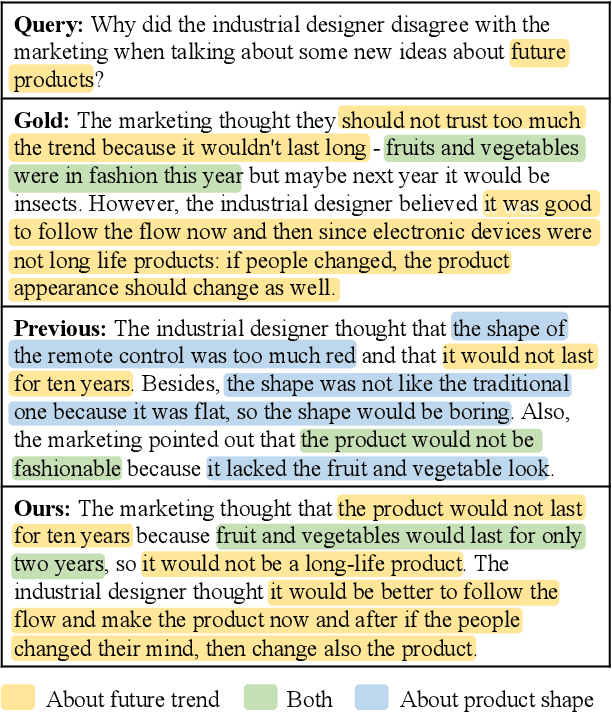
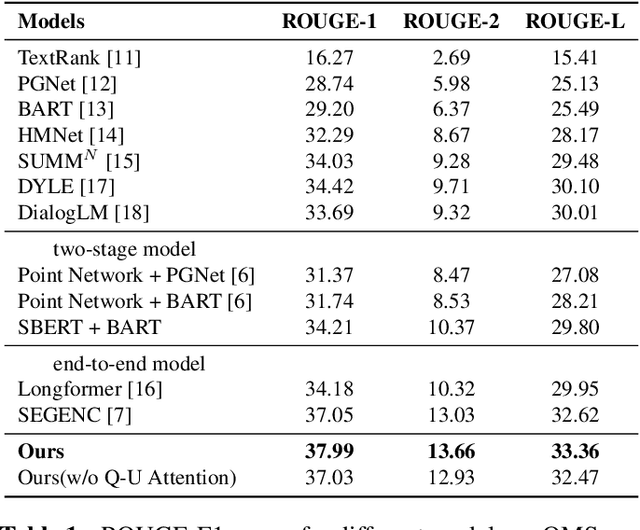
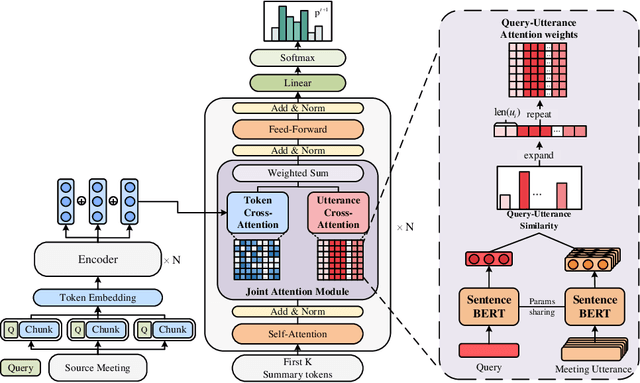
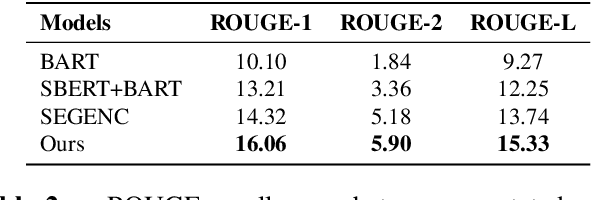
Query-focused meeting summarization (QFMS) aims to generate summaries from meeting transcripts in response to a given query. Previous works typically concatenate the query with meeting transcripts and implicitly model the query relevance only at the token level with attention mechanism. However, due to the dilution of key query-relevant information caused by long meeting transcripts, the original transformer-based model is insufficient to highlight the key parts related to the query. In this paper, we propose a query-aware framework with joint modeling token and utterance based on Query-Utterance Attention. It calculates the utterance-level relevance to the query with a dense retrieval module. Then both token-level query relevance and utterance-level query relevance are combined and incorporated into the generation process with attention mechanism explicitly. We show that the query relevance of different granularities contributes to generating a summary more related to the query. Experimental results on the QMSum dataset show that the proposed model achieves new state-of-the-art performance.