 Add to Chrome
 Add to Firefox
 Add to Edge
How Psychological Learning Paradigms Shaped and Constrained Artificial Intelligence
Mar 18, 2026
The dominant paradigms of artificial intelligence were shaped by learning theories from psychology: behaviorism inspired reinforcement learning, cognitivism gave rise to deep learning and memory-augmented architectures, and constructivism influenced curriculum learning and compositional approaches. This paper argues that each AI paradigm inherited not only the strengths but the structural limitations of the psychological theory that inspired it. Reinforcement learning cannot account for the internal structure of knowledge, deep learning compresses representations into opaque parameter spaces resistant to principled update, and current integrative approaches lack a formal account of how new understanding is constructed from existing components. The paper further examines a cross-cultural divergence in the interpretation of rote learning, arguing that the Eastern conception of memorization as a structured, multi-phase precursor to understanding offers an underexploited bridge between psychological theory and AI methodology. Drawing on the systematicity debate and critique of Aizawa of both classicism and connectionism, this paper introduces ReSynth, a trimodular framework that separates reasoning (Intellect), purpose (Identity), and knowledge (Memory) as architecturally independent components. The paper traces the genealogy from psychological paradigm to AI method, diagnoses the inherited limitations at each stage, and argues that adaptability, the central challenge of artificial general intelligence requires a representational architecture in which systematic behavior is a necessary consequence rather than an accidental property.

Contracting and Involutive Negations of Probability Distributions
Mar 30, 2021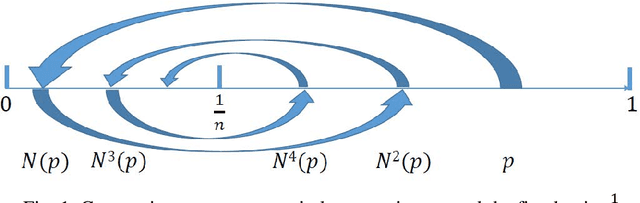
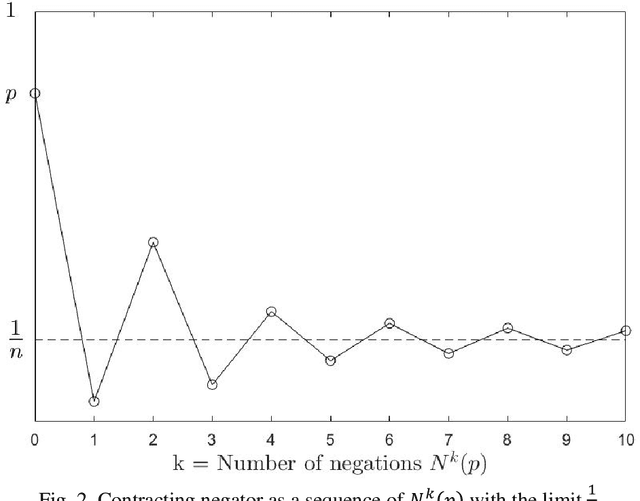
A dozen papers have considered the concept of negation of probability distributions (pd) introduced by Yager. Usually, such negations are generated point-by-point by functions defined on a set of probability values and called here negators. Recently it was shown that Yager negator plays a crucial role in the definition of pd-independent linear negators: any linear negator is a function of Yager negator. Here, we prove that the sequence of multiple negations of pd generated by a linear negator converges to the uniform distribution with maximal entropy. We show that any pd-independent negator is non-involutive, and any non-trivial linear negator is strictly contracting. Finally, we introduce an involutive negator in the class of pd-dependent negators that generates an involutive negation of probability distributions.
Generating Negations of Probability Distributions
Mar 27, 2021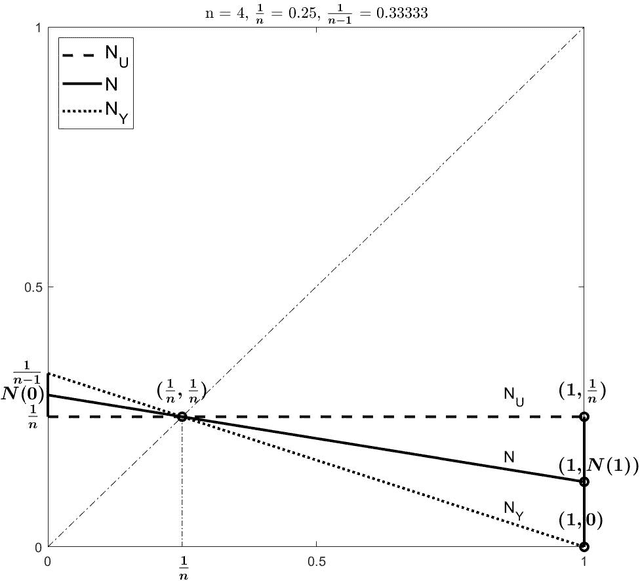
Recently it was introduced a negation of a probability distribution. The need for such negation arises when a knowledge-based system can use the terms like NOT HIGH, where HIGH is represented by a probability distribution (pd). For example, HIGH PROFIT or HIGH PRICE can be considered. The application of this negation in Dempster-Shafer theory was considered in many works. Although several negations of probability distributions have been proposed, it was not clear how to construct other negations. In this paper, we consider negations of probability distributions as point-by-point transformations of pd using decreasing functions defined on [0,1] called negators. We propose the general method of generation of negators and corresponding negations of pd, and study their properties. We give a characterization of linear negators as a convex combination of Yager and uniform negators.
Constructing Time Series Shape Association Measures: Minkowski Distance and Data Standardization
May 20, 2014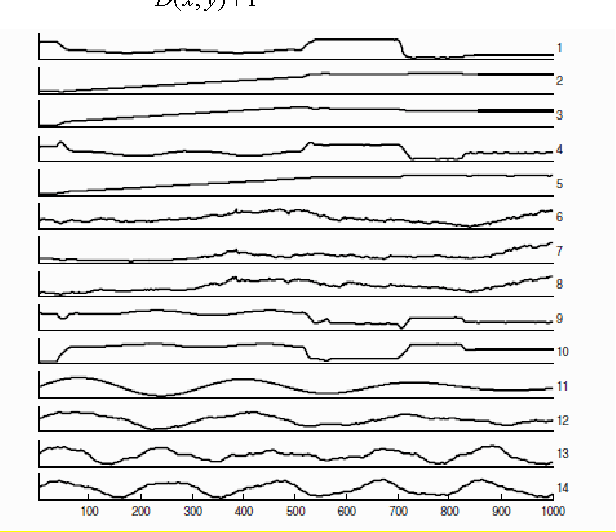
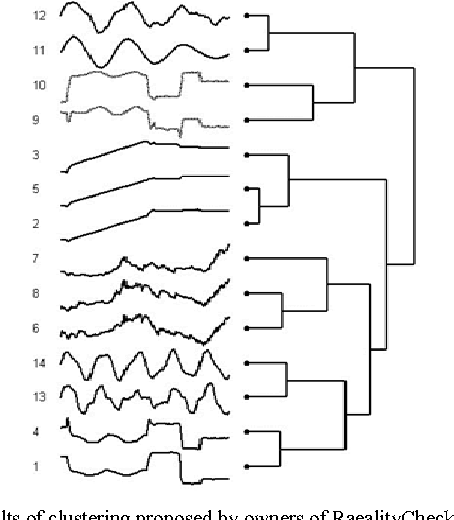
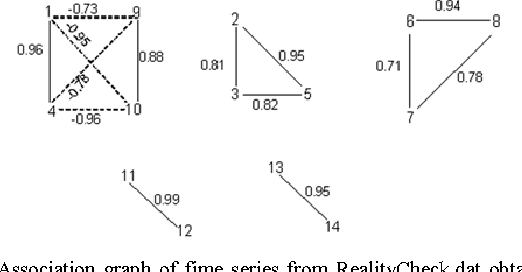
It is surprising that last two decades many works in time series data mining and clustering were concerned with measures of similarity of time series but not with measures of association that can be used for measuring possible direct and inverse relationships between time series. Inverse relationships can exist between dynamics of prices and sell volumes, between growth patterns of competitive companies, between well production data in oilfields, between wind velocity and air pollution concentration etc. The paper develops a theoretical basis for analysis and construction of time series shape association measures. Starting from the axioms of time series shape association measures it studies the methods of construction of measures satisfying these axioms. Several general methods of construction of such measures suitable for measuring time series shape similarity and shape association are proposed. Time series shape association measures based on Minkowski distance and data standardization methods are considered. The cosine similarity and the Pearsons correlation coefficient are obtained as particular cases of the proposed general methods that can be used also for construction of new association measures in data analysis.
* Presented at BRICS CCI 2013, Porto de Galinhas, Brasil, 8-11 September 2013. Reference on Proceedings of BRICS CCI 2013 is added