 Add to Chrome
 Add to Firefox
 Add to Edge
Analyzing Error Sources in Global Feature Effect Estimation
Mar 17, 2026
Global feature effects such as partial dependence (PD) and accumulated local effects (ALE) plots are widely used to interpret black-box models. However, they are only estimates of true underlying effects, and their reliability depends on multiple sources of error. Despite the popularity of global feature effects, these error sources are largely unexplored. In particular, the practically relevant question of whether to use training or holdout data to estimate feature effects remains unanswered. We address this gap by providing a systematic, estimator-level analysis that disentangles sources of bias and variance for PD and ALE. To this end, we derive a mean-squared-error decomposition that separates model bias, estimation bias, model variance, and estimation variance, and analyze their dependence on model characteristics, data selection, and sample size. We validate our theoretical findings through an extensive simulation study across multiple data-generating processes, learners, estimation strategies (training data, validation data, and cross-validation), and sample sizes. Our results reveal that, while using holdout data is theoretically the cleanest, potential biases arising from the training data are empirically negligible and dominated by the impact of the usually higher sample size. The estimation variance depends on both the presence of interactions and the sample size, with ALE being particularly sensitive to the latter. Cross-validation-based estimation is a promising approach that reduces the model variance component, particularly for overfitting models. Our analysis provides a principled explanation of the sources of error in feature effect estimates and offers concrete guidance on choosing estimation strategies when interpreting machine learning models.

xplainfi: Feature Importance and Statistical Inference for Machine Learning in R
Mar 16, 2026We introduce xplainfi, an R package built on top of the mlr3 ecosystem for global, loss-based feature importance methods for machine learning models. Various feature importance methods exist in R, but significant gaps remain, particularly regarding conditional importance methods and associated statistical inference procedures. The package implements permutation feature importance, conditional feature importance, relative feature importance, leave-one-covariate-out, and generalizations thereof, and both marginal and conditional Shapley additive global importance methods. It provides a modular conditional sampling architecture based on Gaussian distributions, adversarial random forests, conditional inference trees, and knockoff-based samplers, which enable conditional importance analysis for continuous and mixed data. Statistical inference is available through multiple approaches, including variance-corrected confidence intervals and the conditional predictive impact framework. We demonstrate that xplainfi produces importance scores consistent with existing implementations across multiple simulation settings and learner types, while offering competitive runtime performance. The package is available on CRAN and provides researchers and practitioners with a comprehensive toolkit for feature importance analysis and model interpretation in R.
CASHomon Sets: Efficient Rashomon Sets Across Multiple Model Classes and their Hyperparameters
Mar 16, 2026Rashomon sets are model sets within one model class that perform nearly as well as a reference model from the same model class. They reveal the existence of alternative well-performing models, which may support different interpretations. This enables selecting models that match domain knowledge, hidden constraints, or user preferences. However, efficient construction methods currently exist for only a few model classes. Applied machine learning usually searches many model classes, and the best class is unknown beforehand. We therefore study Rashomon sets in the combined algorithm selection and hyperparameter optimization (CASH) setting and call them CASHomon sets. We propose TruVaRImp, a model-based active learning algorithm for level set estimation with an implicit threshold, and provide convergence guarantees. On synthetic and real-world datasets, TruVaRImp reliably identifies CASHomon sets members and matches or outperforms naive sampling, Bayesian optimization, classical and implicit level set estimation methods, and other baselines. Our analyses of predictive multiplicity and feature-importance variability across model classes question the common practice of interpreting data through a single model class.
Interpretability-by-Design with Accurate Locally Additive Models and Conditional Feature Effects
Feb 18, 2026Generalized additive models (GAMs) offer interpretability through independent univariate feature effects but underfit when interactions are present in data. GA$^2$Ms add selected pairwise interactions which improves accuracy, but sacrifices interpretability and limits model auditing. We propose \emph{Conditionally Additive Local Models} (CALMs), a new model class, that balances the interpretability of GAMs with the accuracy of GA$^2$Ms. CALMs allow multiple univariate shape functions per feature, each active in different regions of the input space. These regions are defined independently for each feature as simple logical conditions (thresholds) on the features it interacts with. As a result, effects remain locally additive while varying across subregions to capture interactions. We further propose a principled distillation-based training pipeline that identifies homogeneous regions with limited interactions and fits interpretable shape functions via region-aware backfitting. Experiments on diverse classification and regression tasks show that CALMs consistently outperform GAMs and achieve accuracy comparable with GA$^2$Ms. Overall, CALMs offer a compelling trade-off between predictive accuracy and interpretability.
Optimal Transport Group Counterfactual Explanations
Jan 28, 2026Group counterfactual explanations find a set of counterfactual instances to explain a group of input instances contrastively. However, existing methods either (i) optimize counterfactuals only for a fixed group and do not generalize to new group members, (ii) strictly rely on strong model assumptions (e.g., linearity) for tractability or/and (iii) poorly control the counterfactual group geometry distortion. We instead learn an explicit optimal transport map that sends any group instance to its counterfactual without re-optimization, minimizing the group's total transport cost. This enables generalization with fewer parameters, making it easier to interpret the common actionable recourse. For linear classifiers, we prove that functions representing group counterfactuals are derived via mathematical optimization, identifying the underlying convex optimization type (QP, QCQP, ...). Experiments show that they accurately generalize, preserve group geometry and incur only negligible additional transport cost compared to baseline methods. If model linearity cannot be exploited, our approach also significantly outperforms the baselines.
Privilege Scores
Feb 03, 2025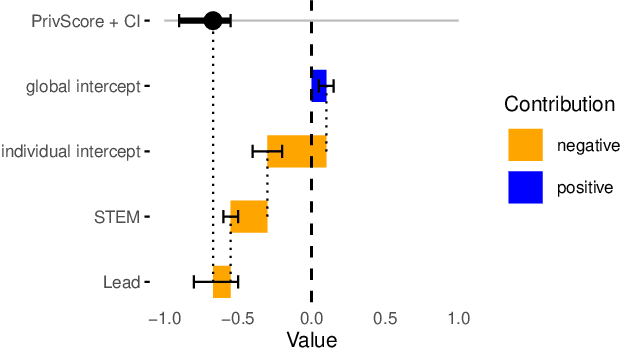
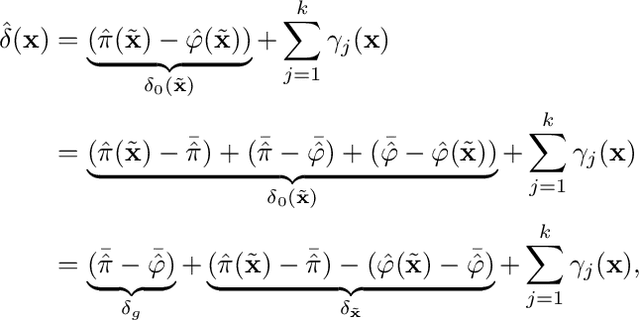
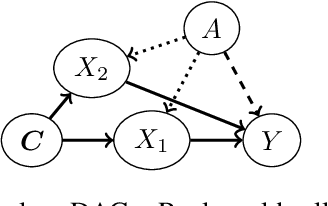

Bias-transforming methods of fairness-aware machine learning aim to correct a non-neutral status quo with respect to a protected attribute (PA). Current methods, however, lack an explicit formulation of what drives non-neutrality. We introduce privilege scores (PS) to measure PA-related privilege by comparing the model predictions in the real world with those in a fair world in which the influence of the PA is removed. At the individual level, PS can identify individuals who qualify for affirmative action; at the global level, PS can inform bias-transforming policies. After presenting estimation methods for PS, we propose privilege score contributions (PSCs), an interpretation method that attributes the origin of privilege to mediating features and direct effects. We provide confidence intervals for both PS and PSCs. Experiments on simulated and real-world data demonstrate the broad applicability of our methods and provide novel insights into gender and racial privilege in mortgage and college admissions applications.
Efficient and Accurate Explanation Estimation with Distribution Compression
Jun 26, 2024Exact computation of various machine learning explanations requires numerous model evaluations and in extreme cases becomes impractical. The computational cost of approximation increases with an ever-increasing size of data and model parameters. Many heuristics have been proposed to approximate post-hoc explanations efficiently. This paper shows that the standard i.i.d. sampling used in a broad spectrum of algorithms for explanation estimation leads to an approximation error worthy of improvement. To this end, we introduce Compress Then Explain (CTE), a new paradigm for more efficient and accurate explanation estimation. CTE uses distribution compression through kernel thinning to obtain a data sample that best approximates the marginal distribution. We show that CTE improves the estimation of removal-based local and global explanations with negligible computational overhead. It often achieves an on-par explanation approximation error using 2-3x less samples, i.e. requiring 2-3x less model evaluations. CTE is a simple, yet powerful, plug-in for any explanation method that now relies on i.i.d. sampling.
On the Robustness of Global Feature Effect Explanations
Jun 13, 2024We study the robustness of global post-hoc explanations for predictive models trained on tabular data. Effects of predictor features in black-box supervised learning are an essential diagnostic tool for model debugging and scientific discovery in applied sciences. However, how vulnerable they are to data and model perturbations remains an open research question. We introduce several theoretical bounds for evaluating the robustness of partial dependence plots and accumulated local effects. Our experimental results with synthetic and real-world datasets quantify the gap between the best and worst-case scenarios of (mis)interpreting machine learning predictions globally.
Position Paper: Rethinking Empirical Research in Machine Learning: Addressing Epistemic and Methodological Challenges of Experimentation
May 03, 2024We warn against a common but incomplete understanding of empirical research in machine learning (ML) that leads to non-replicable results, makes findings unreliable, and threatens to undermine progress in the field. To overcome this alarming situation, we call for more awareness of the plurality of ways of gaining knowledge experimentally but also of some epistemic limitations. In particular, we argue most current empirical ML research is fashioned as confirmatory research while it should rather be considered exploratory.
mlr3summary: Concise and interpretable summaries for machine learning models
Apr 25, 2024
This work introduces a novel R package for concise, informative summaries of machine learning models. We take inspiration from the summary function for (generalized) linear models in R, but extend it in several directions: First, our summary function is model-agnostic and provides a unified summary output also for non-parametric machine learning models; Second, the summary output is more extensive and customizable -- it comprises information on the dataset, model performance, model complexity, model's estimated feature importances, feature effects, and fairness metrics; Third, models are evaluated based on resampling strategies for unbiased estimates of model performances, feature importances, etc. Overall, the clear, structured output should help to enhance and expedite the model selection process, making it a helpful tool for practitioners and researchers alike.