 Add to Chrome
 Add to Firefox
 Add to Edge
SAILS: Surrogate-based Analysis of Interactions via Local Effect Smooths
Jun 08, 2026
Feature interactions drive much of the predictive power of machine learning models, yet existing explanation methods only detect and quantify interactions without revealing their functional form, or visualize only restricted interaction types. We propose Surrogate-based Analysis of Interactions via Local effect Smooths (SAILS), a model-agnostic framework that analyzes pairwise interactions through interpretable generalized additive model (GAM) surrogates fitted to the local effects of a black-box model. For each interval of a feature of interest, the surrogate smooth terms isolate the interaction components on derivative level, enabling (i) interaction detection through a heuristic derived from significance tests on smooth terms, (ii) interaction form categorization into linear, product-separable, and non-product-separable types, and (iii) tailored, interpretable visualizations for each interaction type. We empirically validate the framework through controlled simulations and a real-world task, demonstrating its effectiveness for pairwise interactions, with limitations under strong feature correlations and higher-order interactions. SAILS fills a notable gap in the XAI toolbox, going beyond detection of interactions alone to characterizing their functional form.

Analyzing Error Sources in Global Feature Effect Estimation
Mar 17, 2026Global feature effects such as partial dependence (PD) and accumulated local effects (ALE) plots are widely used to interpret black-box models. However, they are only estimates of true underlying effects, and their reliability depends on multiple sources of error. Despite the popularity of global feature effects, these error sources are largely unexplored. In particular, the practically relevant question of whether to use training or holdout data to estimate feature effects remains unanswered. We address this gap by providing a systematic, estimator-level analysis that disentangles sources of bias and variance for PD and ALE. To this end, we derive a mean-squared-error decomposition that separates model bias, estimation bias, model variance, and estimation variance, and analyze their dependence on model characteristics, data selection, and sample size. We validate our theoretical findings through an extensive simulation study across multiple data-generating processes, learners, estimation strategies (training data, validation data, and cross-validation), and sample sizes. Our results reveal that, while using holdout data is theoretically the cleanest, potential biases arising from the training data are empirically negligible and dominated by the impact of the usually higher sample size. The estimation variance depends on both the presence of interactions and the sample size, with ALE being particularly sensitive to the latter. Cross-validation-based estimation is a promising approach that reduces the model variance component, particularly for overfitting models. Our analysis provides a principled explanation of the sources of error in feature effect estimates and offers concrete guidance on choosing estimation strategies when interpreting machine learning models.
CAPO: Cost-Aware Prompt Optimization
Apr 22, 2025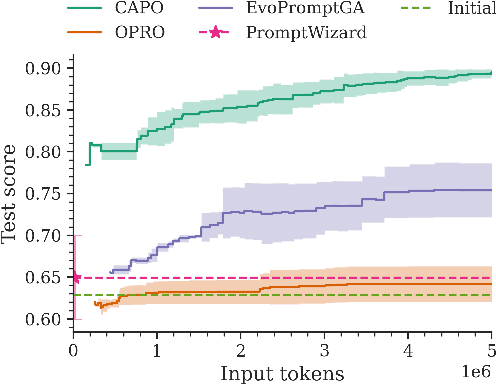
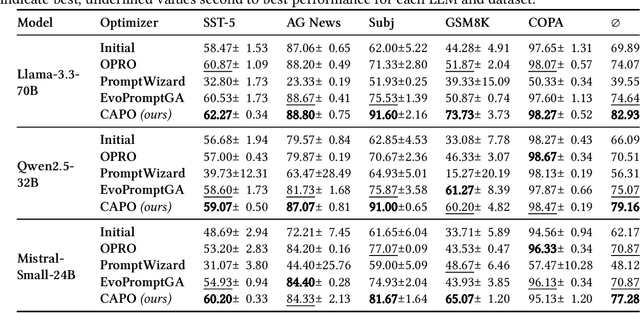
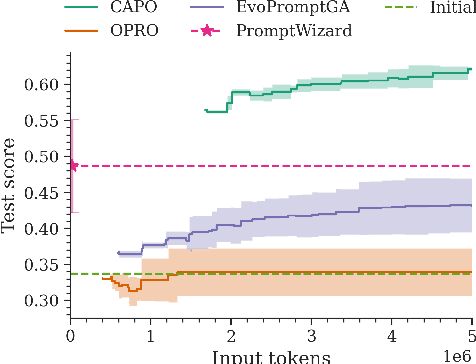
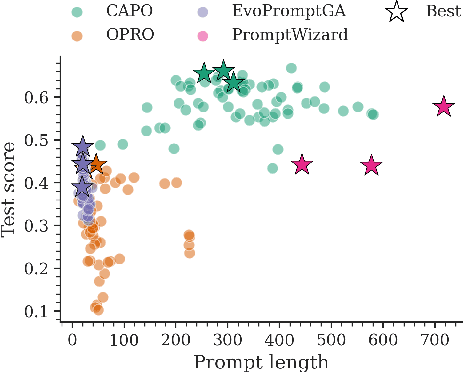
Large language models (LLMs) have revolutionized natural language processing by solving a wide range of tasks simply guided by a prompt. Yet their performance is highly sensitive to prompt formulation. While automated prompt optimization addresses this challenge by finding optimal prompts, current methods require a substantial number of LLM calls and input tokens, making prompt optimization expensive. We introduce CAPO (Cost-Aware Prompt Optimization), an algorithm that enhances prompt optimization efficiency by integrating AutoML techniques. CAPO is an evolutionary approach with LLMs as operators, incorporating racing to save evaluations and multi-objective optimization to balance performance with prompt length. It jointly optimizes instructions and few-shot examples while leveraging task descriptions for improved robustness. Our extensive experiments across diverse datasets and LLMs demonstrate that CAPO outperforms state-of-the-art discrete prompt optimization methods in 11/15 cases with improvements up to 21%p. Our algorithm achieves better performances already with smaller budgets, saves evaluations through racing, and decreases average prompt length via a length penalty, making it both cost-efficient and cost-aware. Even without few-shot examples, CAPO outperforms its competitors and generally remains robust to initial prompts. CAPO represents an important step toward making prompt optimization more powerful and accessible by improving cost-efficiency.