 Add to Chrome
 Add to Firefox
 Add to Edge
LiD-GLM: Lipschitz-constrained Deep Generalized Linear Models
Aug 17, 2026
The combination of traditional statistical models and neural network (NN) components into semi-structured hybrid models is an intriguing approach to construct models that, ideally, combine traditional interpretability with the unprecedented flexibility of NNs. In order to preserve interpretability, it is usually necessary to restrict the NN components to prevent them from dominating the model. However, existing methods that enforce structural constraints on their NN components severely limit their models' flexibility; in contrast, methods that only enforce weak, indirect constraints lose meaningful interpretability. The method we propose therefore leverages invertible residual neural networks (i-ResNets) to equip generalized linear models with both nonlinear parameter estimation and a flexible correction of their distributional assumptions while always retaining stochastic monotonicity of the modeled distribution in the (formerly linear) predictor. The i-ResNets correspond to a controlled deviation from identity and by constraining their Lipschitz constant one can rigorously limit and quantify how far the hybrid model deviates from its traditional counterpart. This enables a user-specifiable compromise between flexibility and interpretability without limiting the structure of nonlinear and interaction effects that can be learned. Furthermore, we develop specific inherent interpretation techniques for our model and enforce model identifiability through an adapted post-hoc orthogonalization.

xMICD: Explainable Representation of Multiple ICD Codes
Aug 02, 2026Electronic Health Records (EHRs) are widely used for clinical risk prediction using machine learning. International Classification of Diseases (ICD) codes provide structured information about patient diagnoses, but representing them effectively remains challenging. Existing approaches often face a trade-off between predictive performance and interpretability: grouping-based representations are interpretable but may lose information, while embedding-based representations achieve strong predictive performance but are difficult to interpret. We propose Explainable Representation of Multiple ICD Codes (xMICD), a method for constructing low-dimensional patient representations from sets of ICD codes. xMICD combines clinically meaningful diagnostic groupings with similarity in a pre-trained ICD embedding space. Instead of using binary group membership, the method assigns codes to groups via similarity-based relative assignments, yielding features that reflect how closely a patient's diagnoses align with each clinical group. Experiments on large-scale EHR datasets demonstrate that xMICD achieves predictive performance comparable to embedding-based representations such as ICD2Vec across multiple clinical prediction tasks. At the same time, the resulting features remain clinically interpretable because each dimension corresponds to a recognizable diagnostic group. xMICD therefore provides a practical way to integrate embedding-based semantic relationships into interpretable clinical feature spaces for machine learning models.
xplainfi: Feature Importance and Statistical Inference for Machine Learning in R
Mar 16, 2026We introduce xplainfi, an R package built on top of the mlr3 ecosystem for global, loss-based feature importance methods for machine learning models. Various feature importance methods exist in R, but significant gaps remain, particularly regarding conditional importance methods and associated statistical inference procedures. The package implements permutation feature importance, conditional feature importance, relative feature importance, leave-one-covariate-out, and generalizations thereof, and both marginal and conditional Shapley additive global importance methods. It provides a modular conditional sampling architecture based on Gaussian distributions, adversarial random forests, conditional inference trees, and knockoff-based samplers, which enable conditional importance analysis for continuous and mixed data. Statistical inference is available through multiple approaches, including variance-corrected confidence intervals and the conditional predictive impact framework. We demonstrate that xplainfi produces importance scores consistent with existing implementations across multiple simulation settings and learner types, while offering competitive runtime performance. The package is available on CRAN and provides researchers and practitioners with a comprehensive toolkit for feature importance analysis and model interpretation in R.
Machine Learning in Epidemiology
Feb 18, 2026In the age of digital epidemiology, epidemiologists are faced by an increasing amount of data of growing complexity and dimensionality. Machine learning is a set of powerful tools that can help to analyze such enormous amounts of data. This chapter lays the methodological foundations for successfully applying machine learning in epidemiology. It covers the principles of supervised and unsupervised learning and discusses the most important machine learning methods. Strategies for model evaluation and hyperparameter optimization are developed and interpretable machine learning is introduced. All these theoretical parts are accompanied by code examples in R, where an example dataset on heart disease is used throughout the chapter.
Functional Decomposition and Shapley Interactions for Interpreting Survival Models
Feb 18, 2026Hazard and survival functions are natural, interpretable targets in time-to-event prediction, but their inherent non-additivity fundamentally limits standard additive explanation methods. We introduce Survival Functional Decomposition (SurvFD), a principled approach for analyzing feature interactions in machine learning survival models. By decomposing higher-order effects into time-dependent and time-independent components, SurvFD offers a previously unrecognized perspective on survival explanations, explicitly characterizing when and why additive explanations fail. Building on this theoretical decomposition, we propose SurvSHAP-IQ, which extends Shapley interactions to time-indexed functions, providing a practical estimator for higher-order, time-dependent interactions. Together, SurvFD and SurvSHAP-IQ establish an interaction- and time-aware interpretability approach for survival modeling, with broad applicability across time-to-event prediction tasks.
GRANITE: A Generalized Regional Framework for Identifying Agreement in Feature-Based Explanations
Jan 30, 2026Feature-based explanation methods aim to quantify how features influence the model's behavior, either locally or globally, but different methods often disagree, producing conflicting explanations. This disagreement arises primarily from two sources: how feature interactions are handled and how feature dependencies are incorporated. We propose GRANITE, a generalized regional explanation framework that partitions the feature space into regions where interaction and distribution influences are minimized. This approach aligns different explanation methods, yielding more consistent and interpretable explanations. GRANITE unifies existing regional approaches, extends them to feature groups, and introduces a recursive partitioning algorithm to estimate such regions. We demonstrate its effectiveness on real-world datasets, providing a practical tool for consistent and interpretable feature explanations.
Imputation Uncertainty in Interpretable Machine Learning Methods
Dec 19, 2025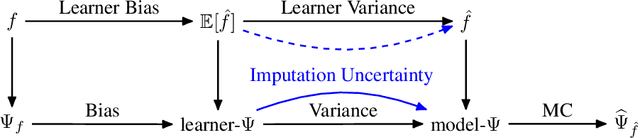
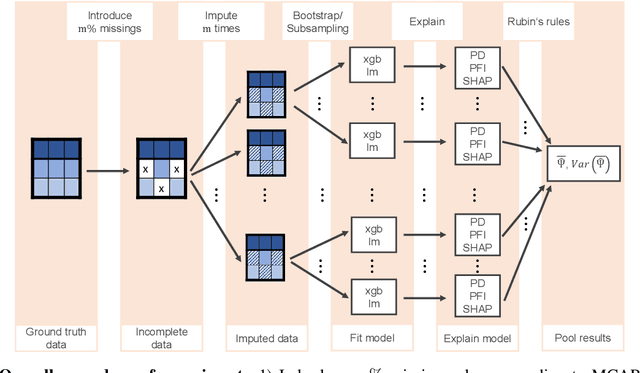
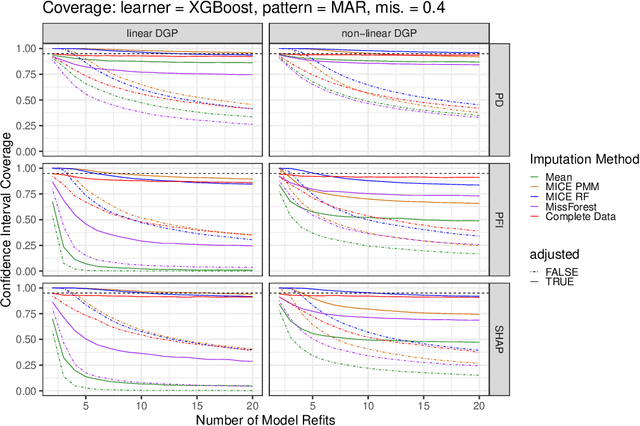
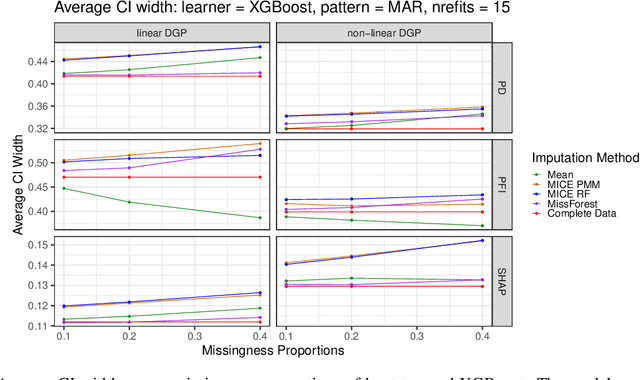
In real data, missing values occur frequently, which affects the interpretation with interpretable machine learning (IML) methods. Recent work considers bias and shows that model explanations may differ between imputation methods, while ignoring additional imputation uncertainty and its influence on variance and confidence intervals. We therefore compare the effects of different imputation methods on the confidence interval coverage probabilities of the IML methods permutation feature importance, partial dependence plots and Shapley values. We show that single imputation leads to underestimation of variance and that, in most cases, only multiple imputation is close to nominal coverage.
Can synthetic data reproduce real-world findings in epidemiology? A replication study using tree-based generative AI
Aug 19, 2025Generative artificial intelligence for synthetic data generation holds substantial potential to address practical challenges in epidemiology. However, many current methods suffer from limited quality, high computational demands, and complexity for non-experts. Furthermore, common evaluation strategies for synthetic data often fail to directly reflect statistical utility. Against this background, a critical underexplored question is whether synthetic data can reliably reproduce key findings from epidemiological research. We propose the use of adversarial random forests (ARF) as an efficient and convenient method for synthesizing tabular epidemiological data. To evaluate its performance, we replicated statistical analyses from six epidemiological publications and compared original with synthetic results. These publications cover blood pressure, anthropometry, myocardial infarction, accelerometry, loneliness, and diabetes, based on data from the German National Cohort (NAKO Gesundheitsstudie), the Bremen STEMI Registry U45 Study, and the Guelph Family Health Study. Additionally, we assessed the impact of dimensionality and variable complexity on synthesis quality by limiting datasets to variables relevant for individual analyses, including necessary derivations. Across all replicated original studies, results from multiple synthetic data replications consistently aligned with original findings. Even for datasets with relatively low sample size-to-dimensionality ratios, the replication outcomes closely matched the original results across various descriptive and inferential analyses. Reducing dimensionality and pre-deriving variables further enhanced both quality and stability of the results.
Gradient-based Explanations for Deep Learning Survival Models
Feb 07, 2025Deep learning survival models often outperform classical methods in time-to-event predictions, particularly in personalized medicine, but their "black box" nature hinders broader adoption. We propose a framework for gradient-based explanation methods tailored to survival neural networks, extending their use beyond regression and classification. We analyze the implications of their theoretical assumptions for time-dependent explanations in the survival setting and propose effective visualizations incorporating the temporal dimension. Experiments on synthetic data show that gradient-based methods capture the magnitude and direction of local and global feature effects, including time dependencies. We introduce GradSHAP(t), a gradient-based counterpart to SurvSHAP(t), which outperforms SurvSHAP(t) and SurvLIME in a computational speed vs. accuracy trade-off. Finally, we apply these methods to medical data with multi-modal inputs, revealing relevant tabular features and visual patterns, as well as their temporal dynamics.
Conditional Feature Importance with Generative Modeling Using Adversarial Random Forests
Jan 19, 2025This paper proposes a method for measuring conditional feature importance via generative modeling. In explainable artificial intelligence (XAI), conditional feature importance assesses the impact of a feature on a prediction model's performance given the information of other features. Model-agnostic post hoc methods to do so typically evaluate changes in the predictive performance under on-manifold feature value manipulations. Such procedures require creating feature values that respect conditional feature distributions, which can be challenging in practice. Recent advancements in generative modeling can facilitate this. For tabular data, which may consist of both categorical and continuous features, the adversarial random forest (ARF) stands out as a generative model that can generate on-manifold data points without requiring intensive tuning efforts or computational resources, making it a promising candidate model for subroutines in XAI methods. This paper proposes cARFi (conditional ARF feature importance), a method for measuring conditional feature importance through feature values sampled from ARF-estimated conditional distributions. cARFi requires only little tuning to yield robust importance scores that can flexibly adapt for conditional or marginal notions of feature importance, including straightforward extensions to condition on feature subsets and allows for inferring the significance of feature importances through statistical tests.