 Add to Chrome
 Add to Firefox
 Add to Edge
Long-Range Backscatter: A Bottom-Up Approach
May 12, 2026
Continued progress towards energy-neutral Internet of Things (IoT) nodes expose the wireless communication link as the dominant energy bottleneck. While low-power wide-area network (LPWAN) technologies achieve long-range communication with multiple years of battery life, their active radios hinder reaching full energy neutrality. Long-range backscatter communication emerged as a key enabler, reaching one to three order of magnitude lower power consumption. New advancements leverage concepts from active radio systems such as chirp spread spectrum (CSS) modulation and integrate them on a low-power backscatter tag. This paper presents a comprehensive survey of long-range backscatter communication, using a bottom-up analysis spanning system topologies, hardware architecture, modulation techniques and medium access. Backscatter communication requires different topologies compared to active radios to reach longer communication distances. Different hardware architectures support backscattering a modulated signal with differing complexity, power consumption and spectral efficiency. At the physical layer binary switch-based modulation are well known and provide an easy form of modulation while chirp spread spectrum (CSS)-based modulation gain traction due to their robustness. Medium Access Control (MAC) techniques are examined with a focus on synchronization, concurrency and lightweight feedback mechanisms requiring low-power, low-complexity hardware. Building on these established solutions the paper evaluates the feasibility of long-range backscatter communication in different energy-neutral Internet of Things (IoT) applications. Starting from the available energy budget, harvested through solar, radio frequency (RF) or capacitive harvesting, feasible hardware, modulation and Medium Access Control (MAC) solutions are explored.

An Open-Source Hardware-Aware Sub-THz Radio-Stripe Simulator
Apr 16, 2026Sub-Terahertz radio-stripe and distributed MIMO architectures promise extreme spatial reuse and multi-GHz bandwidths, but the cascaded fiber front-haul and RF hardware impairments strongly shape end-to-end performance. This paper presents an open-source, configuration-driven simulator that models the full waveform-level signal chain from CP-OFDM baseband generation in the central unit, through measurement-parameterized polymer microwave fiber and coupler links, to booster/active Radio Units (RUs) with configurable nonlinearity, noise, in-phase and quadrature imbalance, and oscillator phase noise and carrier frequency offset. Wireless propagation is supported via lightweight deterministic and stochastic per-subcarrier channel models as well as site-specific ray-tracing datasets generated with a companion Sionna ray-tracer module. The simulator exports intermediate waveforms and system metrics (e.g., normalised mean square error, signal-to-noise-and-distortion ratio, bit error rate) to enable reproducible studies of impairment accumulation, calibration, and algorithmic choices such as RU selection and beam management.
Experimental Evaluation of Geometry and Reciprocity-Based Beamforming with Large Arrays for RF Wireless Power Transfer
Apr 13, 2026This paper experimentally investigates geometry-based multi-antenna RF wireless power transfer (WPT) using a large-scale distributed indoor transmit array measuring 8 m by 4 m. Geometry-based beamforming uses known transmitter and receiver positions to perform phase-only precoding, avoiding the need for explicit channel estimation or feedback. The experiments use a ceiling-mounted array of 41 phase-synchronized transmit antennas operating at 920 MHz. Geometry-based beamforming is compared with channel state information (CSI)-based beamforming. The spatial power delivery is evaluated through two-dimensional scans over an area of 1.25 m by 1.25 m. The harvested DC power is measured using an RF-to-DC energy profiler. Under line-of-sight (LoS) conditions, geometry-based beamforming achieves a power gain of 18.75 dB, which is within 0.82 dB of CSI-based beamforming. In obstructed LoS scenarios with reflections, the gain decreases to 16.7 dB, while CSI-based beamforming achieves 20.53 dB, resulting in a performance gap of 3.83 dB. These results quantify the trade-off between reduced system overhead and robustness to multipath propagation in geometry-driven WPT, and represent an initial step toward geometry-based wireless power transfer enabled by digital twins.
Experimental Study of Interference Suppression for Backscatter Communication in Distributed MIMO
Apr 10, 2026Bistatic backscatter communication requires strong illumination of a backscatter device (BD), while a spatially separated reader detects the weak modulated reflection. In practice, the resulting direct link interference (DLI) at the reader can dominate the received backscattered signal and limit detection performance. This paper experimentally investigates transmit beamforming that jointly maximizes BD illumination and suppresses DLI at the reader in a distributed multiple-input multiple-output setup. We compare phase-only maximum ratio transmission (PO-MRT) with the proposed direct-link suppression (DLS) scheme, which enforces a spatial null at the reader under per-antenna power constraints. Measurements using a phase-coherent 42-element ceiling array at 920 MHz show that DLS reduces the DLI at the target reader and improves the signal-to-interference ratio by up to 31 dB compared to PO-MRT.
Testbed Evaluation of AI-based Precoding in Distributed MIMO Systems
Nov 14, 2025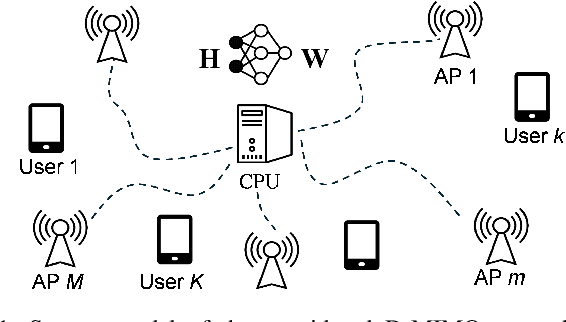
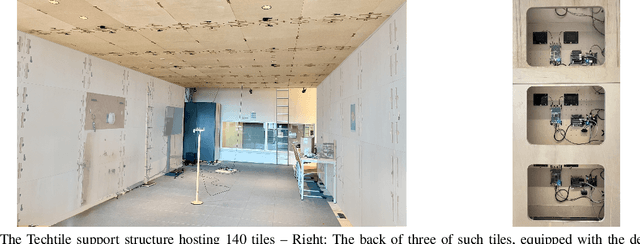
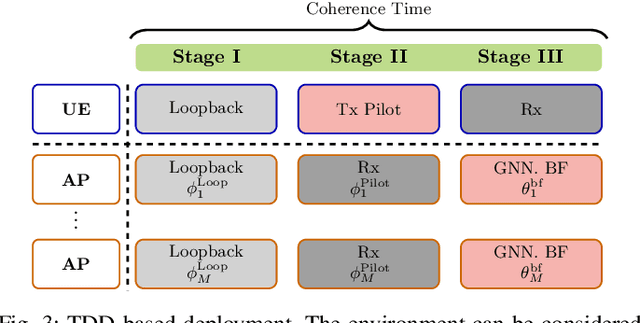
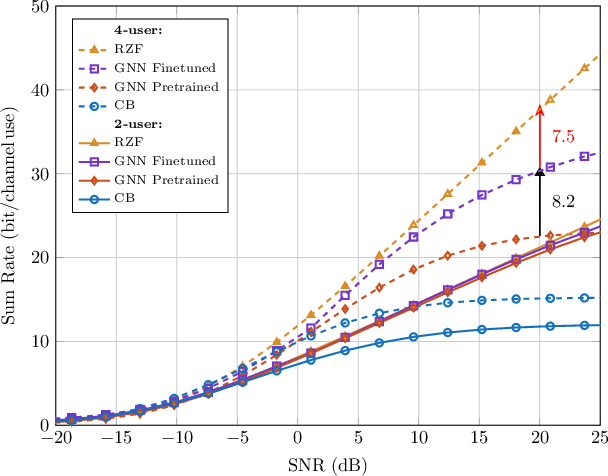
Distributed MIMO (D-MIMO) has emerged as a key architecture for future sixth-generation (6G) networks, enabling cooperative transmission across spatially distributed access points (APs). However, most existing studies rely on idealized channel models and lack hardware validation, leaving a gap between algorithmic design and practical deployment. Meanwhile, recent advances in artificial intelligence (AI)-driven precoding have shown strong potential for learning nonlinear channel-to-precoder mappings, but their real-world deployment remains limited due to challenges in data collection and model generalization. This work presents a framework for implementing and validating an AI-based precoder on a D-MIMO testbed with hardware reciprocity calibration. A pre-trained graph neural network (GNN)-based model is fine-tuned using real-world channel state information (CSI) collected from the Techtile platform and evaluated under both interpolation and extrapolation scenarios before end-to-end validation. Experimental results demonstrate a 15.7% performance gain over the pre-trained model in the multi-user case after fine-tuning, while in the single-user scenario the model achieves near-maximum ratio transmission (MRT) performance with less than 0.7 bits/channel use degradation out of a total throughput of 5.19 bits/channel use on unseen positions. Further analysis confirms the data efficiency of real-world measurements, showing consistent gains with increasing training samples, and end-to-end validation verifies coherent power focusing comparable to MRT.
RF-Powered Batteryless Plant Movement Sensor for Precision Agriculture
Sep 16, 2025Precision agriculture demands non-invasive, energy-efficient, and sustainable plant monitoring solutions. In this work, we present the design and implementation of a lightweight, batteryless plant movement sensor powered solely by RF energy. This sensor targets Controlled Environment Agriculture (CEA) and utilizes inertial measurements units (IMUs) to monitor leaf motion, which correlates with plant physiological responses to environmental stress. By eliminating the battery, we reduce the ecological footprint, weight, and maintenance requirements, transitioning from lifetime-based to operation-based energy storage. Our design minimizes circuit complexity while enabling flexible, adaptive readout scheduling based on energy availability and sensor data. We detail the energy requirements, RF power transfer considerations, integration constraints, and outline future directions, including multi-antenna power delivery and networked sensor synchronization.
A Low-Cost Open-Source BLE-Based Asian Hornet Tracking System
Sep 04, 2025The Asian hornet (Vespa velutina) poses a serious threat to ecosystems and beekeeping. Locating nests is essential, but usually involves time-consuming manual triangulation. We present a low-cost, open-source tracking system based on Bluetooth Low Energy (BLE). The system consists of a lightweight BLE tag and a software-defined radio (SDR) receiver implemented in GNU Radio. By bypassing the BLE stack, we embed a custom pseudo-noise (PN) sequence in the uncoded PHY for correlation-based detection. Using a Yagi antenna and PlutoSDR, the receiver performs digital beam sweeping to determine the tag's direction. Field tests show reliable angular resolution at 50m and a communication range up to 360m. While our modulation increases receiver complexity, it enables future improvements such as multichannel spreading and tag identification. The design is fully open-source and provides a scalable framework for hornet tracking and related applications in environmental monitoring.
GNN-based Precoder Design and Fine-tuning for Cell-free Massive MIMO with Real-world CSI
May 13, 2025Cell-free massive MIMO (CF-mMIMO) has emerged as a promising paradigm for delivering uniformly high-quality coverage in future wireless networks. To address the inherent challenges of precoding in such distributed systems, recent studies have explored the use of graph neural network (GNN)-based methods, using their powerful representation capabilities. However, these approaches have predominantly been trained and validated on synthetic datasets, leaving their generalizability to real-world propagation environments largely unverified. In this work, we initially pre-train the GNN using simulated channel state information (CSI) data, which incorporates standard propagation models and small-scale Rayleigh fading. Subsequently, we finetune the model on real-world CSI measurements collected from a physical testbed equipped with distributed access points (APs). To balance the retention of pre-trained features with adaptation to real-world conditions, we adopt a layer-freezing strategy during fine-tuning, wherein several GNN layers are frozen and only the later layers remain trainable. Numerical results demonstrate that the fine-tuned GNN significantly outperforms the pre-trained model, achieving an approximate 8.2 bits per channel use gain at 20 dB signal-to-noise ratio (SNR), corresponding to a 15.7 % improvement. These findings highlight the critical role of transfer learning and underscore the potential of GNN-based precoding techniques to effectively generalize from synthetic to real-world wireless environments.
Physically Large Apertures for Wireless Power Transfer: Performance and Regulatory Aspects
Mar 09, 2025Wireless power transfer (WPT) is a promising service for the Internet of Things, providing a cost-effective and sustainable solution to deploy so-called energy-neutral devices on a massive scale. The power received at the device side decays rapidly with the distance from a conventional transmit antenna with a physically small aperture. New opportunities arise from the transition from conventional far-field beamforming to near-field beam focusing. We argue that a "physically large" aperture, i.e., large w.r.t. the distance to the receiver, enables a power budget that remains practically independent of distance. Distance-dependent array gain patterns allow focusing the power density maximum precisely at the device location, while reducing the power density near the infrastructure. The physical aperture size is a key resource in enabling efficient yet regulatory-compliant WPT. We use real-world measurements to demonstrate that a regulatory-compliant system operating at sub-10GHz frequencies can increase the power received at the device into the milliwatt range. Our empirical demonstration shows that power-optimal near-field beam focusing inherently exploits multipath propagation, yielding both increased WPT efficiency and improved human exposure safety in real-world scenarios.
Experimental Study on the Effect of Synchronization Accuracy for Near-Field RF Wireless Power Transfer in Multi-Antenna Systems
Dec 15, 2024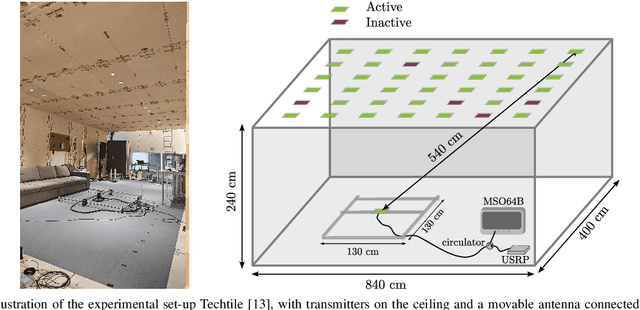
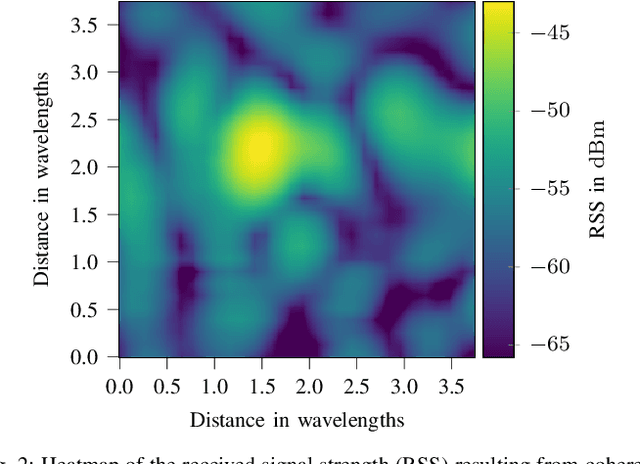
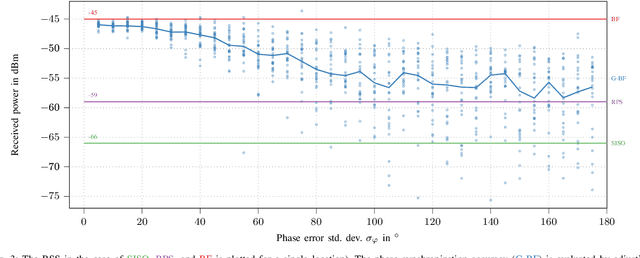
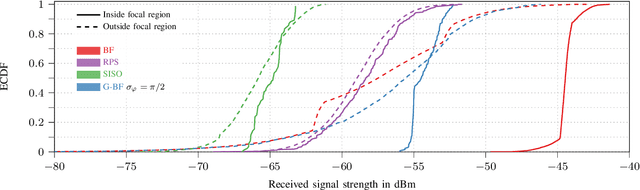
Wireless power transfer (WPT) technologies hold promise for enhancing device autonomy, particularly for energy-limited IoT systems. This paper presents experimental results on coherent and non-coherent transmit diversity approaches for WPT, tested in the near field using the Techtile testbed. We demonstrate that a fully synchronized beamfocusing system achieves a 14 dB gain over non-coherent transmission, consistent with the theoretical 14.9 dB gain for a 31-element array. Additionally, phase alignment errors below 20{\deg} result in less than 1 dB of gain loss, while errors exceeding 40{\deg} lead to losses over 3 dB. These findings suggest that phase coherency requirements for WPT can be relaxed, and that scaling the number of antennas is a promising strategy for improving power transfer efficiency.