 Add to Chrome
 Add to Firefox
 Add to Edge
Experimental Evaluation of Geometry and Reciprocity-Based Beamforming with Large Arrays for RF Wireless Power Transfer
Apr 13, 2026
This paper experimentally investigates geometry-based multi-antenna RF wireless power transfer (WPT) using a large-scale distributed indoor transmit array measuring 8 m by 4 m. Geometry-based beamforming uses known transmitter and receiver positions to perform phase-only precoding, avoiding the need for explicit channel estimation or feedback. The experiments use a ceiling-mounted array of 41 phase-synchronized transmit antennas operating at 920 MHz. Geometry-based beamforming is compared with channel state information (CSI)-based beamforming. The spatial power delivery is evaluated through two-dimensional scans over an area of 1.25 m by 1.25 m. The harvested DC power is measured using an RF-to-DC energy profiler. Under line-of-sight (LoS) conditions, geometry-based beamforming achieves a power gain of 18.75 dB, which is within 0.82 dB of CSI-based beamforming. In obstructed LoS scenarios with reflections, the gain decreases to 16.7 dB, while CSI-based beamforming achieves 20.53 dB, resulting in a performance gap of 3.83 dB. These results quantify the trade-off between reduced system overhead and robustness to multipath propagation in geometry-driven WPT, and represent an initial step toward geometry-based wireless power transfer enabled by digital twins.

Experimental Study of Interference Suppression for Backscatter Communication in Distributed MIMO
Apr 10, 2026Bistatic backscatter communication requires strong illumination of a backscatter device (BD), while a spatially separated reader detects the weak modulated reflection. In practice, the resulting direct link interference (DLI) at the reader can dominate the received backscattered signal and limit detection performance. This paper experimentally investigates transmit beamforming that jointly maximizes BD illumination and suppresses DLI at the reader in a distributed multiple-input multiple-output setup. We compare phase-only maximum ratio transmission (PO-MRT) with the proposed direct-link suppression (DLS) scheme, which enforces a spatial null at the reader under per-antenna power constraints. Measurements using a phase-coherent 42-element ceiling array at 920 MHz show that DLS reduces the DLI at the target reader and improves the signal-to-interference ratio by up to 31 dB compared to PO-MRT.
Testbed Evaluation of AI-based Precoding in Distributed MIMO Systems
Nov 14, 2025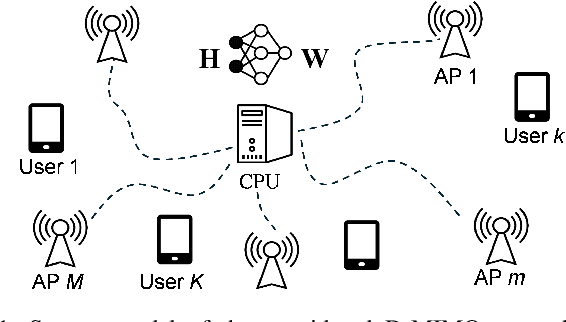
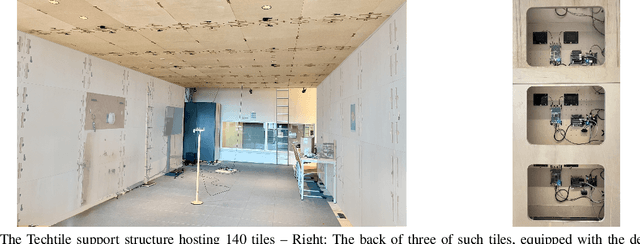
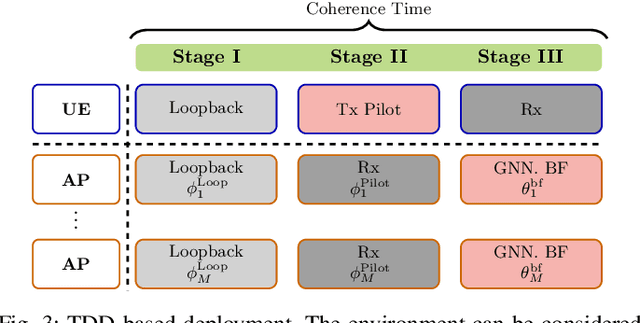
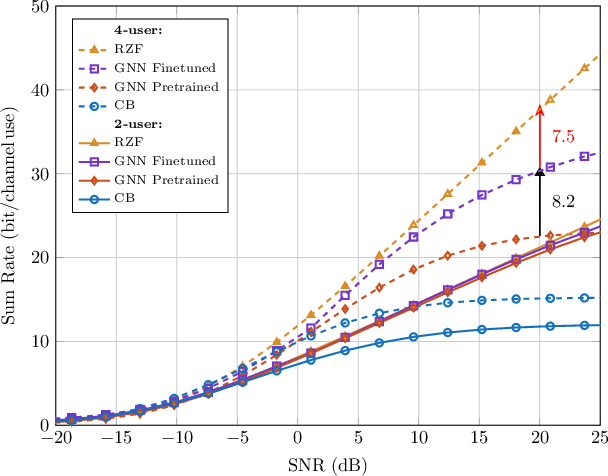
Distributed MIMO (D-MIMO) has emerged as a key architecture for future sixth-generation (6G) networks, enabling cooperative transmission across spatially distributed access points (APs). However, most existing studies rely on idealized channel models and lack hardware validation, leaving a gap between algorithmic design and practical deployment. Meanwhile, recent advances in artificial intelligence (AI)-driven precoding have shown strong potential for learning nonlinear channel-to-precoder mappings, but their real-world deployment remains limited due to challenges in data collection and model generalization. This work presents a framework for implementing and validating an AI-based precoder on a D-MIMO testbed with hardware reciprocity calibration. A pre-trained graph neural network (GNN)-based model is fine-tuned using real-world channel state information (CSI) collected from the Techtile platform and evaluated under both interpolation and extrapolation scenarios before end-to-end validation. Experimental results demonstrate a 15.7% performance gain over the pre-trained model in the multi-user case after fine-tuning, while in the single-user scenario the model achieves near-maximum ratio transmission (MRT) performance with less than 0.7 bits/channel use degradation out of a total throughput of 5.19 bits/channel use on unseen positions. Further analysis confirms the data efficiency of real-world measurements, showing consistent gains with increasing training samples, and end-to-end validation verifies coherent power focusing comparable to MRT.
RF-Powered Batteryless Plant Movement Sensor for Precision Agriculture
Sep 16, 2025Precision agriculture demands non-invasive, energy-efficient, and sustainable plant monitoring solutions. In this work, we present the design and implementation of a lightweight, batteryless plant movement sensor powered solely by RF energy. This sensor targets Controlled Environment Agriculture (CEA) and utilizes inertial measurements units (IMUs) to monitor leaf motion, which correlates with plant physiological responses to environmental stress. By eliminating the battery, we reduce the ecological footprint, weight, and maintenance requirements, transitioning from lifetime-based to operation-based energy storage. Our design minimizes circuit complexity while enabling flexible, adaptive readout scheduling based on energy availability and sensor data. We detail the energy requirements, RF power transfer considerations, integration constraints, and outline future directions, including multi-antenna power delivery and networked sensor synchronization.
GNN-based Precoder Design and Fine-tuning for Cell-free Massive MIMO with Real-world CSI
May 13, 2025Cell-free massive MIMO (CF-mMIMO) has emerged as a promising paradigm for delivering uniformly high-quality coverage in future wireless networks. To address the inherent challenges of precoding in such distributed systems, recent studies have explored the use of graph neural network (GNN)-based methods, using their powerful representation capabilities. However, these approaches have predominantly been trained and validated on synthetic datasets, leaving their generalizability to real-world propagation environments largely unverified. In this work, we initially pre-train the GNN using simulated channel state information (CSI) data, which incorporates standard propagation models and small-scale Rayleigh fading. Subsequently, we finetune the model on real-world CSI measurements collected from a physical testbed equipped with distributed access points (APs). To balance the retention of pre-trained features with adaptation to real-world conditions, we adopt a layer-freezing strategy during fine-tuning, wherein several GNN layers are frozen and only the later layers remain trainable. Numerical results demonstrate that the fine-tuned GNN significantly outperforms the pre-trained model, achieving an approximate 8.2 bits per channel use gain at 20 dB signal-to-noise ratio (SNR), corresponding to a 15.7 % improvement. These findings highlight the critical role of transfer learning and underscore the potential of GNN-based precoding techniques to effectively generalize from synthetic to real-world wireless environments.
Experimental Study on the Effect of Synchronization Accuracy for Near-Field RF Wireless Power Transfer in Multi-Antenna Systems
Dec 15, 2024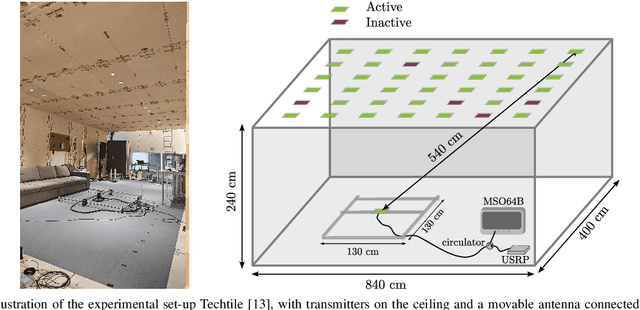
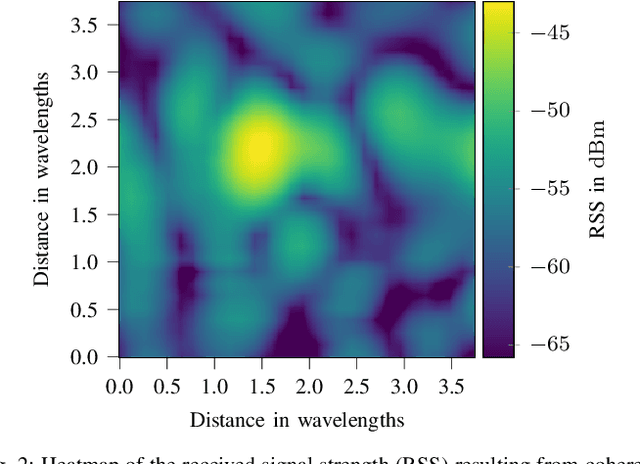
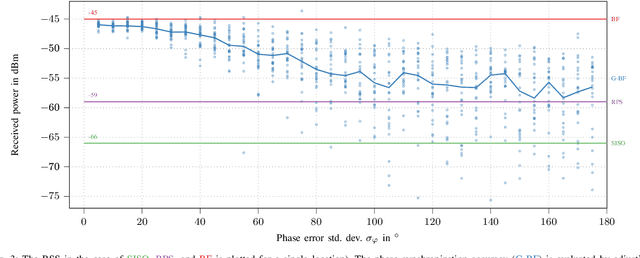
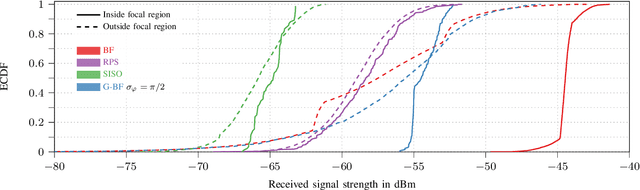
Wireless power transfer (WPT) technologies hold promise for enhancing device autonomy, particularly for energy-limited IoT systems. This paper presents experimental results on coherent and non-coherent transmit diversity approaches for WPT, tested in the near field using the Techtile testbed. We demonstrate that a fully synchronized beamfocusing system achieves a 14 dB gain over non-coherent transmission, consistent with the theoretical 14.9 dB gain for a 31-element array. Additionally, phase alignment errors below 20{\deg} result in less than 1 dB of gain loss, while errors exceeding 40{\deg} lead to losses over 3 dB. These findings suggest that phase coherency requirements for WPT can be relaxed, and that scaling the number of antennas is a promising strategy for improving power transfer efficiency.
How to Perform Distributed Precoding to Wirelessly Power Shelf Labels: Signal Processing and Measurements
Aug 20, 2024Wireless power transfer (WPT) has garnered increasing attention due to its potential to eliminate device-side batteries. With the advent of (distributed) multiple-input multiple-output (MIMO), radio frequency (RF) WPT has become feasible over extended distances. This study focuses on optimizing the energy delivery to Energy Receivers (ERs) while minimizing system total transmit power. Rather than continuous power delivery, we optimize the precoding weights within specified time slots to meet the energy requirements of the ERs. Both unsynchronized (non-coherent) and synchronized (coherent) systems are evaluated. Our analysis indicates that augmenting the number of antennas and transitioning from an unsynchronized to asynchronized full phase-coherent system substantially enhances system performance. This optimization ensures precise energy delivery, reducing overshoots and overall energy consumption. Experimental validation was conducted using a testbed with84 antennas, validating the trends observed in our numerical simulations.
Techtile -- Open 6G R&D Testbed for Communication, Positioning, Sensing, WPT and Federated Learning
Feb 09, 2022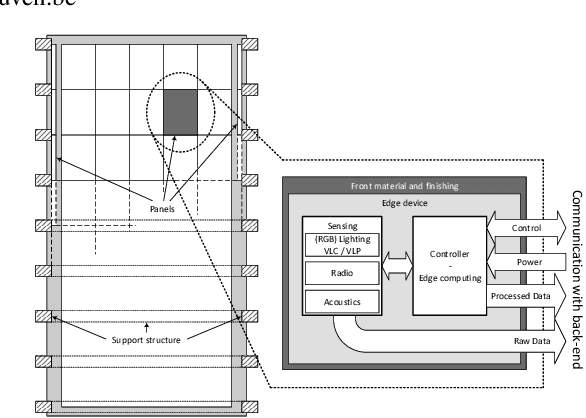
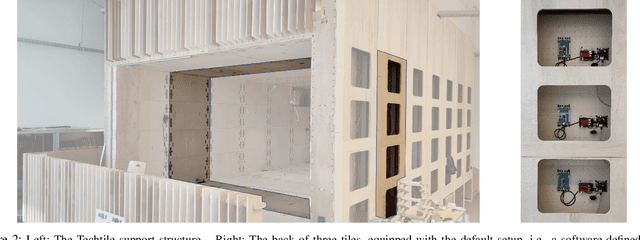
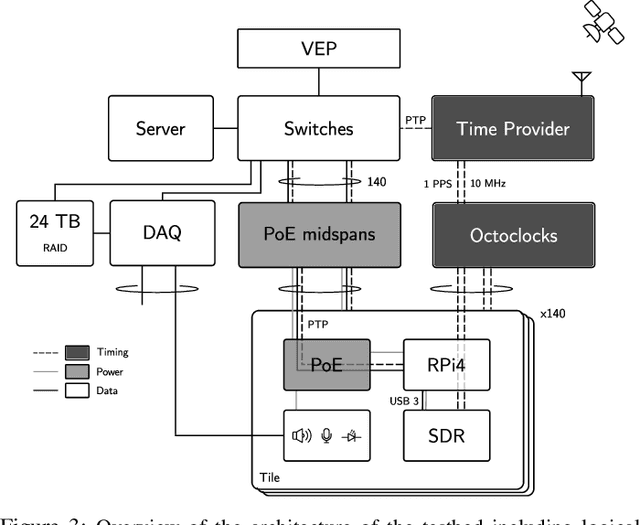
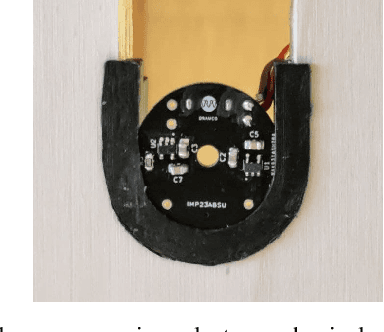
New concepts for next-generation wireless systems are being developed. It is expected that these 6G and beyond systems will incorporate more than only communication, but also sensing, positioning, (deep) edge computing, and other services. The discussed measurement facility and approach, named Techtile, is an open, both in design and operation, and unique testbed to evaluate these newly envisioned systems. Techtile is a multi-functional and versatile testbed, providing fine-grained distributed resources for new communication, positioning and sensing technologies. The facility enables experimental research on hyper-connected interactive environments and validation of new algorithms and topologies. The backbone connects 140~resource units equipped with edge computing devices, software-defined radios, sensors, and LED sources. By doing so, different network topologies and local-versus-central computing can be assessed. The introduced diversity of i) the technologies (e.g., RF, acoustics and light), ii) the distributed resources and iii) the interconnectivity allows exploring more degrees and new types of diversity, which can be investigated in this testbed.
A Primer on Techtile: An R&D Testbed for Distributed Communication, Sensing and Positioning
May 14, 2021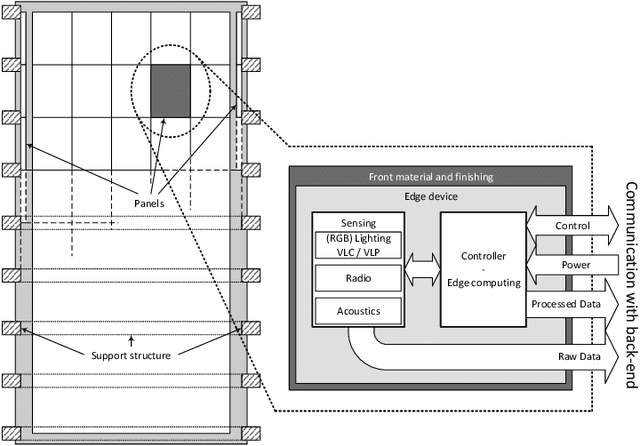
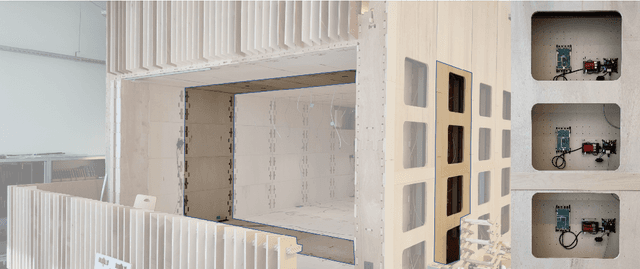
The Techtile measurement infrastructure is a multi-functional, versatile testbed for new communication and sensing technologies relying on fine-grained distributed resources. The facility enables experimental research on hyper-connected interactive environments and validation of new wireless connectivity, sensing and positioning solutions. It consists of a data acquisition and processing equipment backbone and a fabric of dispersed edge computing devices, Software-Defined Radios, sensors, and LED sources. These bring intelligence close to the applications and can also collectively function as a massive, distributed resource. Furthermore, the infrastructure allows exploring more degrees and new types of diversity, i.e., scaling up the number of elements, introducing `3D directional diversity' by deploying the distributed elements with different orientations, and `interface diversity' by exploiting multiple technologies and hybrid signals (RF, acoustic, and visible light).