 Add to Chrome
 Add to Firefox
 Add to Edge
Testbed Evaluation of AI-based Precoding in Distributed MIMO Systems
Paper and Code

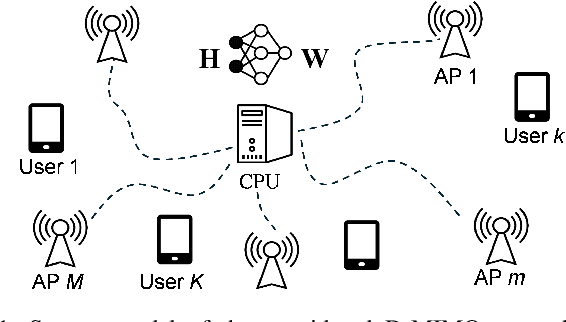
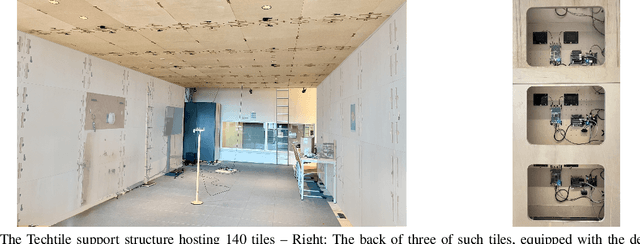
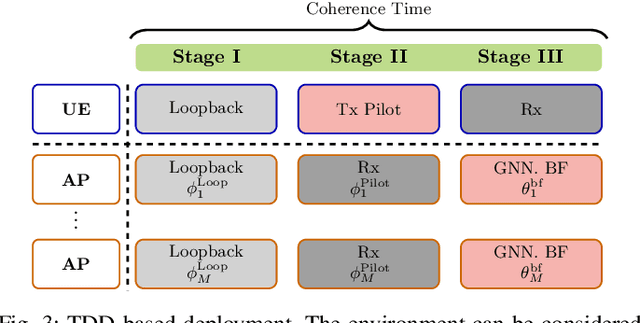
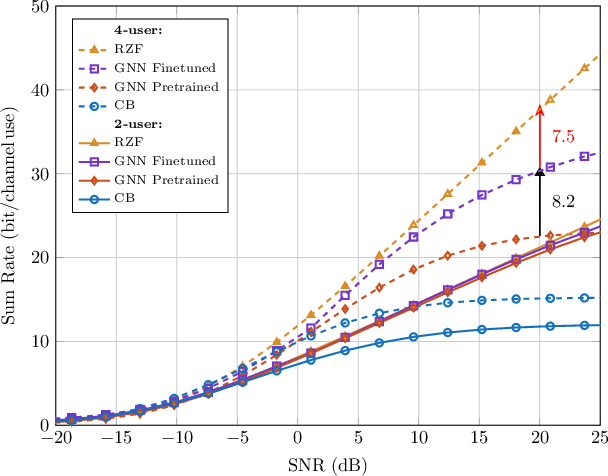
Distributed MIMO (D-MIMO) has emerged as a key architecture for future sixth-generation (6G) networks, enabling cooperative transmission across spatially distributed access points (APs). However, most existing studies rely on idealized channel models and lack hardware validation, leaving a gap between algorithmic design and practical deployment. Meanwhile, recent advances in artificial intelligence (AI)-driven precoding have shown strong potential for learning nonlinear channel-to-precoder mappings, but their real-world deployment remains limited due to challenges in data collection and model generalization. This work presents a framework for implementing and validating an AI-based precoder on a D-MIMO testbed with hardware reciprocity calibration. A pre-trained graph neural network (GNN)-based model is fine-tuned using real-world channel state information (CSI) collected from the Techtile platform and evaluated under both interpolation and extrapolation scenarios before end-to-end validation. Experimental results demonstrate a 15.7% performance gain over the pre-trained model in the multi-user case after fine-tuning, while in the single-user scenario the model achieves near-maximum ratio transmission (MRT) performance with less than 0.7 bits/channel use degradation out of a total throughput of 5.19 bits/channel use on unseen positions. Further analysis confirms the data efficiency of real-world measurements, showing consistent gains with increasing training samples, and end-to-end validation verifies coherent power focusing comparable to MRT.
