 Add to Chrome
 Add to Firefox
 Add to Edge
Hardware-in-the-Loop Phase-Aware CNN for Real-Time 5G Channel Estimation
Aug 11, 2026
This demo presents real-time AI-based uplink channel-estimation inference using data collected from a hardware-in-the-loop 5G platform. The data-collection setup integrates commercial RF signal generation, programmable channel emulation, an O-RAN Radio Unit, DU emulation, and a lightweight phase-aware convolutional neural network (CNN) that estimates the channel response directly from received DMRS signals. Unlike simulation-only evaluations, the hardware-derived dataset exposes the estimator to practical RF and system-level impairments, including calibration mismatches, synchronization imperfections, quantization effects, phase noise, and implementation-specific nonlinearities. During the demo, attendees will observe real-time CNN inference and channel reconstruction using captured hardware-generated DMRS observations and compare the proposed CNN against Least Squares (LS) and frequency-domain LMMSE baselines. The objective is to showcase a practical AI-native physical-layer inference pipeline that combines hardware-derived 5G data with real-time neural channel estimation for future 5G-Advanced and 6G systems.

Aging-Resistant Wideband Precoding in 5G and Beyond Using 3D Convolutional Neural Networks
Jul 10, 2024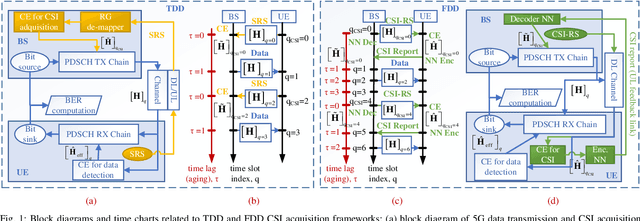
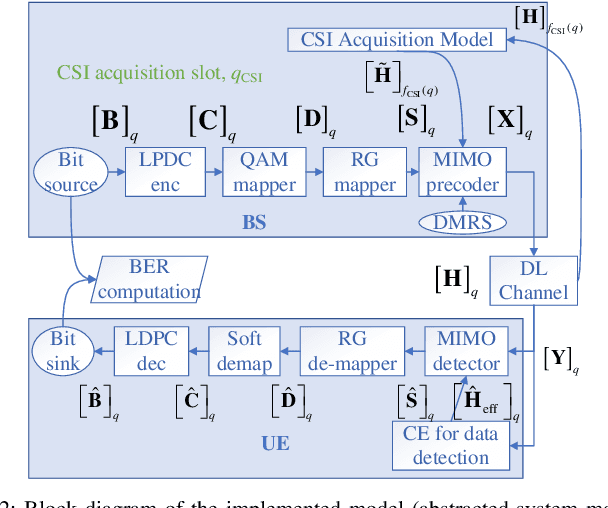
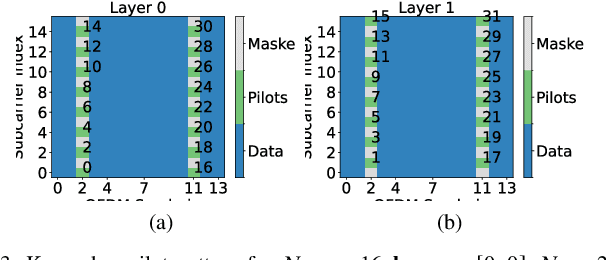
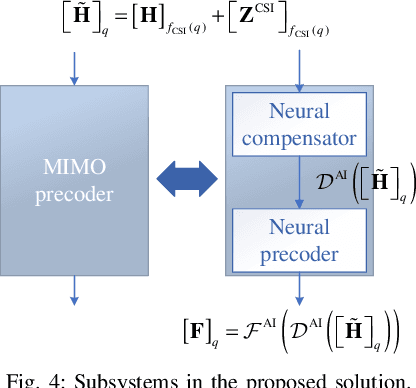
To meet the ever-increasing demand for higher data rates, 5G and 6G technologies are shifting transceivers to higher carrier frequencies, to support wider bandwidths and more antenna elements. Nevertheless, this solution poses several key challenges: i) increasing the carrier frequency and bandwidth leads to greater channel frequency selectivity in time and frequency domains, and ii) the greater the number of antennas the greater the the pilot overhead for channel estimation and the more prohibitively complex it becomes to determine the optimal precoding matrix. This paper presents two deep-learning frameworks to solve these issues. Firstly, we propose a 3D convolutional neural network (CNN) that is based on image super-resolution and captures the correlations between the transmitting and receiving antennas and the frequency domains to combat frequency selectivity. Secondly, we devise a deep learning-based framework to combat the time selectivity of the channel that treats channel aging as a distortion that can be mitigated through deep learning-based image restoration techniques. Simulation results show that combining both frameworks leads to a significant improvement in performance compared to existing techniques with little increase in complexity.